When the Mughal imperial order was fracturing and the East India Company was consolidating its grip on Bengal, a Calcutta agency house quietly did something no Indian institution had done before: it printed a promise to pay and circulated it as money. That institution was the Bank of Hindostan, and the notes it issued between roughly 1770 and 1832 represent the genesis of paper currency on the subcontinent.12 For the collector, these are not merely rare pieces of paper — they are the type specimens from which the entire field of Indian notaphily begins.
This article assembles what the published record actually documents about the bank and, more importantly for the specialist, catalogues every Bank of Hindostan note type that has been described, illustrated, or sold at auction. Where sources disagree — and on early Indian paper money they frequently do — the disagreements are flagged rather than smoothed over.
Why the Bank of Hindostan Matters to Collectors
Three facts make Bank of Hindostan notes foundational rather than peripheral.
First, primacy. The Reserve Bank of India's own currency museum identifies the Bank of Hindostan, founded by the agency house of Alexander and Company, as one of the earliest note issuers in the country, and the Company's published histories credit it as "the first bank to introduce currency paper notes in India."12 Whatever survives from it is, by definition, at or near the headwaters of the series.
Second, scarcity. The bank's notes were never legal tender in the modern sense. The East India Company government did not recognise their legality, so they functioned as private promissory instruments with restricted circulation, and when the bank and its peers wound up around 1832 there were very few notes in circulation to begin with.3 Add nearly two centuries of tropical heat, humidity, insects, and monsoon damp — the same forces that decimated all early Indian paper — and the survival rate is brutally low.8
Third, the type is genuinely iconic. The bank's "Sicca Rupee Sixteen" note of 1830 is among the most reproduced and most discussed pieces in Indian numismatic literature, frequently illustrated in the standard references and cited whenever the origin of Indian paper money is recounted.42
Historical Background
Founding and the agency-house system
The "banking system" in colonial India is conventionally dated to 1770, when Alexander and Company, a Calcutta agency house, established the Bank of Hindostan.12 To understand the bank, one has to understand the agency house. After the East India Company began trading in indigo, cotton, silk and other commodities, European merchants needed institutions to finance international trade. The Company encouraged agency houses in Calcutta to perform these banking functions, and Messrs. Alexander and Company's house laid the foundation of British India's banks.2
The Bank of Hindostan was, in effect, a banking branch of Alexander and Company. It was privately owned, embedded in a trading business, and — crucially — did not operate on joint-stock principles.2 That structural fact would later prove fatal: the bank's fortunes were tied directly to those of its parent firm.
The notes as instruments
It is essential to be precise about what these notes were. They were representational. Silver and gold coin — the Rupiya, and specifically the sicca rupee — remained the legal tender of the land, and the bank held reserves of coin against its paper.2 Every note carried a promissory clause in which the bank undertook to pay the actual coin to the bearer on demand; the institution was liable to redeem on presentation.25
Contemporary numismatic writing places these issues in the "era of free banking" between the late eighteenth century and 1861, when banks in India were broadly free to issue promissory notes payable to the bearer on demand, convertible into the current coin of the region.5 Because they were issued freely and circulated within trusted peer groups, early notes were registered and passed among a known circle — a practice that doubled as the period's most effective anti-forgery control.5
Three runs and a collapse
The Bank of Hindostan was, by the standards of its day, "particularly successful," and it earned a reputation for resilience by surviving three separate panic runs.1 The published accounts date these to 1819 (triggered by a malicious rumour), 1829 (following the failure of the Calcutta agency house Palmer and Company), and 1832 (the general commercial crisis that pulled down numerous private banks).2 On each of the first occasions, sufficient coin reserves allowed the bank to honour redemptions and ride out the panic.2
The end came through the parent firm. The commercial crisis afflicting the Bengal Presidency's agency houses in the early 1830s — fed by volatile indigo prices through the mid-1820s, the metal scarcity that accompanied the First Anglo-Burmese War, and rising interest rates as an investment boom in Britain made capital cautious — drove house after house under.2 Alexander and Company withdrew its banknotes from circulation and fell into debt, and the failure of the parent dragged the Bank of Hindostan down with it.12 The RBI puts it plainly: "The Bank of Hindostan finally went under when its parent firm M/s Alexander and Co. failed in the commercial crisis of 1832."1
A note on dates. The closure is variously given as 1830–1832 (liquidation), 1831 (some numismatic catalogues), and 1832 (the year of the parent's failure). The general-reference infobox lists a defunct date of 31 March 1832.7 The 1832 commercial crisis is the event all sources agree on; the precise winding-up date should be cited cautiously. The bank's own undated notes are commonly catalogued as "183-" (i.e. 1830–1831).19
Where it sits in the family tree
The Bank of Hindostan was not alone, and a collector should know its neighbours to avoid mis-attribution. The standard listing of Bengal Presidency note-issuers of the free-banking era includes the Bank of Hindostan (1770–1832), the General Bank in Bengal and Behar, the Bengal Bank, the Commercial Bank, the Calcutta Bank, and the Union Bank.5 Dates for several of these institutions vary between sources, so attributions of unsigned early notes should always be checked against design, not date alone.15
What distinguished the later Presidency Banks (the Bank of Bengal, established 1806 as the Bank of Calcutta, and its Bombay and Madras counterparts) from the Bank of Hindostan was official patronage: their notes were accepted in payment of revenue and circulated far more widely. The Bank of Hindostan never enjoyed that recognition, which is precisely why its notes are rarer and why so many surviving examples are unissued remainders rather than circulated, signed notes.13
An Illustrated, Referenced Catalogue of Bank of Hindostan Notes
The following catalogue lists every Bank of Hindostan note type for which a published description, illustration, or auction record could be located. Denominations are stated in sicca rupees, the silver standard of Bengal from which the bank took its name.4 Entries are flagged Described / illustrated where a specimen is documented, and Attested where the denomination is named in the record but no individual specimen description was located.
The authoritative classification is the Jhunjhunwalla–Razack (J&R) typology set out in The Revised Standard Reference Guide to Indian Paper Money, under group 1A.1 for the Bank of Hindostan. The bank's notes fall into exactly four design types, and the full sub-type checklist appears in the type checklist table below.106
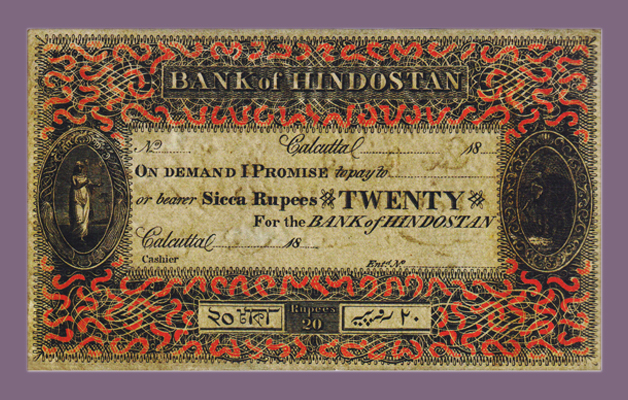
- J&R 1A.1.1 — "Ganga & Elephant" type (design 1): the earliest plain issues bearing a Ganga-and-elephant vignette. Denominations: 4, 10, 20 sicca rupees (18xx, unissued).95
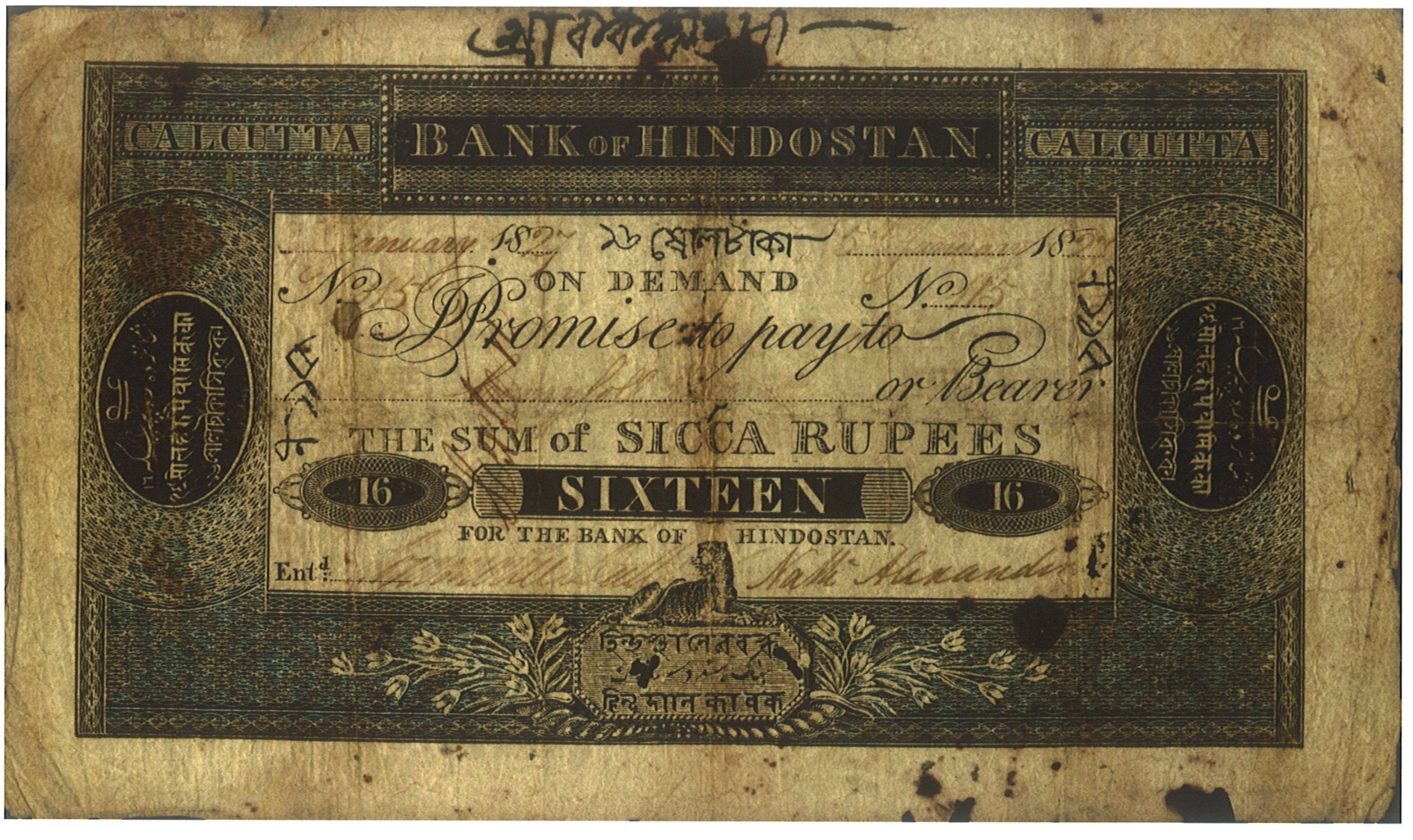
- J&R 1A.1.2 — "CALCUTTA-in-corners" tiger type (1823–1829): header "BANK OF HINDOSTAN" with CALCUTTA in both upper corner cartouches, a resting tiger on a multilingual cartouche at the foot flanked by floral sprays, value in a central tablet. Denominations: 4, 10, 16, 20 sicca rupees.10
- J&R 1A.1.3 — tiger higher-denomination type (18xx, unissued): a resting tiger at lower centre, value flanked by numerals, CALCUTTA in the border top centre, ornate multilingual border — Perkins Bacon engravings. Denominations: 50, 100, 250, 500, 1000 sicca rupees.106
- J&R 1A.1.4 — central-tablet type (18xx/183x, unissued): value in a central rectangular tablet (in italics) flanked by numerals, ornate four-language border — also Perkins Bacon engravings. Denominations: 4, 10, 16 sicca rupees.109
Two attribution points matter. First, the popular 16 sicca rupees (one gold mohur) exists in both 1A.1.2 (CALCUTTA-in-corners) and 1A.1.4 (central-tablet, italics).10 Second, the 8 sicca rupees (one half of a gold mohur) sold by Spink is a denomination not listed at all in J&R (or Pick) — recorded by the house as "type 1A.1.4 for similar" and possibly the only example extant.10
J&R 1A.1.1 — the "Ganga & Elephant" type (design 1)
10 Sicca Rupees — J&R 1A.1.1.2 (Ganga & Elephant) Described / illustrated
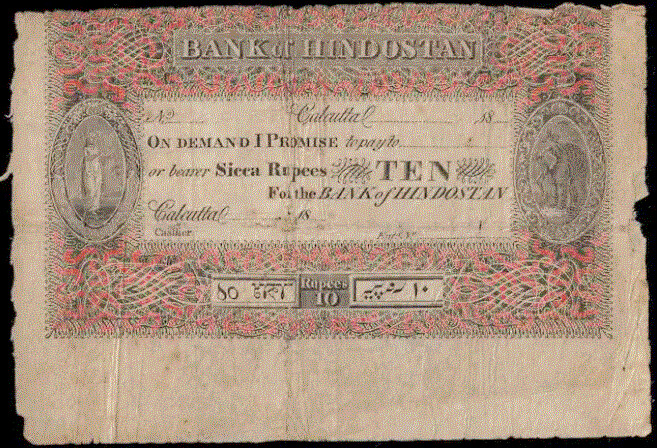
images/10-sicca-1A.1.1.jpg (falls back to the Flickr source until saved).
- Denomination
- 10 sicca rupees.9
- J&R type
- 1A.1.1.2 — "Ganga & Elephant" type (18xx, unissued).10
- Documentation
- Illustrated as the "Bank of Hindustan 10 Rupees note" in The E-Sylum (Numismatic Bibliomania Society), accompanying the Hindustan Times feature "Cash of the titans: How India's paper money came to be."9
20 Sicca Rupees — J&R 1A.1.1.3 (Ganga & Elephant) Described / illustrated
J&R 1A.1.2 — "CALCUTTA-in-corners" tiger type (1823–1829)
16 Sicca Rupees (1 Gold Mohur), 182– · J&R 1A.1.2.3 Described / illustrated
- Denomination
- 16 sicca rupees (one gold mohur).
- Catalogue reference
- Jhunjhunwalla–Razack 1A.1.2.3 (16 sicca rupees, 1823–1829).10
- Date / status
- Manuscript-dated "182–" (1820s); an issued example — bearing a serial number ("No. 15"), handwritten dates on both sides, payee, and signatures ("For the Bank of Hindostan … Ent.d"). Issued notes of this bank are markedly rarer than the unissued remainders.
- Obverse layout
- Header "BANK OF HINDOSTAN" centre, "CALCUTTA" in both upper corner panels; oval cartouches at left and right with Persian/Arabic and Bengali/Nagari script; "ON DEMAND / Promise to pay to … or Bearer / THE SUM of SICCA RUPEES / SIXTEEN"; "16" in ovals flanking the central tablet; Bengali "১৬ ষোল টাকা" (sixteen taka) at upper centre; "FOR THE BANK OF HINDOSTAN" below.
- Vignette
- A resting tiger on a cartouche bearing Persian and Bengali/Nagari text ("Bank of Hindostan, Calcutta"), flanked by floral sprays at the foot.
- Note
- The 16 sicca rupees also exists in the central-tablet italics type (J&R 1A.1.4, below); the CALCUTTA-in-corners layout here is the diagnostic of 1A.1.2.10
J&R 1A.1.3 — tiger higher-denomination type (ND c. 1823–1827)
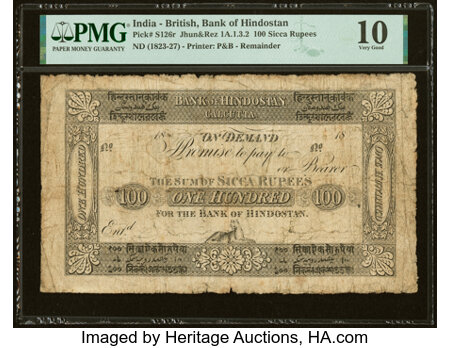
100 Sicca Rupees — J&R 1A.1.3.2 / Pick S126r Described / illustrated US$20,000
- Denomination
- 100 sicca rupees.10
- Date
- ND (1823–1827); remainder, without serial numbers, signatures or date.10
- Catalogue references
- Pick S126r; Jhunjhunwalla–Razack 1A.1.3.2.10
- Design
- Higher-denomination type with a resting tiger vignette at front; Perkins Bacon engraving.106
- Grade / rarity
- PMG Very Good 10 — the first example graded by PMG; "extremely rare."10
- Auction record
- Sold for US$20,000, Heritage Auctions Sale #4045, Lot 24328, 9 Nov 2023 (≈ ₹16,93,200 equivalent).10
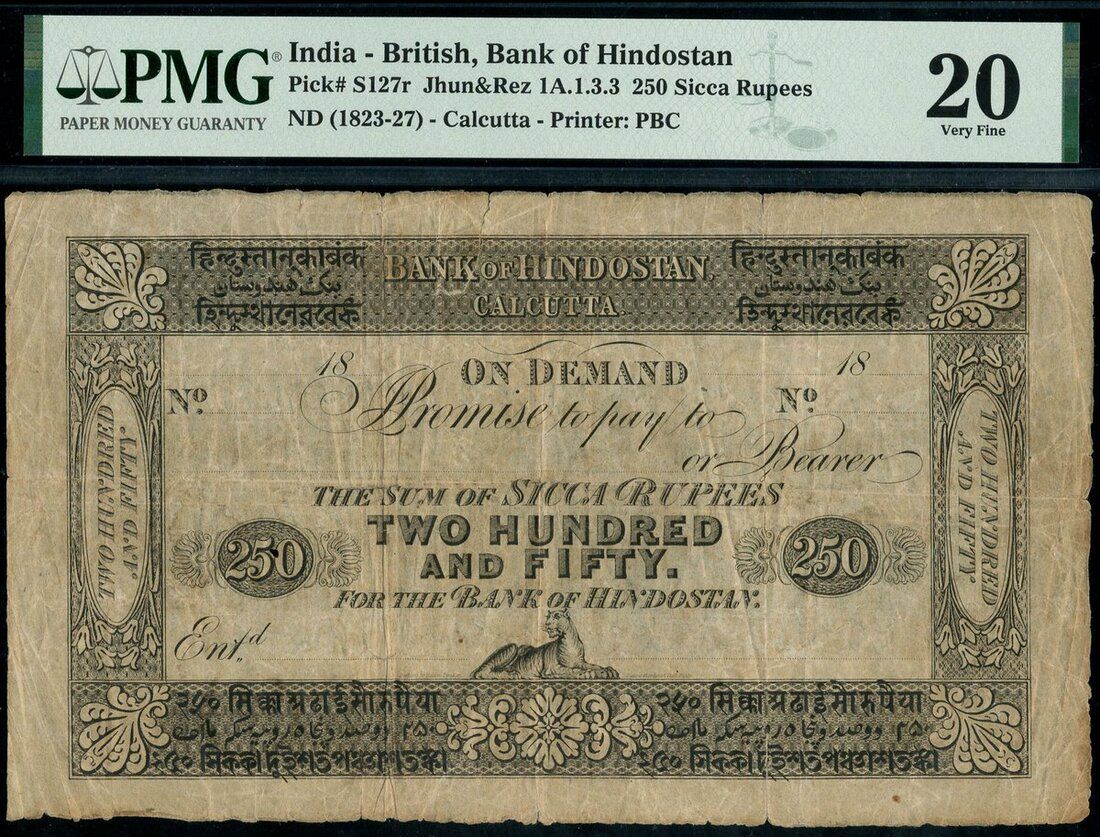
250 Sicca Rupees — J&R 1A.1.3.3 / Pick S127r Described / illustrated £50,000
- Denomination
- 250 sicca rupees.10
- Date
- ND (1823–27); unissued, no signatures.10
- Catalogue references
- Pick S127r; Jhunjhunwalla–Razack 1A.1.3.3.10
- Description
- Black and white; value at centre flanked by the numeral 250 left and right; ornate border, CALCUTTA in border top centre; tiger at lower centre; Hindi, Bangla and Persian text in the lower border; Perkins Bacon engraving.10
- Grade / rarity
- PMG 20 Very Fine (with tears); rare.10
- Auction record
- Sold for £50,000 (start £8,000), Spink Auction 20009 (World Banknotes), Lot 188, 4 Nov 2020 — the highest recorded price for any Bank of Hindostan note located here.10
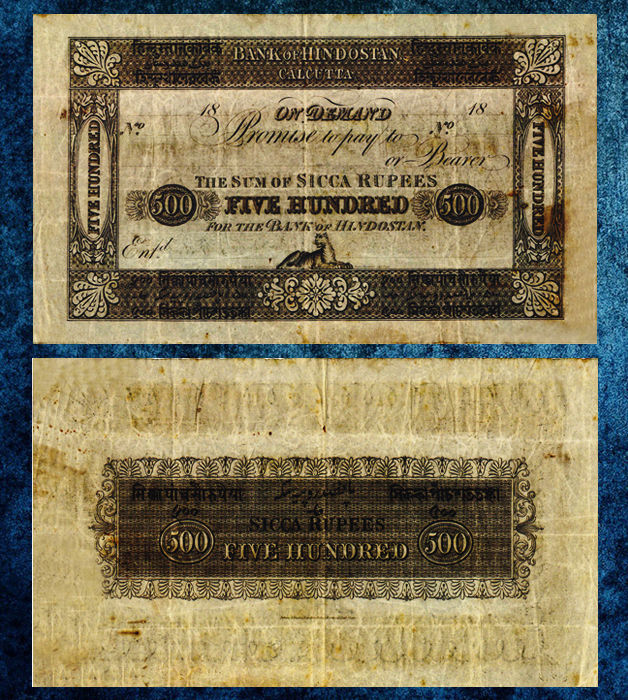
500 Sicca Rupees — J&R 1A.1.3.4 (tiger type) Described / illustrated
- Denomination
- 500 sicca rupees.6
- J&R type
- 1A.1.3.4 (tiger higher-denomination type).10
- Colour
- Unicoloured (single-colour print).6
- Vignette
- A seated tiger above a floral scroll.6
- Inscriptions
- "BANK OF HINDOSTAN" in Hindi, Persian and Bengali; reverse denomination reads "500 SICCA RUPEES."6
- Status
- Printed in the early nineteenth century but unissued.6
J&R 1A.1.4 — central-tablet type (18xx/183x)
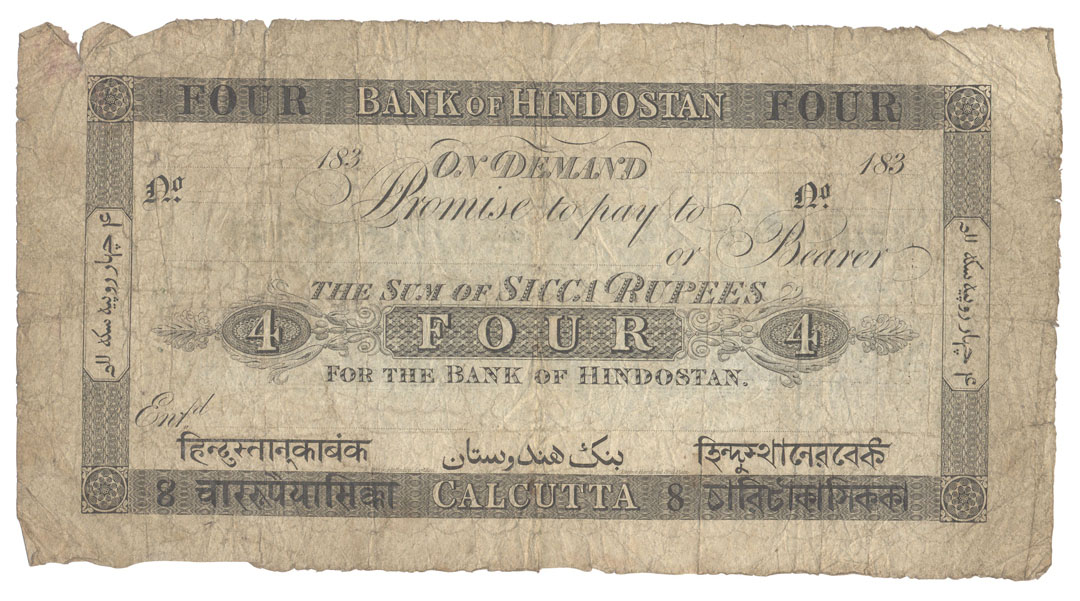
4 Sicca Rupees — J&R 1A.1.4.1 / Pick S135 Described / illustrated ₹3,80,000 · £7,500
- Denomination
- 4 sicca rupees.10
- Date
- ND, "183–" (1830–1831); no serial number.910
- Catalogue references
- Jhunjhunwalla–Razack 1A.1.4.1; Pick S135.910
- Description
- Black and white; central denomination panel in a rectangle; ornate border with four languages; value at centre, left and right.910
- Auction records
- ₹3,80,000 (Fine; Todywalla #39, Lot 224, 2009); £7,500 (Spink Auction 18015, Lot 305); also offered unsold at Todywalla #17, Lot 184 (2006).910
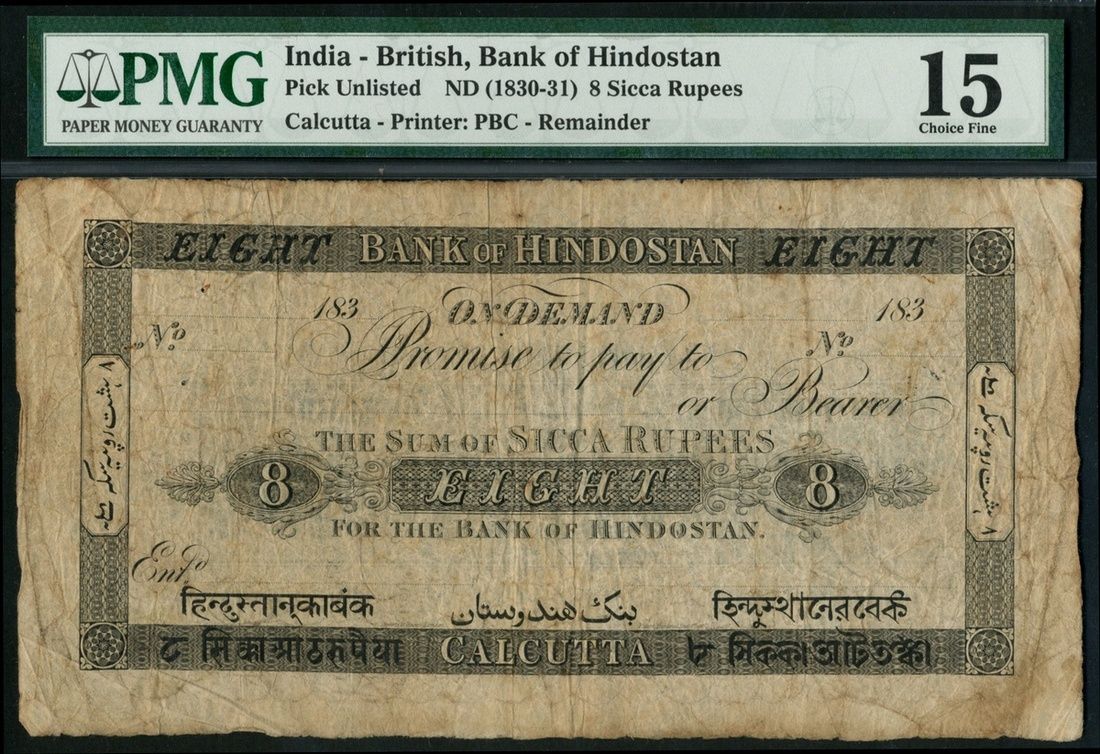
8 Sicca Rupees (½ Gold Mohur) — J&R 1A.1.4 (similar); Pick unlisted Described / illustrated £21,000
- Denomination
- 8 sicca rupees — the equivalent of one half of a gold mohur; a denomination unrecorded by both Pick and Razack–Jhunjhunwalla.10
- Date
- ND (1830–31); unissued.10
- Catalogue reference
- Pick unlisted; Razack–Jhunjhunwalla type 1A.1.4 (for similar).10
- Description
- Black and white; "EIGHT" in a rectangular tablet at centre flanked by the numeral 8 left and right; ornate border, CALCUTTA in border lower centre; Hindi (lower left), Bangla (lower right), Arabic (left) and Persian (right) text; reverse value in an ornate black rectangle at centre; Perkins Bacon engraving.10
- Grade / rarity
- PMG 15 Choice Fine; "excessively rare and possibly the only example extant."10
- Auction record
- Sold for £21,000 (start £5,000), Spink Auction 20008 (World Banknotes), Lot 1112, 7 April 2020.10
16 Sicca Rupees (1 Gold Mohur), 1830 — the type note · J&R 1A.1.4.3 Described / illustrated ₹7,00,000 → ₹15,00,000
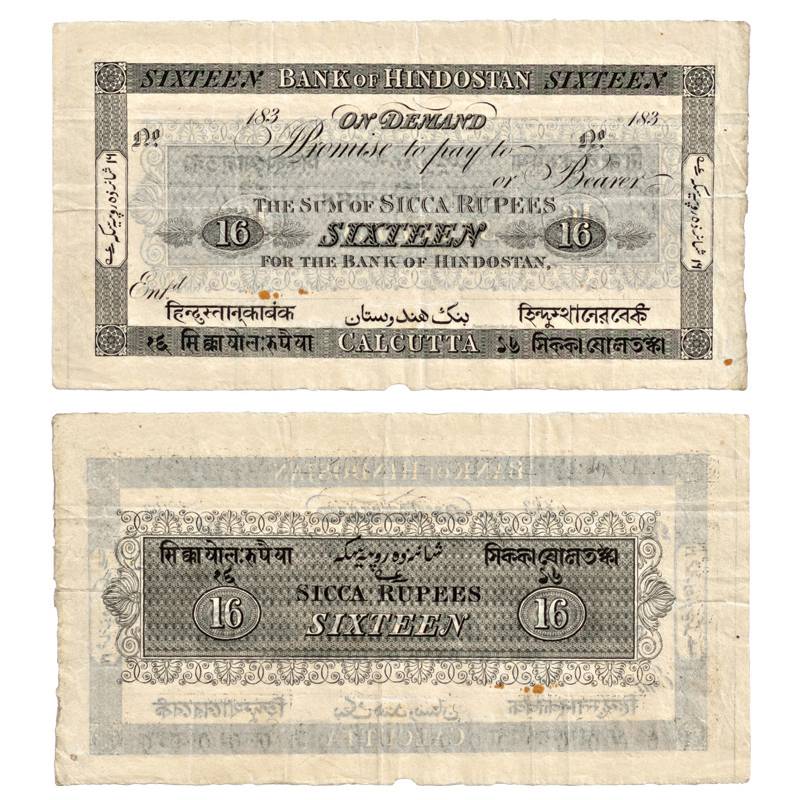
- Denomination
- 16 sicca rupees — one gold mohur in Calcutta, hence the recurrence of this value across early Bengal paper.110
- Date printed
- 1830 ("1830's issue"); unissued / unsigned.410
- Catalogue reference
- Jhunjhunwalla–Razack 1A.1.4.3 (Todywalla/CNG abbreviate this as "1.4.3").10
- Obverse
- Central denomination in italics; Arabic numeral and the value in numerals and words in Persian on a vertical panel on either side; "BANK OF HINDOSTAN" in Hindi, Persian and Bangla below the promise text; "Sixteen" below the promise text; two dates and two serial numbers on either side, plus the payee's name.410
- Reverse
- Value in Bengali, Hindi, Persian and English; "SICCA RUPEE SIXTEEN" flanked by the numeral.4
- Auction records
- ₹7,00,000 (EF; CNG AUC07, Lot 458, 22 Apr 2012); ₹15,00,000 (EF; CNG AUC33, Lot 582, 19 Apr 2019); ₹6,75,000 (VF+; Todywalla #66, Lot 421, 2012); also offered unsold at Todywalla #17, Lot 185 (2006).410
Complete J&R type checklist (group 1A.1)
The full Bank of Hindostan listing from Jhunjhunwalla–Razack, sorted by type. "In this catalogue" marks whether a specimen of that exact sub-type is illustrated above (shown) or is so far only listed in the book (listed).10
| J&R No. | Denomination | Date / remark | Pick | In this catalogue |
|---|---|---|---|---|
| 1A.1.1 — "Ganga & Elephant" type (design 1) | ||||
| 1A.1.1.1 | 4 Sicca Rupees | 18xx, unissued | — | listed |
| 1A.1.1.2 | 10 Sicca Rupees | 18xx, unissued | — | shown |
| 1A.1.1.3 | 20 Sicca Rupees | 18xx, unissued | — | shown |
| 1A.1.2 — "CALCUTTA-in-corners" tiger type | ||||
| 1A.1.2.1 | 4 Sicca Rupees | 1823–1829 | — | listed |
| 1A.1.2.2 | 10 Sicca Rupees | 1823–1829 | — | listed |
| 1A.1.2.3 | 16 Sicca Rupees | 1823–1829 | — | shown |
| 1A.1.2.4 | 20 Sicca Rupees | 1823–1829 | — | listed |
| 1A.1.3 — tiger higher-denomination type | ||||
| 1A.1.3.1 | 50 Sicca Rupees | 18xx, unissued | — | listed |
| 1A.1.3.2 | 100 Sicca Rupees | 18xx, unissued | S126r | shown |
| 1A.1.3.3 | 250 Sicca Rupees | 18xx, unissued | S127r | shown |
| 1A.1.3.4 | 500 Sicca Rupees | 18xx, unissued | — | shown |
| 1A.1.3.5 | 1000 Sicca Rupees | 18xx, unissued | — | listed |
| 1A.1.4 — central-tablet type | ||||
| 1A.1.4.1 | 4 Sicca Rupees | 18xx/183x, unissued | S135 | shown |
| 1A.1.4.2 | 10 Sicca Rupees | 18xx/183x, unissued | — | listed |
| 1A.1.4.3 | 16 Sicca Rupees | 18xx/183x, unissued | — | shown |
| Unlisted denomination | ||||
| (1A.1.4 — "for similar") | 8 Sicca Rupees (½ mohur) | ND 1830–31; not listed by J&R or Pick | unlisted | shown |
Caution on denomination lists. Some secondary summaries fold a much longer denomination string (e.g. Rs. 10, 15, 16, 20, 25, 50, 100, 250, 500, 1,000 and 10,000) into discussions of the Bank of Hindostan. That longer series in fact belongs to the Bank of Bengal Britannia issues, not the Bank of Hindostan, and the conflation is a common error.35 Treat any 10,000-rupee or odd-value (15, 25) note attributed to the Bank of Hindostan with strong skepticism absent a documented specimen.
Caution on the "one crore" figure. A frequently repeated line states that "the Bank issued its own banknotes for a total value of one crore (ten million) sicca rupees." In its original published context this figure describes the Bank of Bengal, not the Bank of Hindostan, and should not be transferred to the latter without a primary source.3
Auction record (public sales located)
Realised figures are shown in each auction house's own currency: Spink in £ (GBP), Heritage in US$, and the Indian houses (Todywalla, Classical Numismatic Gallery) in ₹ (INR). Spink figures are confirmed against the Spink lot pages; the Heritage figure is login-gated (see note).910
| Denom. | J&R type | House & lot | Date | Result | Grade |
|---|---|---|---|---|---|
| 250 sr | 1A.1.3.3 / S127r | Spink 20009, Lot 188 | 2020-11-04 | £50,000 | PMG 20 VF |
| 8 sr | 1A.1.4 (unlisted) | Spink 20008, Lot 1112 | 2020-04-07 | £21,000 | PMG 15 |
| 4 sr | 1A.1.4.1 / S135 | Spink 18015, Lot 305 | — | £7,500 | tears |
| 100 sr | 1A.1.3.2 / S126r | Heritage #4045, Lot 24328 | 2023-11-09 | US$20,000 | PMG VG 10 |
| 16 sr | 1A.1.4.3 | CNG AUC33, Lot 582 | 2019-04-19 | ₹15,00,000 | EF |
| 16 sr | 1A.1.4.3 | CNG AUC07, Lot 458 | 2012-04-22 | ₹7,00,000 | EF |
| 16 sr | 1A.1.4.3 | Todywalla #66, Lot 421 | 2012-10-12 | ₹6,75,000 | VF+ |
| 4 sr | 1A.1.4.1 | Todywalla #39, Lot 224 | 2009-09-12 | ₹3,80,000 | Fine |
| 16 sr | 1A.1.2 / 1A.1.4 | Todywalla #17, Lot 185 | 2006-12-09 | Unsold | — |
| 4 sr | 1A.1.4 / 1A.1.2 | Todywalla #17, Lot 184 | 2006-12-09 | Unsold | — |
"sr" = sicca rupees. The Heritage 100-sicca-rupee realised US$20,000 (≈ ₹16,93,200). The highest realised price located is the 250-sicca-rupee tiger type at £50,000 (Spink, 2020); the 16-sicca-rupee type has the deepest record, with at least four public appearances.910
Design, Scripts and Security: What to Look For
Multilingual inscriptions are the signature. The bank rendered its name and denominations across English, Persian, Bengali and Hindi/Devanagari — a deliberate accommodation of Calcutta's mixed mercantile population.42 On the J&R 1A.1.4 central-tablet notes this takes the form of an ornate border carrying four languages with the value in a central tablet flanked by numerals; on J&R 1A.1.2 the giveaway is instead CALCUTTA in the two upper corner cartouches with the tiger relocated to a cartouche at the foot.910
The promissory clause and manuscript fields. Genuine issued notes carry the engraved promise to pay the bearer in coin, with handwritten entries for date(s), serial number and payee.24 Many surviving Bank of Hindostan pieces are unissued remainders in which these fields are blank (or, as on the Spink 4-rupee, simply "no serial number") — a status that, for this bank, is the norm rather than a defect.49
Early security by registration. Before sophisticated anti-forgery printing existed, the bank relied on registering notes and circulating them within a known peer group; as circulation widened, forgery risk grew, and from 1806 stealing banknotes was made a punishable offence. The Bank of Hindostan specifically added security features to its notes as forgery pressure increased.5 The elaborate multi-colour, labyrinthine designs that defeat forgers belong to the later Presidency-bank era (reforms recommended around 1856), not to the Bank of Hindostan's largely unicoloured, black-and-white output.56
Vignette vocabulary. The seated tiger above a floral scroll is, on current evidence, the bank's characteristic pictorial motif on its higher denominations — a useful point of separation from the allegorical "Commerce" and "Britannia" figures that define Bank of Bengal notes.61
Collecting and Market Notes
First, expect remainders, not circulated notes. Because the notes never had government sanction and the bank failed early, the surviving material skews heavily toward unissued specimens.346 A signed, dated, serial-numbered, genuinely circulated Bank of Hindostan note is a far greater rarity than the (already rare) unissued remainders that appear in the literature.
Second, the price record is now substantial and steeply rising. At the Indian houses the 16-sicca-rupee type climbed from ₹7,00,000 (CNG, 2012) to ₹15,00,000 (CNG, 2019), with a 4-sicca-rupee at ₹3,80,000 (Todywalla, 2009). At Spink the figures are higher still: £7,500 for a 4-sicca-rupee, £21,000 for the unique 8-sicca-rupee (2020), and £50,000 for the 250-sicca-rupee tiger type (2020) — see the auction table above.4910 The broader trajectory of early Indian paper is the same: at Spink's September 2025 sale, a Bank of Madras 3,000-rupee specimen of 1854 reached £130,000, with its companion 1,000-rupee note at £80,000 — a reminder that the foundational, earliest material sits within a market that increasingly rewards historical primacy and rarity.8
Grading drives the headline results. The strongest prices attach to PMG-encapsulated remainders — the 100-sicca-rupee was "the first example graded by PMG," and the 8- and 250-sicca pieces both sold in PMG holders — so professional grading and the matching J&R / Pick attribution are now central to value at the top of this market.10
Third, provenance and reference-matching are everything. Given the conflation problems noted above, match any candidate note to a documented specimen — most authoritatively The Revised Standard Reference Guide to Indian Paper Money by Rezwan Razack and Kishore Jhunjhunwalla, and the Pick/SCWPM catalogue numbers (e.g. Pick S135) used by the major houses — and weight pieces with traceable auction or collection provenance.693
References
- Reserve Bank of India, "Paper Money — Early Issues," RBI Currency Museum. rbi.org.in
- Madras Courier (Staff Writer), "How Alexander & Co. Established The Bank of Hindostan," 12 February 2025. madrascourier.com
- Krutika Haraniya, "India's First Currency Note," Live History India (PeepulTree), 5 October 2018. livehistoryindia.com
- Mintage World, "Sixteen Sicca Rupee Note of Bank of Hindostan," 3 October 2016. mintageworld.com
- Team Mintage World, "The Origins of Indian Paper Money," Mintage World Blog, 15 February 2016. mintageworld.com
- Team Mintage World, "History of Design Changes in 100 Rupees Note (Part 1)," Mintage World Blog, 26 August 2016 (images courtesy Rezwan Razack; reference: The Revised Standard Reference Guide to Indian Paper Money). mintageworld.com
- "Bank of Hindostan," Wikipedia. en.wikipedia.org
- IndiaBanknotes.com Editorial Team, "Presidency Banknotes of British India," IndiaBanknotes.com. indiabanknotes.com
- Spink, "Lot 305 — Bank of Hindustan, 4 sicca rupees, 183- (1830-1831), Pick S135," Auction 18015 (World and British Banknotes). spink.com; and Numismatic Bibliomania Society, "The History of India's Paper Money," The E-Sylum, Vol. 24, No. 15 (11 April 2021), illustrating the Bank of Hindustan 10 Rupees note. coinbooks.org. The 10-rupee image is from the coinbooks.org photostream: photo page flickr.com/photos/coinbooks/51107898100, direct file live.staticflickr.com/65535/51107898100_cbdfb2e1b0_b.jpg (saved locally as
images/10-sicca-1A.1.1.jpg). Reproduced for educational, non-commercial reference; rights remain with the original holder. - Numismatic DB — Bank of Hindostan lots (search "hindostan"), aggregating auction records and images from Todywalla Auctions (#17 Lots 184/185, #39 Lot 224, #66 Lot 421), Heritage Auctions (Sale #4045, Lot 24328), Classical Numismatic Gallery (AUC07 Lot 458; AUC33 Lot 582) and Spink (20008 Lot 1112; 20009 Lot 188), with Jhunjhunwalla–Razack and Pick references and PMG grades as cited. indianpapermoney.io
Standard print references cited within the sources above: Rezwan Razack & Kishore Jhunjhunwalla, The Revised Standard Reference Guide to Indian Paper Money (the principal catalogue for Bank of Hindostan types); Bazil Shaikh & Sandhya Srinivasan, The Paper & The Promise: A Brief History of Indian Currency & Banknotes; and Bazil Shaikh, The Conjuror's Trick (2020).