Of the three Presidency banks of British India, the Bank of Madras issued the fewest notes and left the fewest survivors. For most of the last century its banknotes were known almost only from card-mounted specimen proofs held in a few museums. It was only as genuine issued notes began surfacing at auction — and as those sales could be aggregated and compared — that the series could be read in detail: a single design that evolved through two printing plates, and that varies by signatory and denomination into a family of collectible sub-types. This article sets out that structure from the notes themselves, illustrated with examples that have passed through public sale.
Why the Bank of Madras matters to collectors
The Bank of Madras was the smallest note-issuer of the three Presidency banks. Across its whole note-issuing life (1843–1861) it printed only about 110,000 notes of all denominations combined — the Bank of Bombay issued more than 125,000 notes of the 10-rupee value alone in the same years. A small circulation region, and the 19th-century practice of cancelling and destroying redeemed notes, mean that no denomination is common and several are of extreme rarity. Most survivors are rejoined halves with heavy cancellation; a clean, intact, uncut note is a genuine prize. At the top of the series sit the 1000 and 3000 Rupee proofs of 1854, among the most valuable Indian banknotes ever sold.
A bank built from four
The Bank of Madras commenced business on 1 July 1843 under Act IX of 1843, as the third and last Presidency bank (after the Banks of Bengal and Bombay). It was a joint-stock company capitalised at ₹3 million, in which the colonial government held a one-fifth share and nominated directors — a semi-governmental "quango" with a deliberately exclusive, European mercantile character. Indian merchants and the general public were effectively excluded, and continued to rely on indigenous bankers and hundi credit; the bank's notes served a narrow commercial world.
The bank consolidated the oldest banking lineages of the south. It absorbed the businesses of the Madras Bank (1683) — reckoned the oldest bank in India — the Carnatic Bank (1788), the British Bank of Madras (1795) and the Asiatic Bank (1804), and it was created specifically to replace the state-run Government Bank of Madras (1806): Act IX made the Government Bank's outstanding cash notes payable by the new Bank of Madras, with a deadline of 31 January 1845 to exchange them. That is why roughly 50,000 notes — nearly half the bank's entire lifetime output — were issued in the first year alone.
Note issue was a privilege the Presidency banks lost under the Paper Currency Act of 1861, which reserved paper money to the Government of India. The Presidency Banks Act of 1876 then stripped the government's ownership stakes and board seats and locked surplus balances into "Reserve Treasuries." Finally, on 27 January 1921, the three Presidency banks merged into the Imperial Bank of India, which in 1955 became the State Bank of India. (The Imperial Bank was a commercial bank and never issued notes; India's central-bank note issue passed instead to the Reserve Bank of India in 1935 — a separate lineage frequently confused with the Imperial Bank.)
One design for every value
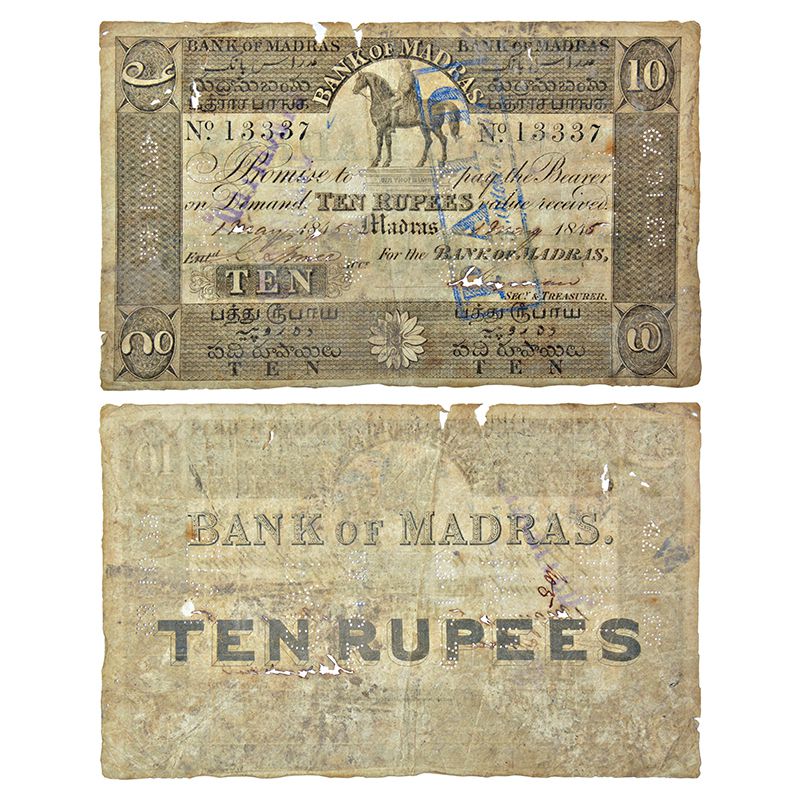
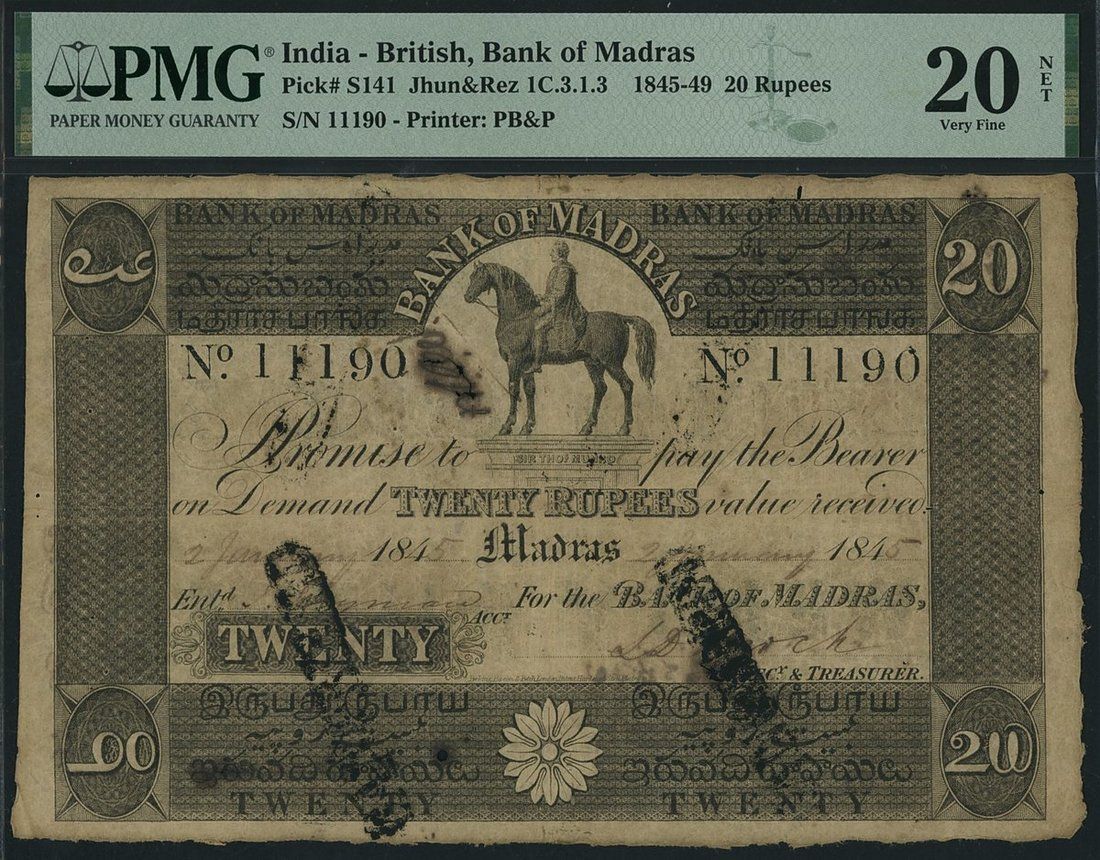
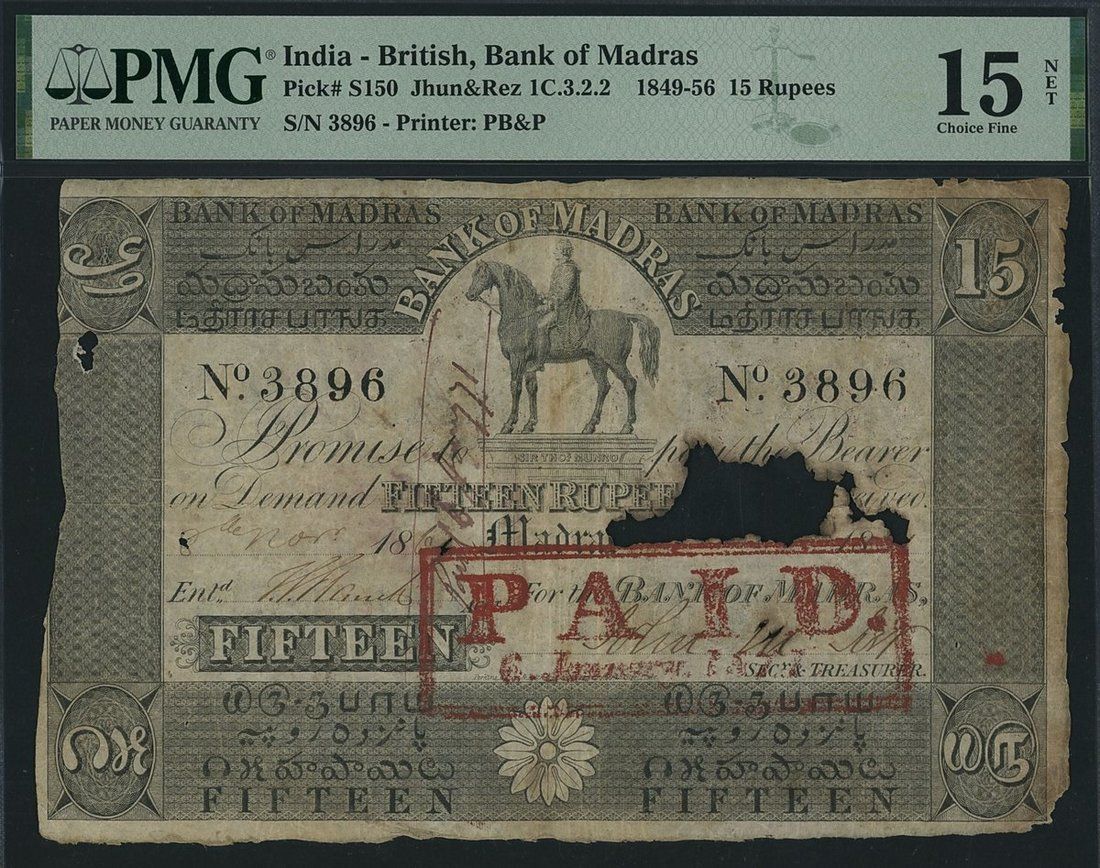
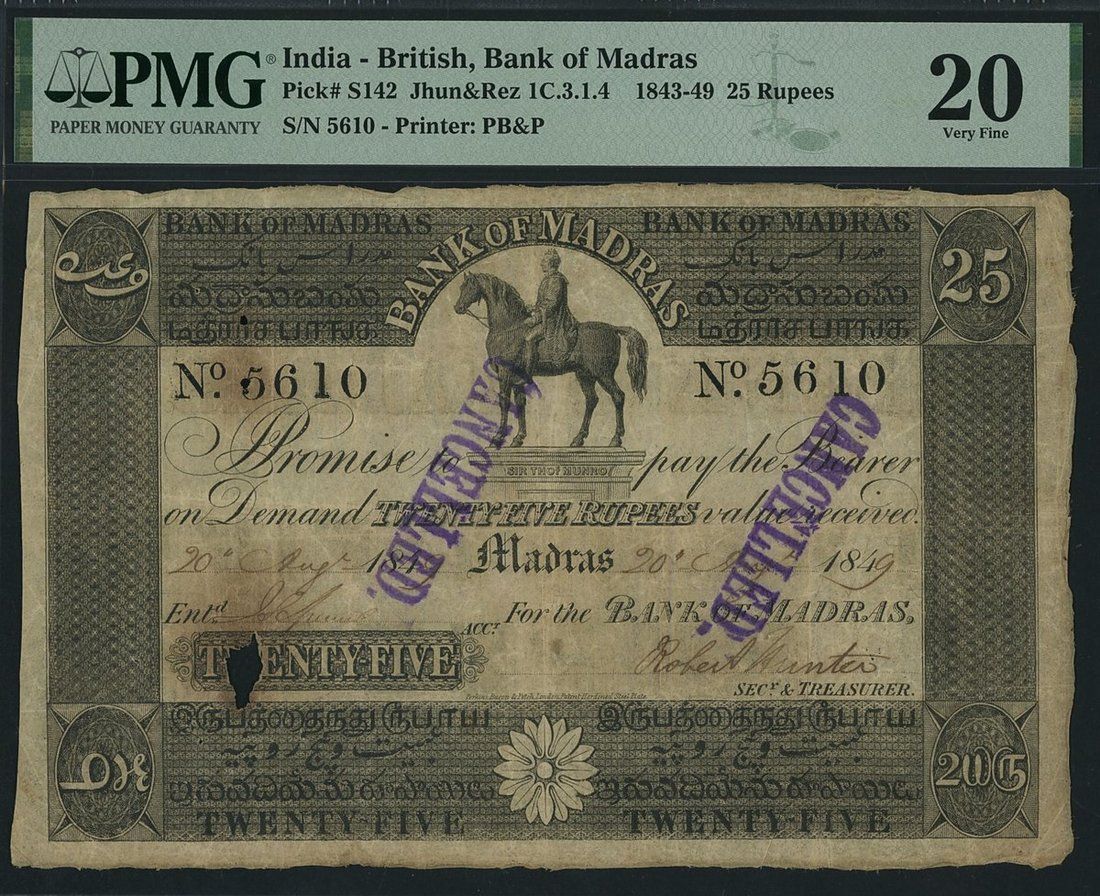
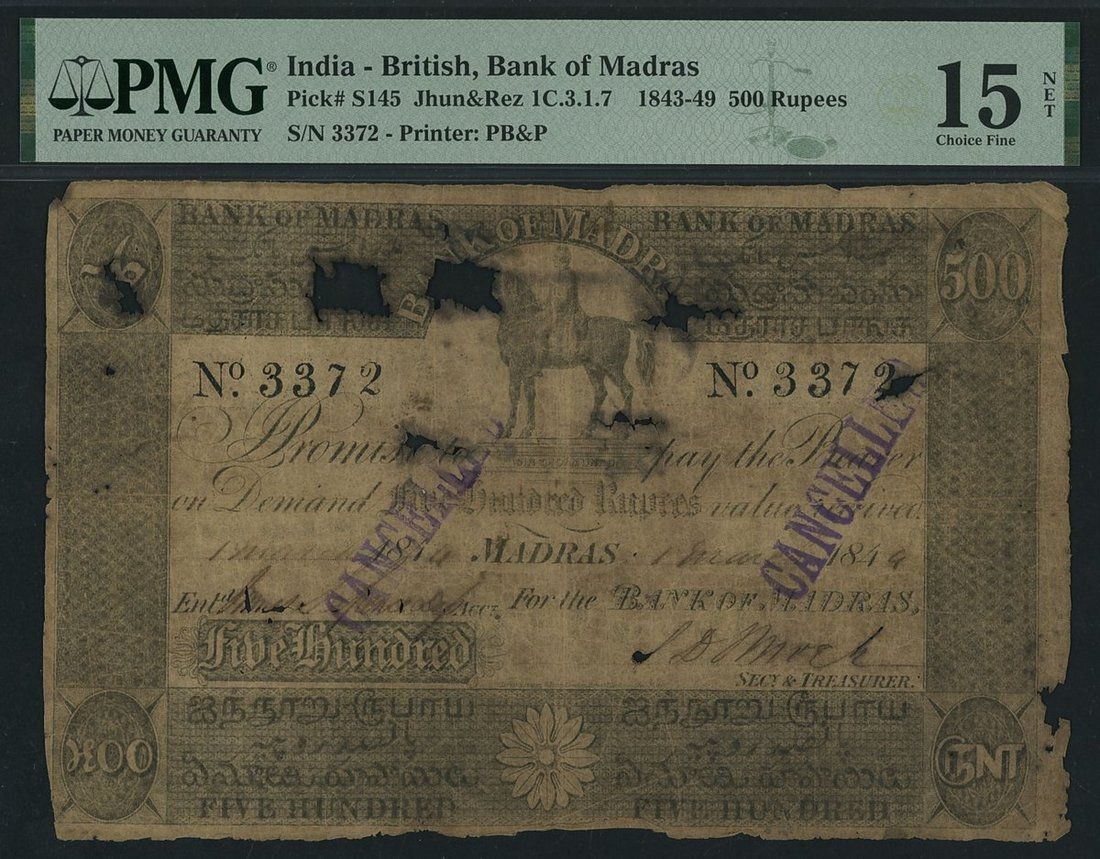
Every Bank of Madras note, from 10 to 3000 Rupees, shares one engraved design, printed on handmade paper by the London security firm Perkins, Bacon & Petch using their patented hardened-steel plates. At the centre is the equestrian statue of Sir Thomas Munro, Governor of Madras 1820–1827, beneath the title BANK OF MADRAS in a semicircle. Munro's choice was pointed: he had introduced the Ryotwari land settlement that let cultivators pay revenue directly to the state, and his statue (sculpted by Francis Chantrey in 1839, near Fort St George) made him a figure of benevolent authority the bank could trade on.
The bank's name appears in the upper panels in English, Persian, Telugu and Tamil, with the value spelled out likewise in the lower panels around a central floral device. The denomination numerals sit in the four corners in four scripts, clockwise — the top-left in Arabic Siyaq (Raqm), a mercantile accounting notation of monogram-like numerals, then English, Tamil and Telugu. The reverse carries BANK OF MADRAS and the value in bold English within a cartouche; the watermark repeats the name in English and Tamil inside an angular triple-line border. The print area is about 179 × 111 mm.
Cut in half for safety
To defeat highway and mail theft, notes were bisected for transport: the sender posted one half, waited for written acknowledgement, then sent the second half, and the recipient pasted the two together to redeem the note in coin. Once paid, the bank marked the note "PAID" or "CANCELLED" and tore or cut the signature to kill it. This is why most surviving Bank of Madras notes are rejoined halves — often with tape residue, a central split, and heavy cancellation — and why an intact, uncut example is so highly prized.
Design evolution: the two plate types
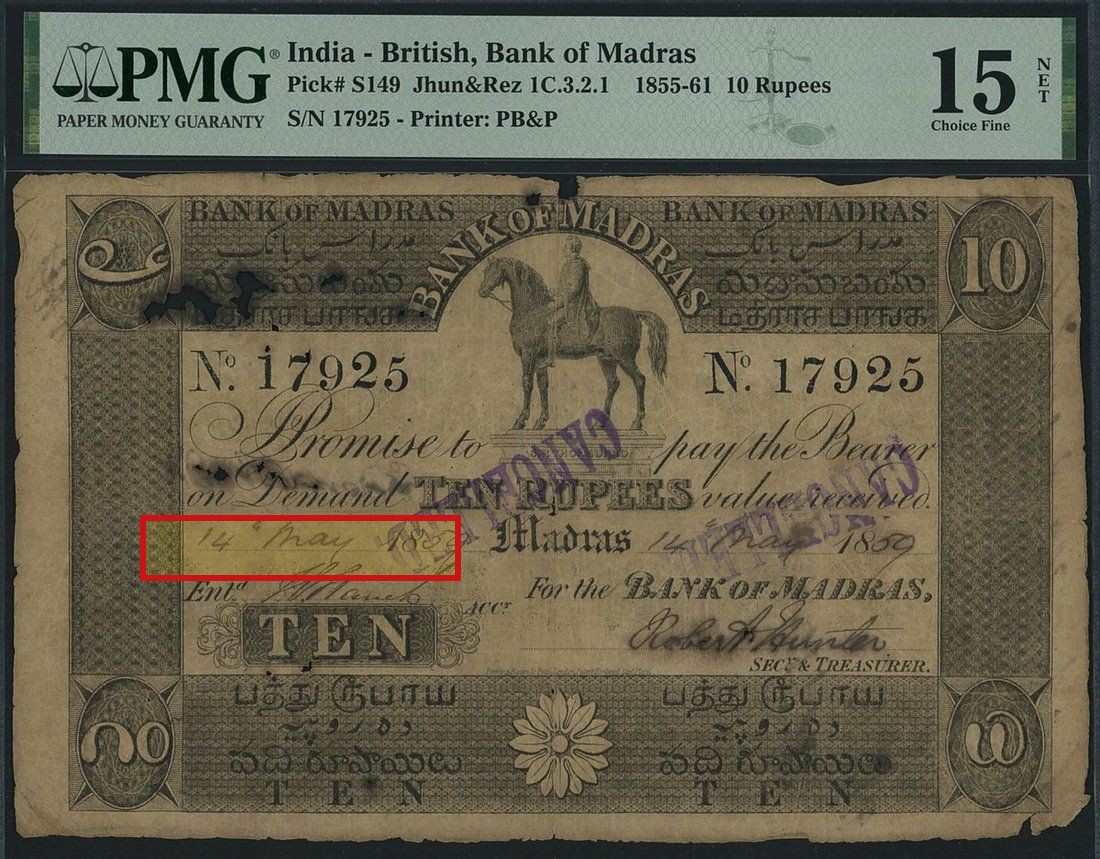
The single most useful thing to read on a Bank of Madras note is its plate type, and the tell is the pre-printed year engraved into the plate. Look at the date line, either side of "MADRAS":
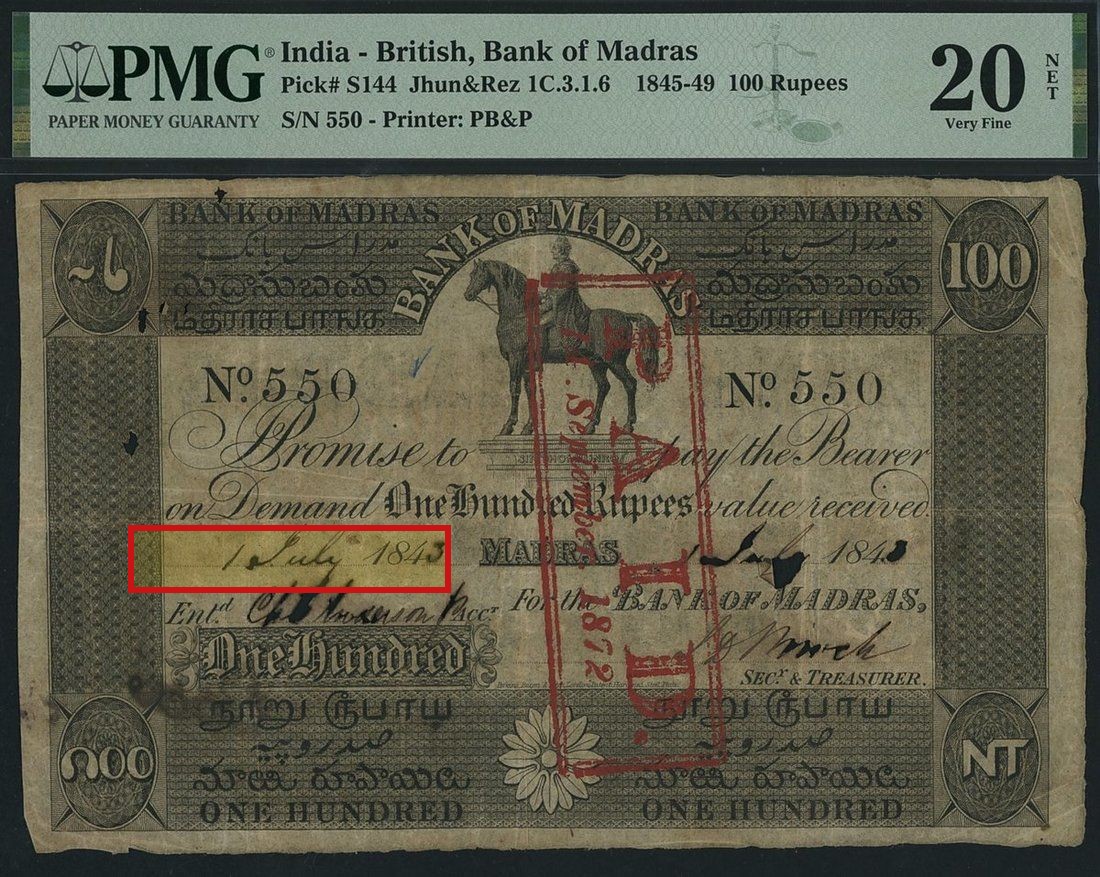
- Plate Type 1 — printed "184X" (1843–1849). With three digits fixed in the plate, it could serve only to the end of 1849.
- Plate Type 2 — printed "18XX" (1850–1861). Re-engraved with only two digits, it carried the series to the end of note issue in 1861.
The plate type is the third digit of the J&R number: 1C.3.1.x for Type 1, 1C.3.2.x for Type 2, with the final digit the denomination. There was no serial-number reset between the two plates — the run was continuous — so a note's serial, date and plate type must all agree.
Serial numbers and fonts
The serial style is a second, finer tell — and the source of the "which font?" question. There are three serial varieties, distinguished by the space after "No." and the typeface:
| Serial variety | "No." spacing | Font | Occurs on |
|---|---|---|---|
| Type A | space after "No." | ≈ Bell MT | all Plate Type 1 (184X) notes |
| Type B | space after "No." | ≈ Engravers MT | Plate Type 2 (18XX) |
| Type C | no space | ≈ Engravers MT | Plate Type 2 (18XX) |
The two fonts differ most in the numerals 2 and 3. On the 10 Rupees the switch from serial Type B to Type C can be dated to about 14 May 1859 — two notes of that date exist just 162 serials apart, one Type B, one Type C. A curiosity: even the font of the word "MADRAS" in the date line differs by denomination group (10/15/20/25/50 · 100 · 500 · 1000 · 3000).
The signatures: four Secretaries & Treasurers
Every issued note was signed by hand by the bank's Secretary & Treasurer — its most senior officer, signing "For the Bank of Madras" at the right — with the Accountant's counter-signature ("Entd.") at the left. Only four men held the office during the note years, and because their terms are known, the signature alone brackets a note's date.
| Signatory | Office | Dated notes | Biography |
|---|---|---|---|
| Sylvester Douglas Birch | 28 Jun 1843 – 31 Jan 1845 | 1 Jul 1843 → 2 Jan 1845 | Founding Secretary & Treasurer; formerly a cashier at the old Government Bank of Madras. Signed 50,000+ notes — perhaps 35,000 of them dated the incorporation day itself — then became a Government Director. |
| John Heyman | 1 Feb 1845 – 26 Aug 1845 | 10R, 1 May 1845 | Ex-London & Westminster Bank, then the bank's Accountant. Died in office aged 28. A single note is known bearing his signature. |
| Robert Hunter | 5 Nov 1845 – 1860 | 10 Apr 1849 → 12 May 1860 | From Calcutta; a former bill-broker (partner in the failed Hunter, Macgregor & Co.). Held the post ~15 years and signed every denomination — yet, oddly, signed no notes at all in his first ~4 years. |
| John McIvor | 1861 | 25 Jul & 9 Nov 1861 | Fourth and last. Recorded so far only on the 10 and 15 Rupees. His 9 November 1861 is the latest date known on any Indian Presidency banknote. |
Signatory × plate × denomination
Put the three variable axes together — plate type, denomination and signatory — and the shape of the series emerges. The grid below marks which signatory is recorded on which denomination (a filled cell), split by plate type where both are known. It is the quickest picture of where the series is well documented and where it is not.
| Denomination | Birch 1843–45 · T1 | Heyman 1845 · T1 | Hunter 1849–60 · T1&T2 | McIvor 1861 · T2 |
|---|---|---|---|---|
| 10 Rupees | ✓ | ✓ | ✓ | ✓ |
| 15 Rupees | – | – | ✓ | ✓ |
| 20 Rupees | ✓ | – | ✓ | – |
| 25 Rupees | ✓ | – | ✓ | – |
| 50 Rupees | ✓ | – | ✓ | – |
| 100 Rupees | ✓ | – | ✓ | – |
| 500 Rupees | ✓ | – | ✓ | – |
| 1000 Rupees | ✓ | – | – | – |
| 3000 Rupees | proof on card only — unsigned | |||
Only the 10 Rupees is confirmed for all four signatories. The 15 Rupees is the one value never signed by Birch (no 1843–45 example is known).
The denominations, one by one
Nine denominations are known — 10, 15, 20, 25, 50, 100, 500, 1000 and 3000 Rupees — each with a Type 1 and, in principle, a Type 2 catalogue number. The table gives estimated original issue, whether a Type 2 has actually been observed, and a representative sale (priced in the auction house's own currency).
| Denom. | J&R (T1 / T2) | Est. issued | Type 2 seen? | Representative example — price (house currency) |
|---|---|---|---|---|
| 10 R | 1C.3.1.1 / 1C.3.2.1 | ~20,000 | yes | Heyman, 1 May 1845 — ₹7,00,000 (CNG) |
| 15 R | 1C.3.1.2 / 1C.3.2.2 | ~4,000 | yes | McIvor, 8 Nov 1861 — est. $12,000–16,000 (Spink) |
| 20 R | 1C.3.1.3 / 1C.3.2.3 | ~20,000 | no | Birch, 2 Jan 1845 — est. $12,000–16,000 (Spink) |
| 25 R | 1C.3.1.4 / 1C.3.2.4 | ~15,000 | no | Hunter, 20 Aug 1849 — est. $12,000–16,000 (Spink) |
| 50 R | 1C.3.1.5 / 1C.3.2.5 | ~20,000 | yes | Hunter, 10 Apr 1849 — est. $16,000–24,000 (Spink) |
| 100 R | 1C.3.1.6 / 1C.3.2.6 | ~20,000 | yes | Birch, 1 Jul 1843 — est. $17,000–22,000 (Spink) |
| 500 R | 1C.3.1.7 / 1C.3.2.7 | ~10,000 | no | Birch, 1 Mar 1844 — est. £22,000–28,000 (Spink) |
| 1000 R | 1C.3.1.8 / 1C.3.2.8 | ~1,000 | – | Proof, 7 Jul 1854 — realised £98,000 (Spink) |
| 3000 R | 1C.3.1.9 / 1C.3.2.9 | none issued | – | Proof, 7 Jul 1854 — realised £159,250 (Spink) |
A few denominations worth calling out
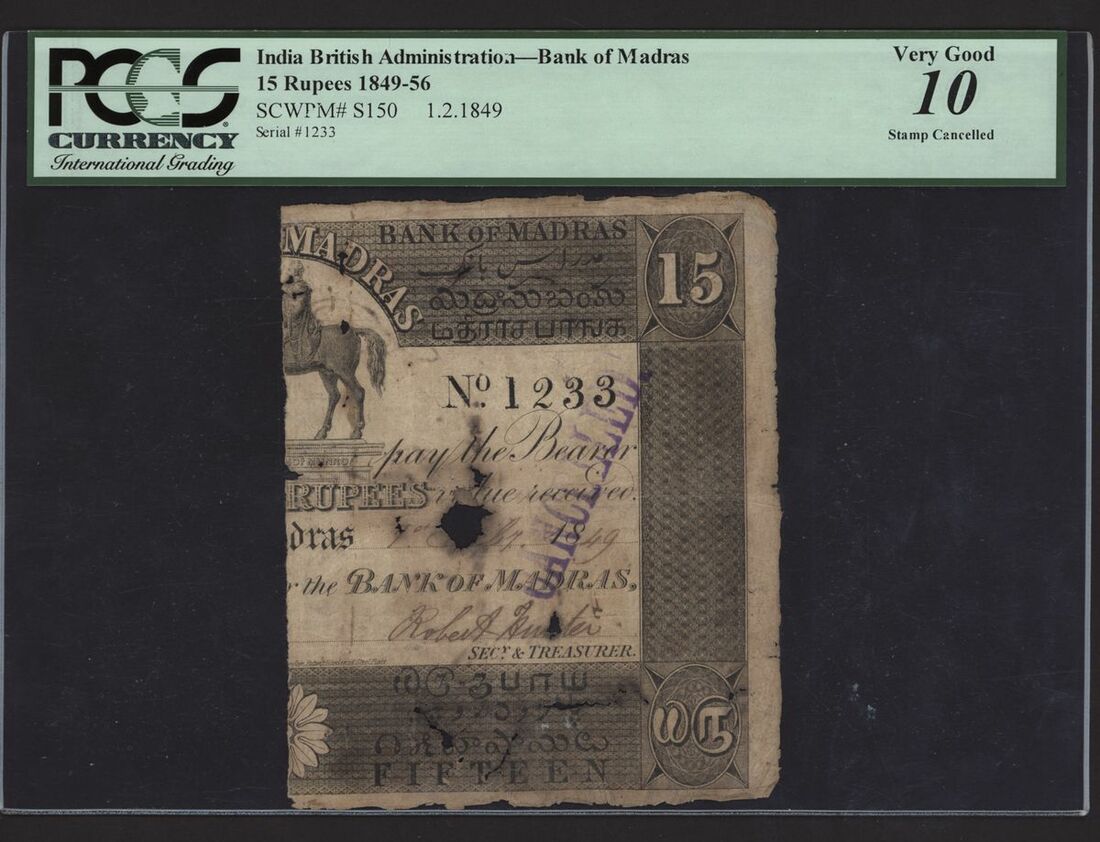
- 15 Rupees — the unusual "fancy" value (also struck by Bengal and Bombay). No Birch/1843 example is known; the earliest is 1 July 1849 (serial 607). Uniquely it was printed only in serial Type A, whatever the plate, and it carries the last-ever Presidency date, 9 November 1861.
- 1000 Rupees — a genuine issued note is recorded from a single example (serial 508, Birch, 1 July 1843), alongside the famous 1854 proof.
- 3000 Rupees — a "super-fancy" value known only as a proof on card; no issued note has ever been recorded.
Specimens, proofs and unissued remainders
Because so few issued notes survived, the series is also represented by three kinds of non-circulating pieces, worth distinguishing carefully:
- Specimen / proof on card — an impression mounted on card, printed "SPECIMEN" where the signature would sign, with a blank "184" date and no serial.
- Unissued remainder — a fully printed note never put into circulation: it bears a serial but no date and no signature (for example a 500 Rupees, serial 770).
- Issued note — serial, hand-written date and the Secretary & Treasurer's signature, usually later CANCELLED or PAID-stamped.
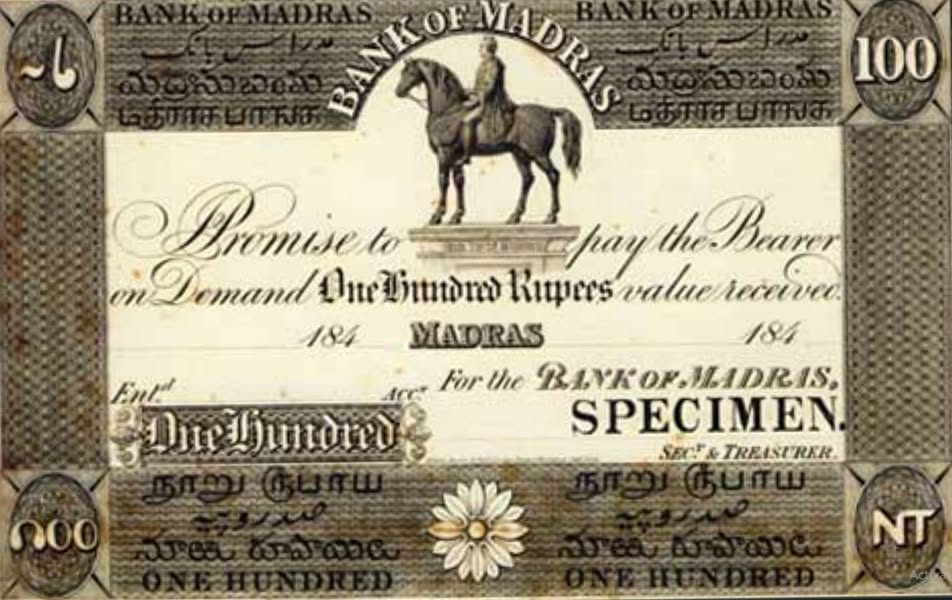
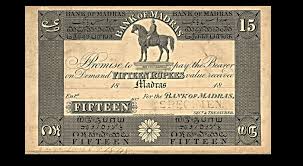
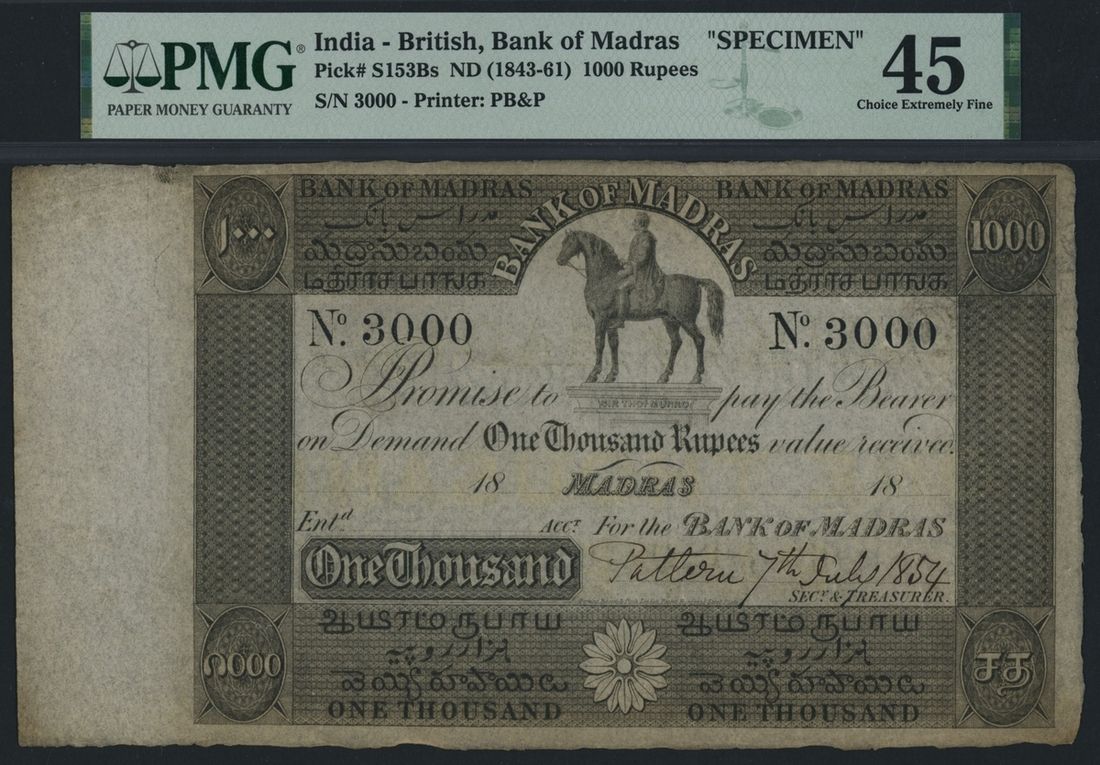
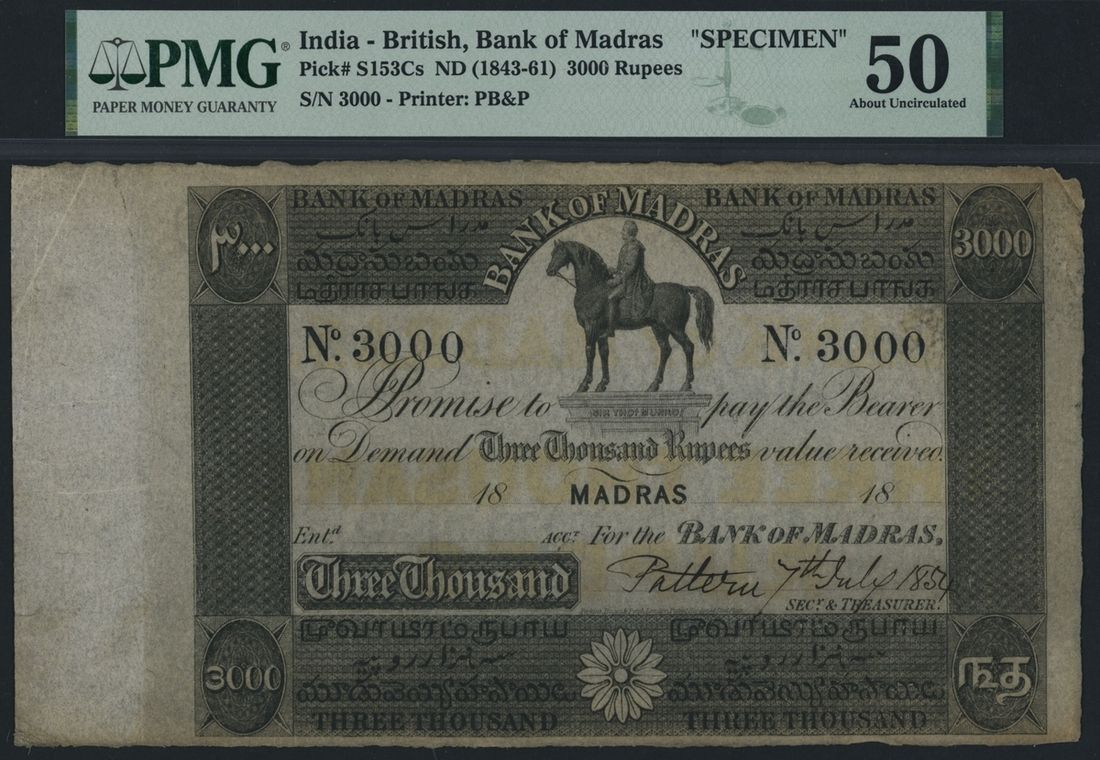
Specimen material of this kind is preserved in institutional collections — the RBI Monetary Museum (Mumbai and Kolkata) and, notably, the Museum of Indian Paper Money in Bengaluru founded by Rezwan Razack, which holds Perkins Bacon proofs and hand-painted essays that trace the evolution of the design.
Reference checklist
The full family of catalogue numbers, with the plate type, the signatories recorded, and — where we have located an example — a link to the sale where it can be seen. Shown means an imaged example has passed through public sale; listed means the type is documented in the literature (chiefly Sarangapani, 2017) but we have not placed an example here; not seen means no example is yet recorded.
| J&R | Denom. | Plate | Signatories recorded | Status | See an example |
|---|---|---|---|---|---|
| 1C.3.1.1 | 10 R | Type 1 (184X) | Heyman, Hunter | Shown | CNG — Heyman, 1845 |
| 1C.3.2.1 | 10 R | Type 2 (18XX) | Hunter, McIvor | Shown | Spink — Hunter, 1859 |
| 1C.3.1.2 | 15 R | Type 1 (184X) | Hunter | Shown | Spink — half, serial 1233 |
| 1C.3.2.2 | 15 R | Type 2 (18XX) | McIvor | Shown | Spink — McIvor, 1861 |
| 1C.3.1.3 | 20 R | Type 1 (184X) | Birch, Hunter | Shown | Spink — Birch, 1845 |
| 1C.3.2.3 | 20 R | Type 2 (18XX) | — | Not seen | no example recorded |
| 1C.3.1.4 | 25 R | Type 1 (184X) | Hunter | Shown | Spink — Hunter, 1849 |
| 1C.3.2.4 | 25 R | Type 2 (18XX) | — | Not seen | no example recorded |
| 1C.3.1.5 | 50 R | Type 1 (184X) | Birch, Hunter | Shown | Spink — Hunter, 1849 |
| 1C.3.2.5 | 50 R | Type 2 (18XX) | Hunter | Listed | few Type C recorded |
| 1C.3.1.6 | 100 R | Type 1 (184X) | Birch, Hunter | Shown | Spink — Birch, 1843 |
| 1C.3.2.6 | 100 R | Type 2 (18XX) | Hunter | Shown | CNG — Hunter, 1859 |
| 1C.3.1.7 | 500 R | Type 1 (184X) | Birch | Shown | Spink — Birch, 1844 |
| 1C.3.2.7 | 500 R | Type 2 (18XX) | — | Not seen | no example recorded |
| 1C.3.1.8 | 1000 R | Type 1 (184X) | Birch (issued); proof | Shown | Spink — proof |
| 1C.3.1.9 | 3000 R | Type 1 (184X) | proof only | Shown | Spink — proof |
Collecting notes
There is no inexpensive Bank of Madras note. Even a worn, cancelled, rejoined example of a "common" value (10–100 Rupees) trades in the region of several lakh rupees — or its equivalent of US$8,000–20,000 at the international houses — reflecting genuine rarity rather than grade; most survivors are Good to Fine with splits, ink-burn and repairs. The 500 Rupees is decidedly rare, and the 1000 and 3000 Rupee proofs are trophy pieces. On any note, check the four points that fix its identity and value: plate type (184X vs 18XX), serial variety (A/B/C), signature, and whether it is an issued note, an unissued remainder, or a specimen.
An interesting read: fraud, panic and the demise of the bank
The Bank of Madras did its business in a financial world that was repeatedly shaken by fraud and collapse — a fragility rooted in weak external accounting oversight and the cosy personal ties between colonial administrators and private bankers. The scale of it is striking: between 1913 and 1966, nearly 1,800 banks failed across India, and the Madras region alone accounted for about a fifth of them. Three episodes in particular frame the world these notes circulated in.
The accountant's fraud of 1840
The risk of internal fraud was clear from the start. In 1840, just before the amalgamation, the predecessor bank's administration uncovered a major embezzlement scheme run by its own chief accountant — a breach that compromised the ledgers and underlined the need for double-entry bookkeeping and independent audit in the institution that would soon become the Bank of Madras.
The coffee blight and the panic of 1884
The region's exposure to external shocks was laid bare in 1884. The largest financial institution in neighbouring Ceylon and Mauritius, the Oriental Bank Corporation, had overextended itself lending to colonial coffee plantations. When the devastating coffee-rust disease (Hemileia vastatrix) swept through Ceylon in the late 1870s, it wiped out the plantation economy and rendered those loans unrecoverable; the Corporation's losses exceeded its entire capital and it collapsed in 1884. The failure triggered a systemic panic across the Indian Ocean trade network, with runs spreading to the Chartered Mercantile Bank and the Bank of Madras. To stop the bleeding, the colonial government stood up a temporary currency board that issued fully-backed, government-convertible notes — injecting liquidity, restoring confidence, and halting the panic.
The Arbuthnot crash of 1906
The most devastating disaster came on 22 October 1906, when the venerable merchant-banking house Arbuthnot & Co. — established in the late 18th century as Francis Latour & Co., and the most trusted financial name in southern India — suspended payments. Its managing partner, Sir George Arbuthnot, was at the same time a Member of the Legislative Council, Chairman of the Madras Chamber of Commerce, and President of the Board of Directors of the Bank of Madras. That overlap was fatal to public judgement: depositors believed Arbuthnot & Co. carried the same implicit backing as the semi-governmental bank.
Behind the respectable facade, the firm's London partner, Patrick Macfadyen, had been systematically siphoning depositor funds from Madras to London to feed reckless stock-market speculation. When his ventures collapsed, Macfadyen threw himself in front of an electric train in London on 21 October 1906. The next day the firm suspended payments, revealing liabilities of over ₹3 crore against mostly illiquid or fictitious assets. The collapse wiped out the savings of thousands of families and forced institutions such as St Peter's College, Thanjavur, to close.
The colonial administration showed little appetite for prosecuting Sir George — until public outrage, led by The Hindu and the advocate V. Krishnaswami Iyer, forced criminal proceedings. When Arbuthnot's defence argued that Iyer could not lead the prosecution because he had no barrister above him, Iyer famously threw off his vakil's gown, impleaded himself as an affected depositor, and pressed a devastating cross-examination. Sir George Arbuthnot was convicted of criminal breach of trust and sentenced to two years' rigorous imprisonment. Out of the wreckage came a wave of financial nationalism: on 5 March 1907, Krishnaswami Iyer and a group of Chettiar merchants founded the Indian Bank as an indigenous, transparent and accountable alternative to the European-controlled institutions.
The quiet demise
The Bank of Madras itself never crashed — it was legislated out of independent existence. It lost the right to issue its own notes under the Paper Currency Act of 1861; the Presidency Banks Act of 1876 withdrew the government's ownership stake and board seats; and on 27 January 1921 the three Presidency banks were amalgamated into the Imperial Bank of India, which in 1955 became the State Bank of India. The Munro-vignette notes — printed for barely eighteen years, and surviving mostly as cancelled, rejoined halves — are what remain of it.
References & further reading
- Ramkumar Sarangapani, "Bank of Madras: A Detailed Study After 175 Years," International Bank Note Society Journal 56.2 (2017) — archive.org. The standard modern reference for plate types, serial varieties and signatory tenures.
- Rezwan Razack & Kishore Jhunjhunwalla, The Revised Standard Reference Guide to Indian Paper Money (2012) — the J&R (1C.3.x) catalogue numbering.
- Spink, World Banknotes (23 September 2025), lots 45–46 (1000 & 3000 Rupee proofs), and earlier Presidency-bank sales — spink.com.
- PMG, "Pair of PMG-certified British India Notes Impress in Spink Auction" — pmgnotes.com.
- Classical Numismatic Gallery and Noonans auction archives — Bank of Madras lots.
- Nilaish, "A Note on Bank of Madras Currency Notes Issues," NWB Blog (2014) — nilaishipm.blogspot.com.
- RBI Monetary Museum, Mumbai, and the Museum of Indian Paper Money, Bengaluru — Presidency-bank holdings and Perkins Bacon proofs.
Images are from public auction records (Spink, CNG, Noonans and others) and, for the 100 Rupees specimen, the Madras Local History Group. Prices are the auction house's own figures (estimate unless a realised price is stated) in that house's currency, and are indicative only.