The Bank of Western India was a private Bombay exchange bank, founded in 1842, that issued some of the earliest paper currency of western India — and then, within a few years, outgrew its own name. Almost no issued notes survive: the series is known today chiefly from front proofs, the uniface printer's impressions on which each denomination was set up before the plates ever ran. This article reads that currency from the notes themselves — a single engraved design built around the Bombay Town Hall, printed in London, adapted value by value — illustrated with the examples that have passed through public sale and one issued note preserved in a museum.
Why the Bank of Western India matters to collectors
Three things make these notes exceptional. First, age: printed in the early 1840s, they are among the oldest joint-stock banknotes of the Bombay Presidency, contemporaries of the earliest Bank of Bombay issues. Second, rarity: the bank operated under this name for less than a decade, redeemed notes were cancelled and destroyed, and what remains is a handful of proofs plus a bare few issued survivors — several denominations are known from a single example. When a 100 Rupees proof appeared at Spink in 2025 it was catalogued as a "discovery note," the first of its denomination ever offered at auction. Third, design: the notes carry a localised civic vignette — the Bombay Town Hall — rather than the imperial allegory of the Bengal notes, a small but pointed statement about who the bank served.
A Bombay exchange bank
The Bank of Western India opened in Bombay in 1842. Its purpose was to break the East India Company's hold on the most profitable business in the port: foreign exchange and bill discounting on the triangular cotton–opium–silver trade linking Bombay, Canton and London. The government-backed Bank of Bombay, chartered in 1840, had been forbidden by its charter from dealing in foreign exchange — leaving a gap that only a private bank could fill.
It was floated by a coalition of native and British merchants. Among the promoters were the Pathare Prabhu banker and philanthropist Sir Jagannath Shankarshet and the Parsi merchant Dadabhoy Rustomjee; executive management fell to William Walter Cargill, a Scot who had been secretary and treasurer of the rival Bank of Bombay and knew the local money market intimately. Capitalised at a reported £1.5 million, the bank expanded fast along the sea-lanes — Colombo (1843), Calcutta (1844), Shanghai and Canton (1845), Singapore and Hong Kong (1846) — becoming the first British bank in Ceylon and, at Hong Kong, the issuer of that colony's first banknotes.
But it carried a fatal weakness: it had no charter, from either the Company or the Crown. Without one it enjoyed no limited liability and could not enforce its corporate contracts in the courts of British India, and the hostile EIC used its influence to block any local charter. That regulatory dead end — not any failure of the notes themselves — is what ended the Bombay bank; we return to it at the close.
One design for every value
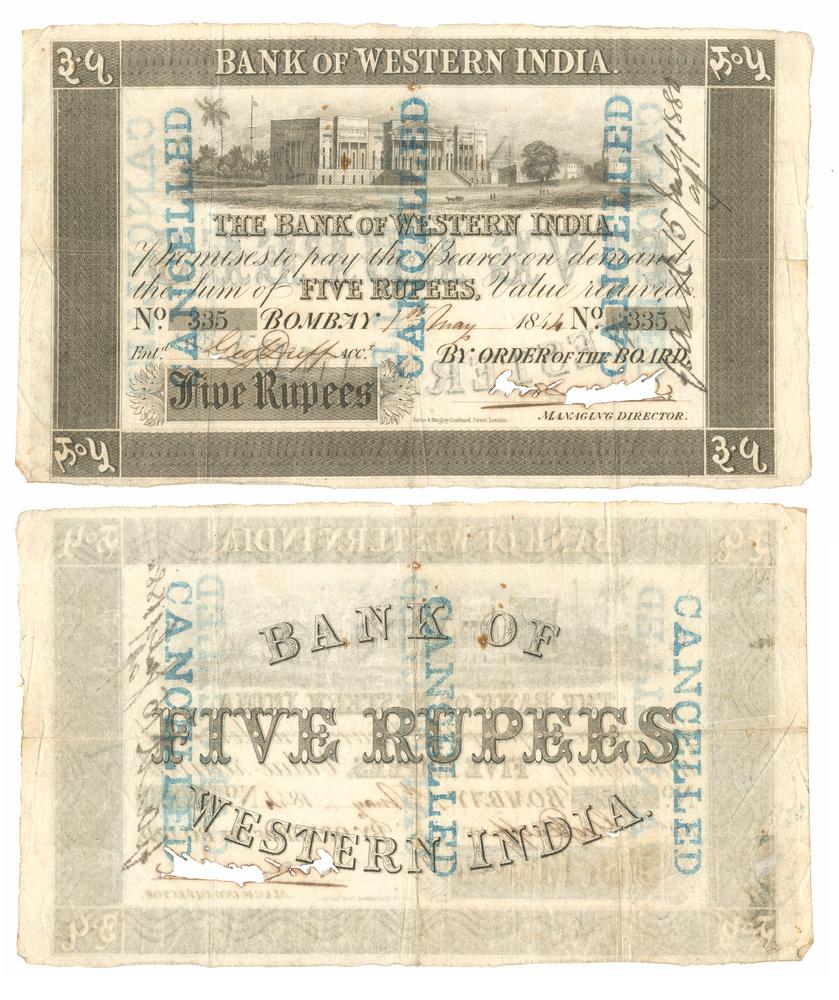
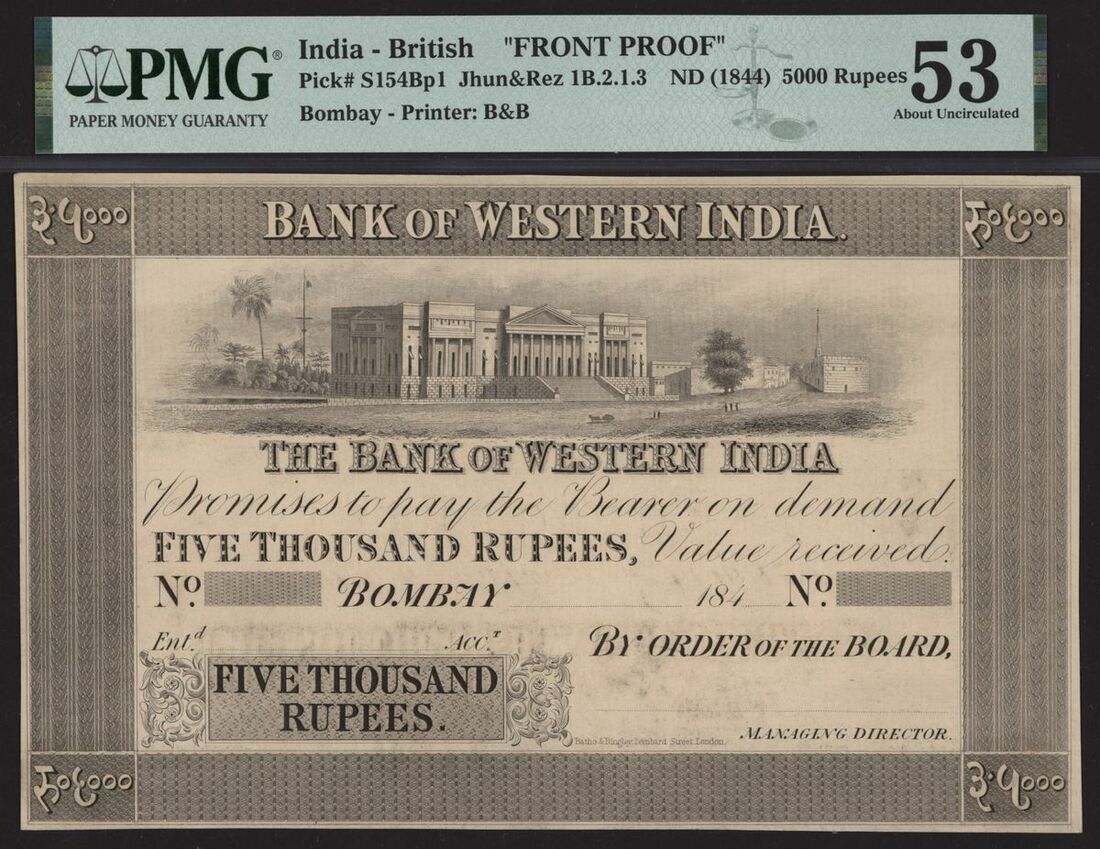
Every Bank of Western India note, from 5 to 5000 Rupees, shares a single engraved design, printed on handmade paper in London by the security firm Batho & Bingley of Lombard Street — their tiny imprint runs along the foot of the note. Rather than engrave a wholly new plate for each value, the bank worked from one master template: only the denomination words, the corner numerals and the value box were swapped from one plate to the next. That is why a 5 Rupees and a 5000 Rupees look, at a glance, like the same note.
At the centre is a finely engraved vignette of the Bombay Town Hall — the columned neoclassical building (today the Asiatic Society) — with palm trees at the left, the ramparts of Bombay Castle and a flagstaff at the right, and a waterfront foreground of small figures. The choice was deliberate. Where the Bank of Bengal reached for European allegory — Britannia, Commerce — the promoters of the Bank of Western India put a local civic monument, the administrative and mercantile heart of the Fort, at the centre of their money. It proved so trusted among Bombay's merchants that when the government's Bank of Bombay later issued notes, it adopted the same Town Hall vignette.
Below the vignette runs the promissory text — "THE BANK OF WESTERN INDIA / Promises to pay the Bearer on demand… [value] RUPEES, Value received" — over the date line "No. ___ BOMBAY 184_ No. ___", with the serial repeated at both ends. Attestation is by two hands: the Accountant enters the note at the lower left ("Entd. ___ Acct.") and the executive signs at the lower right, under "By Order of the Board" and the printed title "MANAGING DIRECTOR" — Cargill's office. The value is repeated in an ornate lathe-work box at the lower left, and the whole is framed by a fine geometric underprint engineered to defeat the plate-forger.
The corners carry the value in two Indian scripts: Gujarati numerals at the left, Marathi (Devanagari) at the right, the right pair prefixed "रु" ("Ru") — the two commercial languages of the Bombay Presidency, a nod to the native merchants the bank courted.
The "184_" printed date
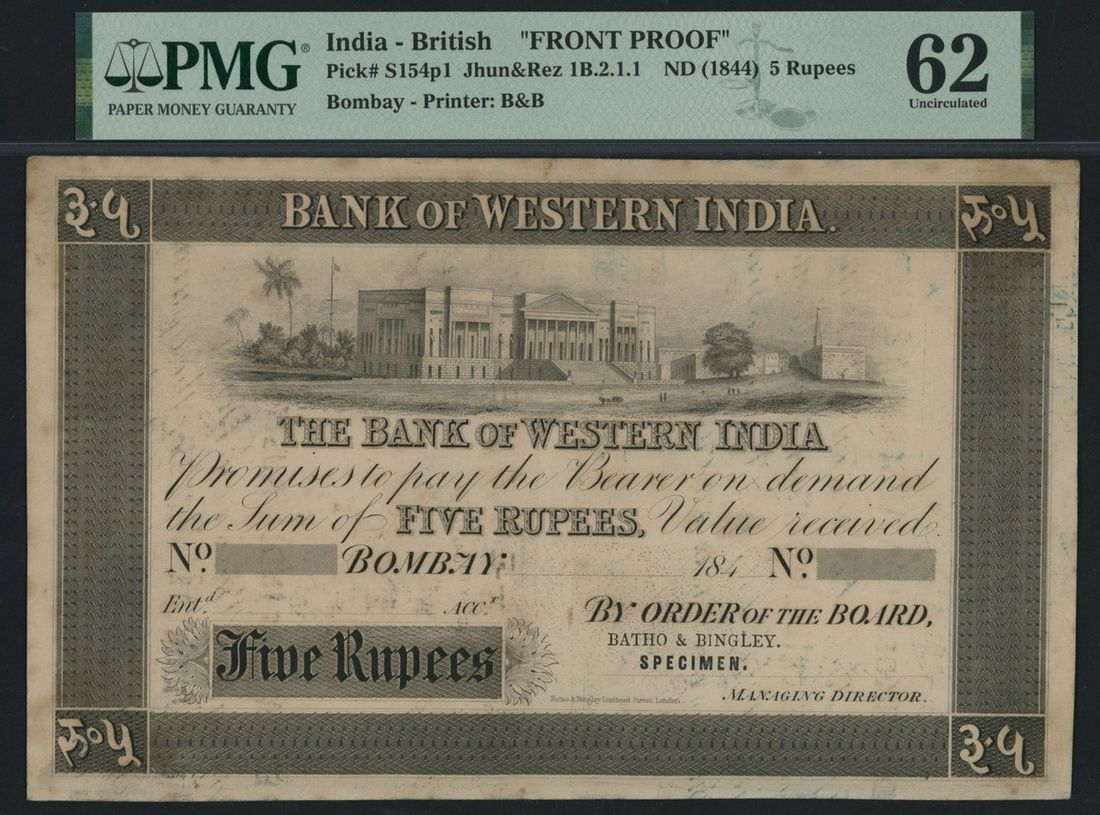
The single most useful thing to read on the date line is what the plate itself supplies. Like the early Bank of Madras plates, the Bank of Western India plates were engraved with a pre-printed partial year, "184_" — the decade fixed, the final digit left to be written by hand on issue. On every front proof the date sits blank as "184_"; on the issued 5 Rupees it is completed to "1st May 1844." The tell dates the entire series firmly to the 1840s.
Issued note versus front proof
Almost everything that survives is a proof, and the distinction is the first thing to establish on any example:
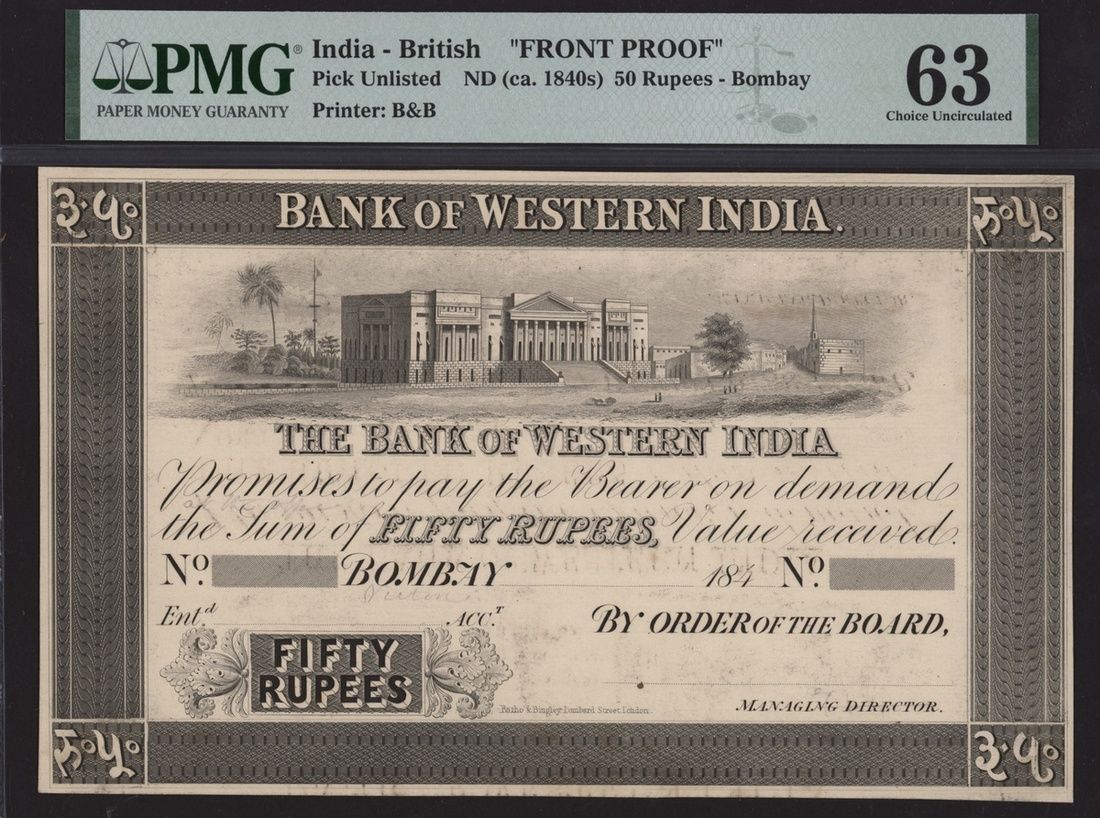
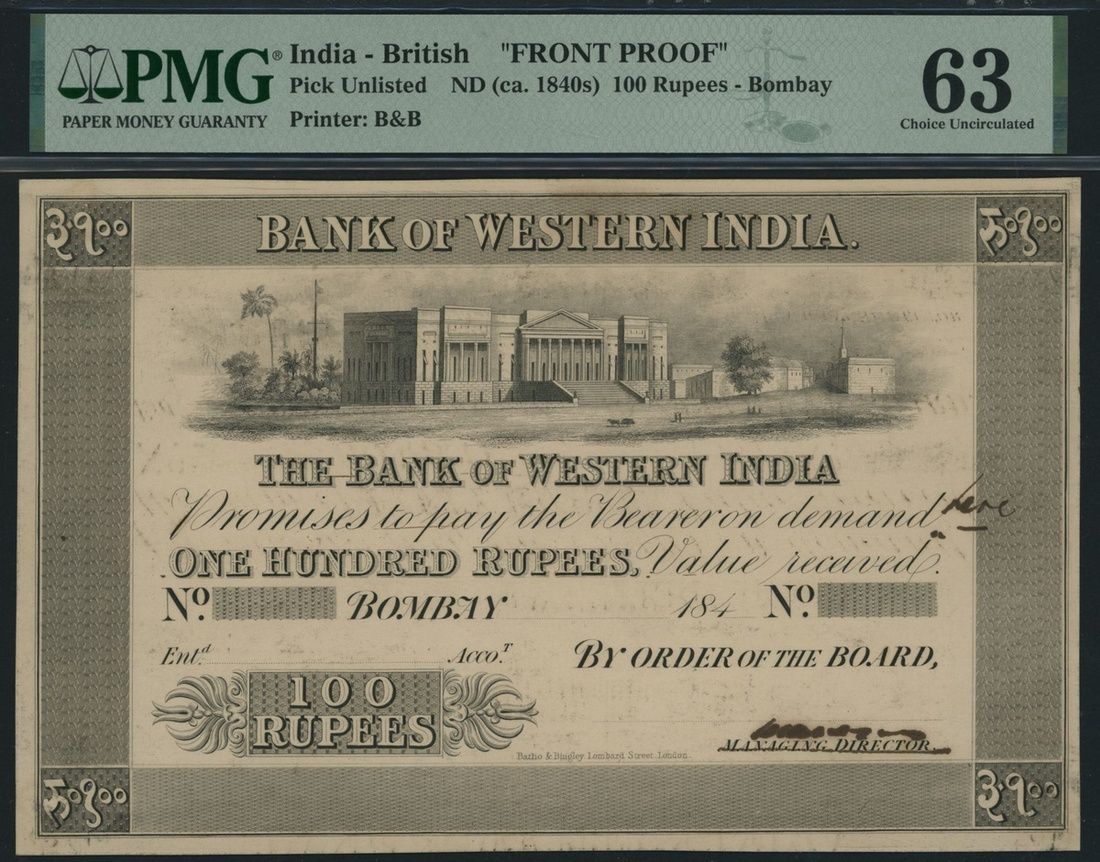
- Front proof — a uniface (obverse-only) intaglio impression on card or paper, in black or grey, with blank serials and a blank "184_" date. It was struck to check the plate before production. Some carry a printed "SPECIMEN" — on the 5 Rupees proof the words "BATHO & BINGLEY. SPECIMEN." are engraved beneath "By Order of the Board." All the high-value pieces below (50, 100, 5000 Rupees) are front proofs.
- Issued note — printed on both sides, completed with a serial, hand-written date and signatures, put into circulation, and — on redemption — stamped CANCELLED or PAID and defaced. The British Museum 5 Rupees above is the only issued note we have located.
A note on the paper and its security
Contemporary accounts describe mould-made paper with an integral watermark as the bank's principal anti-forgery measure. We flag this honestly: the surviving pieces are front proofs on card, which carry no watermark, and the one issued note is too heavily cancelled to read one. The engraved lathe-work underprint and the fine intaglio of the vignette are the security features we can actually see; any watermark description should be treated as documentary rather than confirmed from these notes.
The denominations, one by one
Five denominations are recorded — 5, 50, 100, 1000 and 5000 Rupees. The J&R number runs 1B.2.1.n, with the 5 Rupees as 1B.2.1.1 and the 5000 Rupees as 1B.2.1.3; the 1000 Rupees is attributed to the middle index in the literature. The 50 and 100 Rupees are unlisted within the series — catalogued 1B.2.1.x and Pick-unlisted — and it is our aggregation of recent Spink sales that documents them here.
| Denom. | J&R / Pick | What is known | Representative example — price realised (house currency) |
|---|---|---|---|
| 5 R | 1B.2.1.1 / S154 | Issued note (BM, ser. 335, 1844) and a front proof | Front proof — sold £17,000 (Spink) |
| 50 R | 1B.2.1.x / unlisted | Front proofs only (two recorded) | Front proof — sold $44,000 (Spink) |
| 100 R | 1B.2.1.x / unlisted | Discovery note — first of its denomination ever offered | Front proof — sold $42,500 (Spink) |
| 1000 R | 1B.2.1.2 (attrib.) / NL | In the literature; no auction example located | not seen |
| 5000 R | 1B.2.1.3 / S154Bp1 | Sole example on the PMG census | Front proof — sold £21,000 (Spink) |
Reference checklist
The recorded family of the series, with catalogue number, what kind of piece is known, and — where we have located one — a link to where it can be seen. Shown means an imaged example has passed through public sale or a museum; listed means the type is documented but we have not placed an example here.
| J&R / Pick | Denom. | Known as | Status | See an example |
|---|---|---|---|---|
| 1B.2.1.1 / S154 | 5 R | Issued note | Shown | British Museum — 1 May 1844 |
| 1B.2.1.1 / S154p1 | 5 R | Front proof ("SPECIMEN") | Shown | Spink — front proof |
| 1B.2.1.x / unlisted | 50 R | Front proof | Shown | Spink — "184-" proof |
| 1B.2.1.x / unlisted | 100 R | Front proof (discovery note) | Shown | Spink — 100 R proof |
| 1B.2.1.2 / NL | 1000 R | Attributed in the literature | Listed | no example located |
| 1B.2.1.3 / S154Bp1 | 5000 R | Front proof | Shown | Spink — 5000 R proof |
Our aggregation of Spink sales newly documents the 50 and 100 Rupees, which the standard catalogues leave unlisted; conversely the 1000 Rupees appears in the literature but in no auction record we have found. Both are open items, flagged honestly.
Collecting notes
There is no inexpensive Bank of Western India note. The market is thin to the point of individuality — most values are known from one or two pieces — and prices reflect that: the front proofs above have sold for roughly £17,000–22,000, and $42,500–44,000 at Spink in recent years — several times their pre-sale estimates — and a genuine issued note (as opposed to a proof) is rarer still. On any example, fix four things before anything else: whether it is an issued note or a front proof; the denomination and its catalogue status (the 50 and 100 Rupees are unlisted); the presence of a completed "184_" date and serial versus blanks; and the printer's imprint and lathe-work, which confirm a genuine Batho & Bingley plate.
What became of the bank
The Bank of Western India never failed as a business — it was reconstituted. Recognising that the hostile regulatory climate of Bombay would choke its growth, William Walter Cargill travelled to London in 1845 and persuaded the board to move the head office to Threadneedle Street. Trading thereafter as the Oriental Bank, the enterprise shed its identity as a local Bombay institution; after absorbing the Bank of Ceylon it obtained a Royal Charter on 30 August 1851 and became the Oriental Bank Corporation. The auction houses accordingly date the "Bank of Western India" name to 1842–1851, while the banking historians mark the effective London reconstitution at 1845 — two ways of describing the same handover. What the Oriental Bank did next is another story; the notes catalogued here belong to the Bombay bank, before the name went to London.
Two namesakes, to keep out of the catalogue
Two later, unrelated institutions share the name and cause attribution errors:
- The Central Bank of Western India (1863–1866) — a Bombay company that became the first foreign bank in Yokohama, Japan, and issued Mexican-dollar notes for the treaty ports; it was destroyed in the Overend, Gurney & Co. panic of 1866. Its notes are a separate series (Pick S244-type) despite the near-identical name.
- The Industrial Bank of Western India (Ahmedabad, 1920s) — a domestic, non-issuing bank, notable only in company-law history; it printed no currency.
References & further reading
- Rezwan Razack & Kishore Jhunjhunwalla, The Revised Standard Reference Guide to Indian Paper Money (2012) — the J&R (1B.2.1.x) numbering for the Bank of Western India.
- Spink, World Banknotes — Bank of Western India front proofs: 5000 Rupees (Oct 2024), 5 Rupees (Aug 2024), 50 & 100 Rupees (Jan 2025), 50 Rupees (Sep 2023) — spink.com.
- British Museum, Department of Money and Medals — Bank of Western India 5 Rupees, 1844 (CIB.13981).
- Numista — 5000 Rupees, Bank of Western India, Bombay (catalogue 219983).
- Noonans (formerly Dix Noonan Webb) — research on the printer Batho & Bingley of Lombard Street, London, and the Scottish design connection — noonans.co.uk.
- Reserve Bank of India, "Paper Money" and the RBI Monetary Museum, Mumbai — the Bank of Western India as an early private note-issuer of the Bombay Presidency — rbi.org.in.
- Chhatrapati Shivaji Maharaj Vastu Sangrahalaya (CSMVS), Mumbai — displays a Bank of Western India specimen; and the Museum of Indian Paper Money, Bengaluru (Rezwan Razack), for early private-bank material.
- On the bank's reconstitution as the Oriental Bank: Wikipedia and Gwulo, "Oriental Bank Corporation," and the Cambridge history of the arrival of western banking in Japan (for the separate Central Bank of Western India).
Images are from public auction records (Spink) and the British Museum. Prices are the figures realised at Spink, in that sale's own currency (pounds sterling or US dollars), and are indicative only.