2½ Rupees
3.3.1D
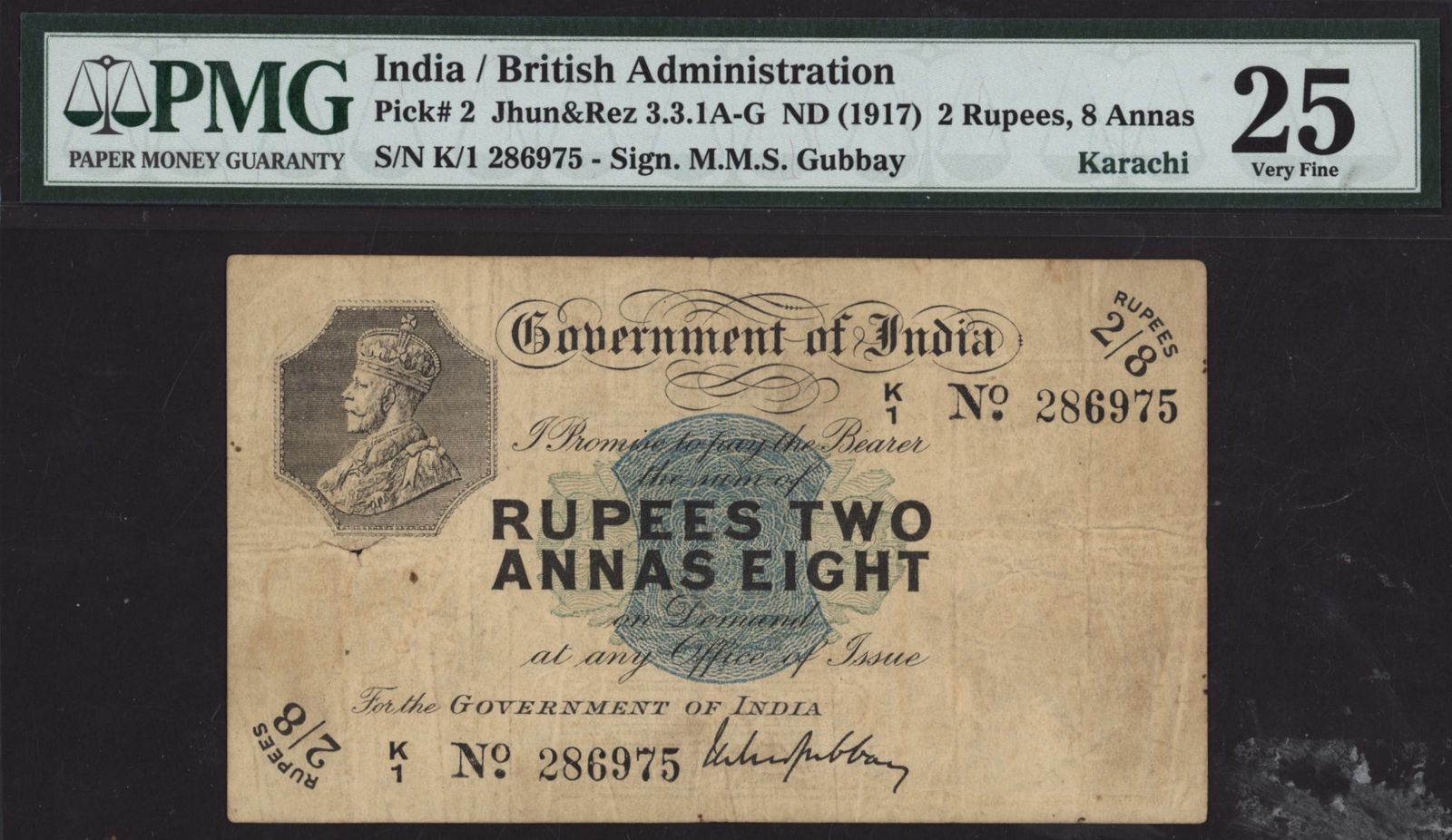
This example
- Grade
- PMG25
- Cert #
- 8065998-004
- Serial
- K/1 286975
- Realised
- —
- Estimate
- £6,000 - £8,000
- Sold
- 2024-01-12 · Spink
Provenance
2 recorded salesThe same physical note — serial K/1 286975 — traced across sales (linked by serial + type at ingest, T1-6).
- Marudhar Artsraw / ungradedSign in to see price
- Spinkthis record2024-01-12PMG25—
This type
View all 14 examplesDescription
Government of India,2 Rupees, 8 Annas, Karachi, ND (1918), serial number K/1 286975,issued on 2nd January 1918 and standardised on 9th November 1918, these banknotes were printed in England on white paper. The front of the note showcases a blue-green rosette with the inscription "Government of India" above it. Below the central denomination panel, a relief underprint in dual tone displays '2 ½' on both sides. An octagonal panel in the top left corner features the portrait of King George V, symbolising his significance during the British colonial period. The note is further distinguished by the signature of M.M.S. Gubbay.M.M.S. Gubbay, also known as Maurice Moses Solomon Gubbay, played a crucial role in the issuance and design of these banknotes. Serving as the Controller of Currency in India, he oversaw the production and management of currency notes. His signature on the notes attests to his pivotal role in the financial administration of British India.These banknotes were marked by seven prefix code variations denoting their circulation locations: A (Cawnpore/Kanpur), B (Bombay), C (Calcutta), K (Karachi), L (Lahore), M (Madras), and R (Rangoon). The particular banknote is noteworthy for bearing the prefix "K" for Karachi, making it one of the rarest within this denomination. It carries the serial number K1 286975.The annas, a historical unit of currency, are reflected in this denomination, exhibiting the monetary structure before India's decimalisation in 1957. Given that one rupee was equivalent to 16 annas, the denomination of '2 ½' on the note is akin to 2 rupees and 8 annas, accurately reflecting the historical monetary system.The reverse of the note features the official cipher of King George V, G.R.I 'Gergius Rex Imperator,' positioned in the top left corner. In the centre, a language panel presents eight Indian languages—Urdu, Kaithi, Bangla, Burmese, Telugu, Tamil, Kannada, and Gujarati—showcasing the cultural diversity of the Indian subcontinent. The denomination is numerically represented on the top right, completing the comprehensive design of this historically significant banknote(Pick 2, BNB 136a5, Jhun&Rez 3.3.1A-F),in PMG holder 25 Very Fine, spindle hole
Auction record
- House
- Spink
- Auction
- 391 - World Banknotes at NY INC (AUCTION WILL COMMENCE AT 9.15AM NY TIME/2.15PM LONDON TIME) - 4-CBUGYC
- Lot
- 307
- Date
- 2024-01-12
- Source
- View original listing