It survived a forger who hid a lakh of rupees inside a wall, a currency that changed its name overnight, and a mutiny that broke out a year after it had already redrawn its notes. Then the Government took the printing press away. This is the story of the Bank of Bengal's paper money, told through the ten designs it issued and the handful of notes that survive — with every claim traced to a book, a journal, a statute, a gazette or an auction catalogue.
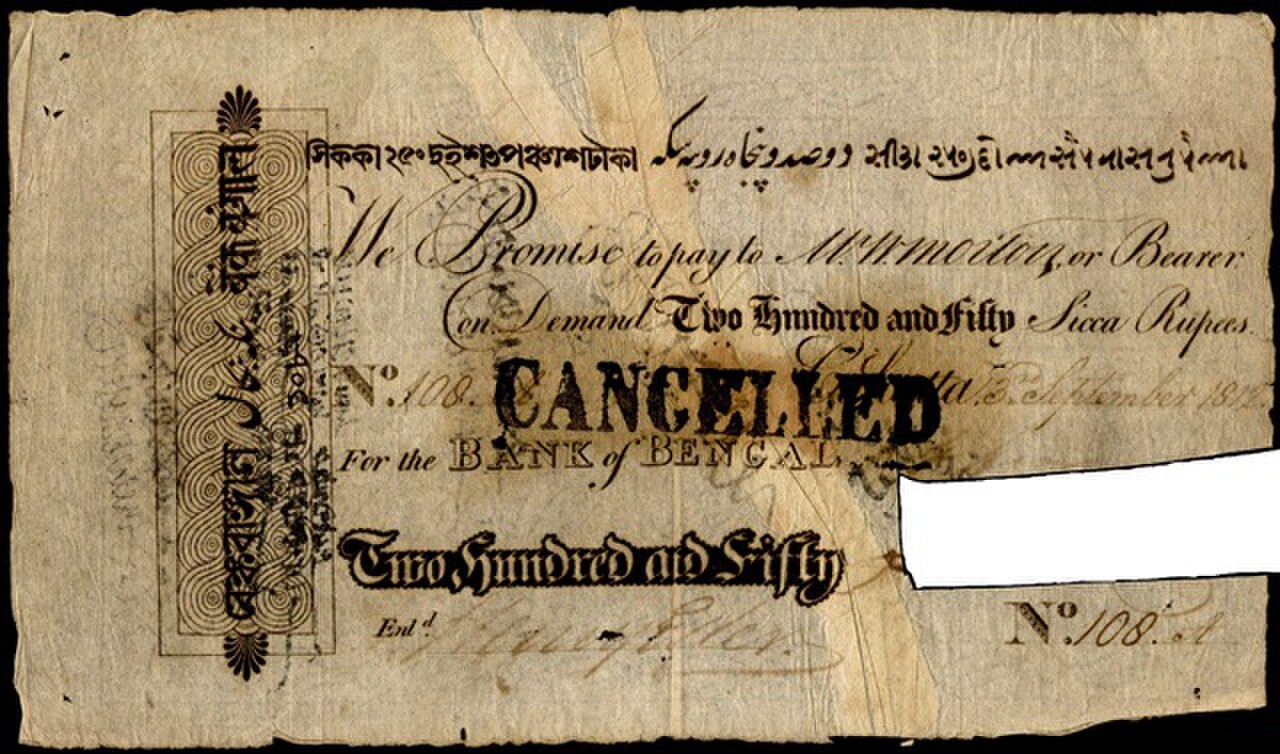
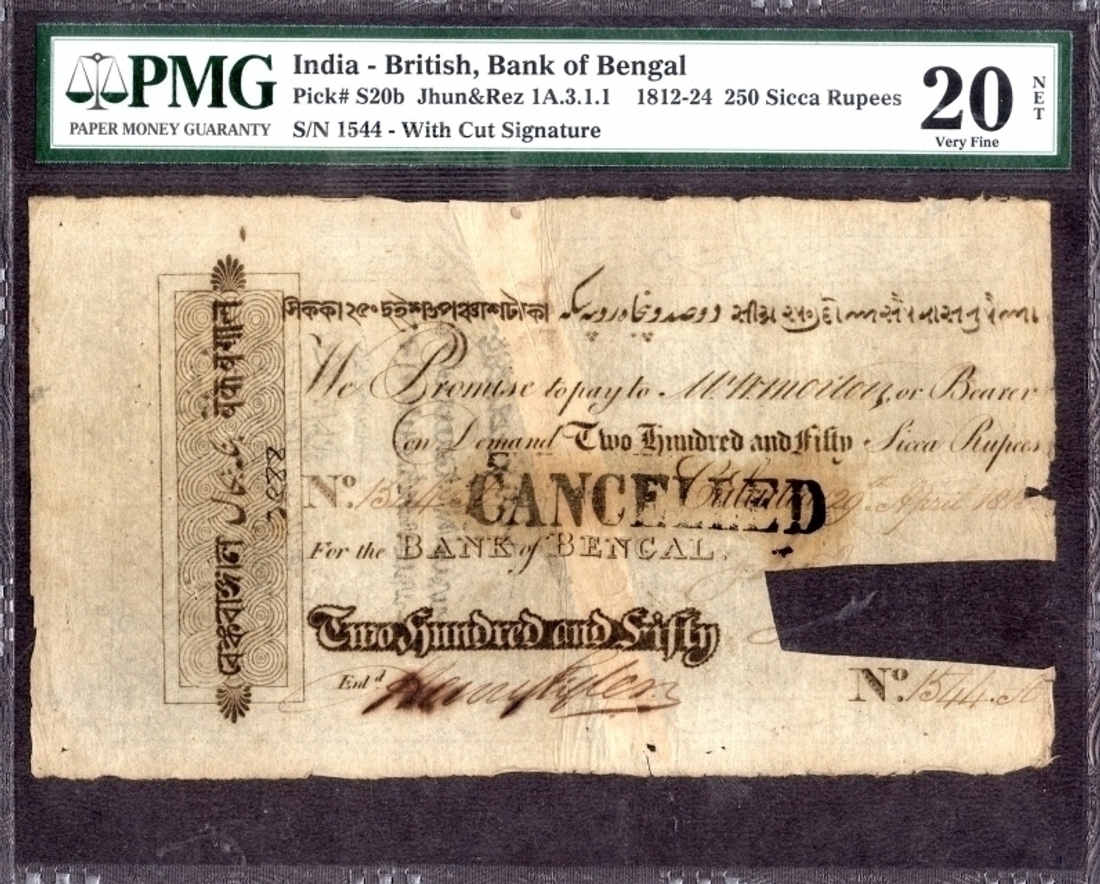
Look closely and half this article is already on it. The engraved promise reads "We Promise to pay to Mr. W. Morton, or Bearer / On Demand Two Hundred and Fifty Sicca Rupees" — the named-payee formula Cooke describes, which a committee would abolish in 1856. It is stamped CANCELLED. And the clean white notch bitten out of the lower right is not damage: it is where the signature was cut away when the note came home to be redeemed. Wikimedia Commons, public domain; the file credits the collection of Rezwan Razack — the "R" of the Razack & Jhunjhunwalla catalogue this article cites throughout.14
What follows
- The banks that died first
- A bank born of a war chest
- What the paper actually said
- The forgers of Calcutta
- The man who hid a lakh in a wall
- The night the money changed its name
- London: the men who cut the plates
- May 1856: the room where it changed
- 1857 — and why Britannia is not about the Mutiny
- The one branch that failed, and what it cost
- Act XIX of 1861: the last day
- The ten designs, in order
- Why almost none survive
- Sources
Chapter OneThe banks that died first
Before the Bank of Bengal there were ghosts. Calcutta in the 1770s and 1780s threw up banks the way a monsoon throws up mushrooms, and most of them left nothing behind but a line in a gazette. The General Bank in Bengal and Bahar (1773–75). The General Bank of India (1786). The Bengal Bank. The Carnatic Bank in Madras, 1791, of which Symes Scutt — the Bank of Bengal's own centenary historian — could only write that "barring the simple fact of its existence no details are forthcoming."1
Of roughly thirty-five banks operating in India between 1770 and 1861, only about ten ever issued notes.3 Most vanished so completely that no specimen is known to exist anywhere in the world today. But one of them left a picture — and it is the single most remarkable survival in this whole story.
In 1863 Charles Northcote Cooke, then an officer of the Bank of Bengal itself, published The Rise, Progress, and Present Condition of Banking in India. On his printed page 391 he reproduced, as an engraving, a complete note of the Bengal Bank of Calcutta. It is dated 15 November 1791.
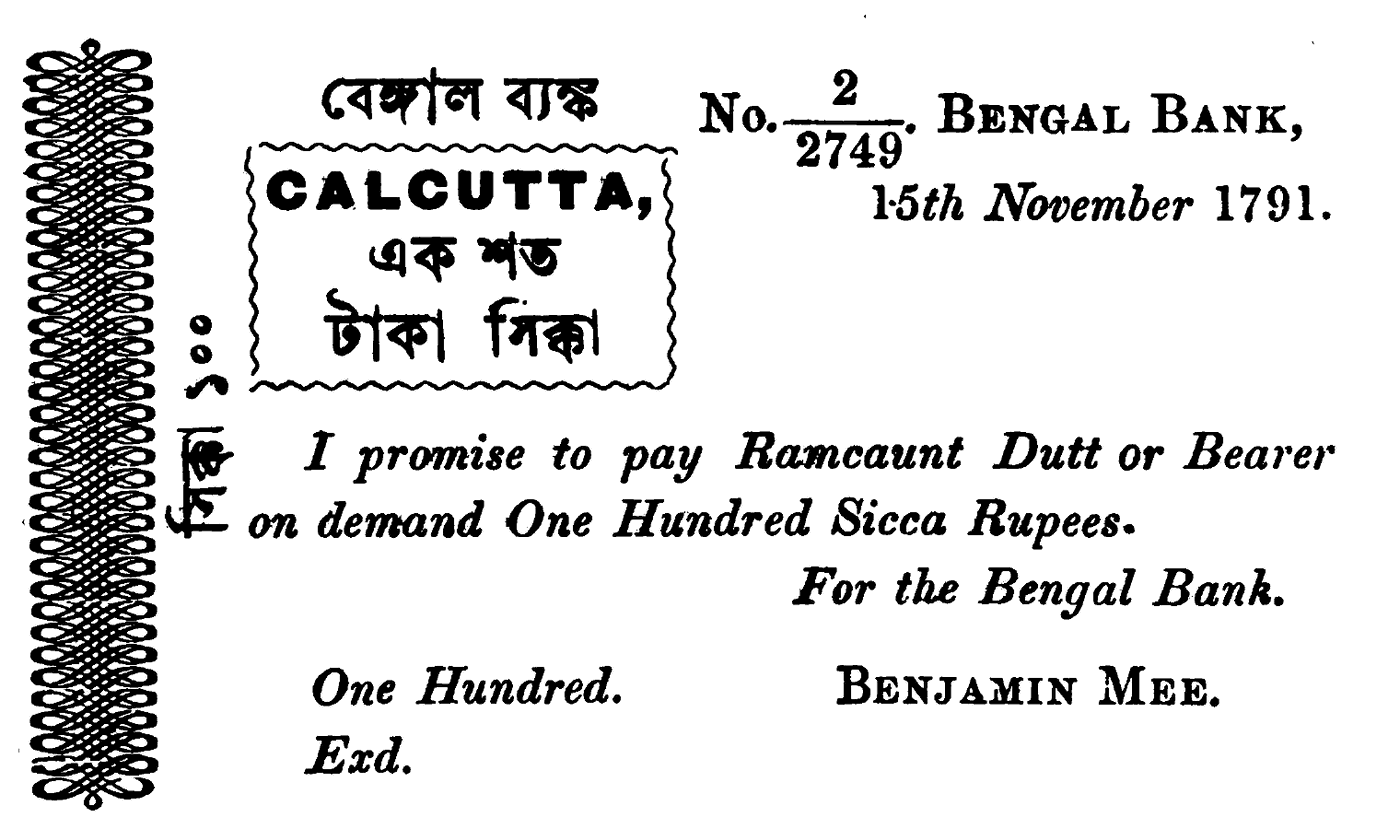
This is not the Bank of Bengal. It is an unrelated private bank of c. 1790, and Scutt is emphatic that it "had no connection whatever with the starting of the present Bank of Bengal."1 Cooke 1863, printed p. 391, cropped at 400 dpi from the Google/archive.org scan.2 Searched for exhaustively: no photograph of this note exists anywhere online, and a full-text search of archive.org for "Ramcaunt Dutt" returns zero results. Cooke's engraving appears to be the only image of it in the world.
A named payee. A named signatory. A date, a denomination, a serial number, and the exact promise-to-pay wording — for a bank almost nobody has heard of. Das Gupta, writing in 1927, noticed something else in it: the words "Sicca Rupees" indicate "that there were other kinds of rupees also current."3 Hold that thought. It will cost the Bank of Bengal an entire redesign in 1837.
A caution the catalogues get wrong
Wikipedia dates the Bengal Bank's dissolution to 31 March 1791 — seven months before the note above was written. One of the two is wrong, and the note is a primary document. Any catalogue entry rendering this piece as "Bank of Bengal, 1791" is also wrong: it is the Bengal Bank, a different institution entirely.
Chapter TwoA bank born of a war chest
The Bank of Bengal did not begin as a bank of issue. It began, in 1806, as the Bank of Calcutta — and in January 1809 it received the charter that renamed it and gave it the privilege that defines this entire article: the right to issue promissory notes payable to bearer on demand.1
Its early officers matter, because their names went onto the paper. Cooke, who worked in the building, is unusually specific:
"Mr. W. Morton, c. s., whose name appeared on all the old notes of the Bank…"
Cooke 1863, printed p. 96
W. Morton served as Secretary from January 1809 to March 1815. For nearly half a century afterwards, the Bank's notes carried a promise to pay a named individual — and for the earliest issues that individual was Morton himself. The note did not say "pay the bearer". It said, in effect, pay Mr Morton, or bearer. That formula survived until a committee killed it in 1856.
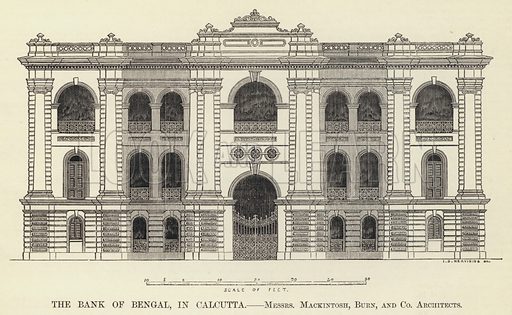
How much paper was out there? The Bank reported one aggregate number, never a breakdown by denomination. But Das Gupta prints a triennial run from 1809, and Cooke and Hübner supply landmarks. The charter capped circulation at two crores of rupees; Cooke says it "seldom exceeded one crore and sixty lacs, except on a recent occasion, when it attained an average maximum of two crores and fifty lacs."2
A bank of one city, one counter, and one signature — issuing paper for a territory the size of Europe.
Chapter ThreeWhat the paper actually said
Before the drama, the object. A Bank of Bengal note is a large piece of hand-made white paper — roughly 15 × 28 cm — carrying a watermark that reads "Bank of Bengal" in English, Bengali, Devanagari and Persian, in four lines inside an ornamented rectangle.15 On it, four languages share the space, because four communities handled the money.
The scripts are worth naming carefully, because the catalogues do not agree with each other and one of them is genuinely unusual:
- English — the promise, the denomination in words, and "For the BANK OF BENGAL".
- Bengali (Bangla) — the language of the city and its hinterland.
- Persian — still, in 1809, the language of administration and of the higher Muslim and learned Hindu classes.
- Kaithi — and this is the surprise. Not Devanagari: Kaithi, a cursive hand that was "known and used in every village in Behar by Hindus and Muhammadans alike," in the words of the Education Commission of 1884.17 It was also a money script — mahājanī, "mercantile"; sarrāfī, "banker". The Bank put the value in the hand that Indian bankers actually wrote in.
Why four languages? The Government wrote the rule down — for the next currency
Nobody recorded the Bank of Bengal's reasoning. But in 1860, on the eve of the Government taking over the note issue, Capt. Thornton published an official explanation of the coming State currency for Indian readers, and it states the design rule outright:
"The Notes will be in the English language, but the amount of Rupees will be expressed in the Hindoostanee language, which is more or less known all over India, and also in the Vernacular dialect of the districts of the circle in which the Note is issued."
Thornton, Exposition of the New Indian Paper Currency, Calcutta: Home Secretariat, 1860, ¶518
A lingua franca everywhere, plus the local vernacular. It is the closest thing to a published rationale that exists for Indian banknote languages — and the Bank of Bengal's panels follow the same logic a half-century early.
One honest caveat. The Reserve Bank of India describes the Bank of Bengal obverse as carrying "Urdu, Bengali and Nagri" — not Kaithi.19 The Kaithi identification comes from the numismatic catalogues. Both cannot be right, and it is worth saying so.
Chapter FourThe forgers of Calcutta
Here is the technique, described in the Bengal Hurkaru of 18 March 1824 and reprinted in the Asiatic Journal. Read it slowly; it is a masterclass.
"One of them, originally genuine, for ten rupees they contrived to circulate for one hundred, by cutting out the former amount which is in german text and substituting the latter; they then in a similar manner changed the Persian and Bengallee characters, and afterwards tore the note and put it together again, by pasting pieces of paper on the back, taking care that the pieces on the back covered the amount they introduced."
Bengal Hurkaru, 18 March 1824, via the Asiatic Journal6
They did not counterfeit a note. They promoted one — surgically excising the value in all three scripts and substituting a bigger one, then deliberately tearing and repairing the paper so the patch had an innocent explanation. A ten-rupee note walked into a shop as a hundred.
It was not an isolated trick. The record, assembled from the Calcutta press of the period:
| Date | What happened |
|---|---|
| India Gazette 7 Dec 1818 | A forgery "to the amount of 500 sicca rupees" — and the forged note was paid into the Bank of Hindostan. Two rival banks' notes circulating interchangeably.6 |
| 1824 | Forgeries on both the Bank of Hindostan and the Bank of Bengal, Rs 100–1,000. Method: the gang "bring over one of the compositors of the government press… who, duly instructed, stole a quantity of types."6 |
| Oriental Observer 11 Mar 1827 | Eighteen arrested. "altering notes of five rupees to 500, one gold mohur to 1,000… principally on the bank of Bengal and Calcutta bank."6 |
| 1834 | Seized: "altered notes of the India Bank (made to resemble Bank of Bengal notes)" together with "a complete set of graving and engine-turning tools." A dead bank's notes, recycled into a living one's.6 |
| Sep–Nov 1837 | Government orders collectors to endorse every Bank of Bengal note. J. A. Dorin — the Bank's own treasurer — objects that it "uselessly spoil[s] the notes" and makes Government liable for forged paper.6 |
| May 1840 | "Vast numbers of forged Bank of Bengal notes are in circulation."6 |
And the Bank's own defences? In 1811 there is a file at the British Library still titled "Papers regarding forgeries of Bank of Bengal notes" that nobody has ever quoted.16 By 1829, under oath in a Calcutta courtroom, a witness let slip what the Bank had not been doing:
"Prior to this the bank of Bengal used not to send notes to be examined; but on witness's return to the office, he found they did so, and paid him 100 rupees per month for the examination."
Supreme Court evidence, Calcutta, 1829 — Asiatic Journal N.S. Vol. 2 (1830)6
Until October 1829, nobody checked. After that, one clerk, privately paid, a hundred rupees a month.
Chapter FiveThe man who hid a lakh in a wall
Every retelling of this story on the internet gets it wrong, so let us be exact. Rajkissore Dutt did not forge Bank of Bengal notes. He forged East India Company government promissory notes — "Company's Paper" — and pledged them as collateral for cash loans. The Bank of Bengal was the lender left holding worthless paper.6
The indictment, verbatim: "having forged a government promissory note, No. 588 of 9495 of 1825-26, for 10,000 rupees, and having uttered the same to Mr. E. Macnaghten on the 23d June 1829."6
He founded a bank to do it. The Advocate-General told the court that the India Bank was established "not for commercial speculations, but for the purpose of facilitating the putting away of false Company's paper as security for loans raised… Presses and types were purchased." The printing was done "on Sundays or such days as offices were shut." A man named Bistochunder wrote the Persian, Bengalee and Nagree.6
The trial, in the order it happened
- 18 December 1829 — a first grand jury returns "not a true bill for forgery" against Dutt, on both bills.
- 26 December 1829 — true bills found.
- 30 December 1829 — tried. His counsel peremptorily challenges fifteen jurymen. The jury is out twenty minutes and returns a verdict of "guilty of uttering the paper, knowing it to be forged" — uttering, not forging.
- Chief Justice Ryan, on the twenty-four counts: "If any part of the instrument be forged, the law considers the whole to be a forgery."
- January 1830 — his associate Raja Buddinath Roy is acquitted: "We do not think Dwarkenauth Mitter's evidence by itself sufficient to convict." Dwarkanath Mitter is pardoned by proclamation as approver.
All quotations: Supreme Court reports, Asiatic Journal N.S. Vol. 2 (May–Aug 1830)6
The money, correctly. The famous "loan of three and a half lakhs" is not a loan. It is the write-off, and the Bank recorded it in its own half-yearly statement after losing on appeal — to the Privy Council, not to the Court of Directors as is usually claimed:
"Sa. Rs. 3,50,000… have been considered bad, in consequence of the decision by the Privy Council… in the case of the forgeries of Rajkissore Dutt."
Bank of Bengal half-yearly statement, Asiatic Journal, Jan–Apr 18356
The same statement contains a line that ought to be famous. The directors "carried to credit, under profit and loss, Sa. Rs. 50,000, on account of old bank notes outstanding for more than fifteen years." Fifty thousand rupees of notes that were never presented — lost, burnt, buried, forgotten — booked as profit.
And Dutt? Transported for life. To Penang — not the Andamans. Five years later the Penang Gazette, via the Bengal Hurkaru of 1 December 1834, reported him "enacting the gentleman in his carriage, and the merchant in his dealings, without let or hindrance," writing home to congratulate himself on "the comfort and liberty he enjoys," having produced "a certificate of ill health, declaring that he could not endure confinement." The paper's verdict: "Transportation to Penang is a farce."6
The best detail comes last, and it comes from his own son. Writing in 1881, Shib Chunder Bose recorded that Dutt
"concealed in a wall of one of the rooms of his house Bank notes for upwards of a Lakh of Rupees. When the search of the Police was over he opened the part of the wall and to his utter disappointment found all the notes crumbled to pieces, and become a small bundle of rotten paper of no earthly use to any one."
Shib Chunder Bose, The Hindoos as They Are (1881), pp. 141–427
Chapter SixThe night the money changed its name
In 1835 the Government of India reformed the coinage. The sicca rupee — 173 grains of silver, the coin the Bank had promised to pay since 1809 — gave way to the Company's rupee. Every note in circulation now promised a currency that no longer existed.
The Bank's answer, on 6 July 1837, was not to redraw the note. It was to rewrite it: the promise text changed from "Sicca Rupees" to "Company's Rupees", and in the same act the Bank reduced the note from two signatures to one.
You can see the changeover in the auction record with almost indecent clarity. Across 150 catalogued Bank of Bengal notes in our own database, the word "Sicca" appears in 38 descriptions of Type 6 and in none at all of the Britannia issue; "Company Rupees" appears in seven Type 7 descriptions and in none earlier. And Todywalla's cataloguer, describing a 100-rupee note of 10 January 1842, spells out the physical change: "Denomination changed to read Company Rupees in Devanagari, English and Bengali scripts on the reverse."
The plate ledgers agree — and correct a popular story
The Royal Philatelic Society London holds the surviving records of the firm that cut the Bank's plates. Its Engraving Books show a concentrated campaign of re-cutting the "native character" panels in September–December 1836 — exactly between the coinage reform and the Bank's resolution.
Those entries have been read elsewhere as 1834, and used to argue that the Bank was responding to the forgery gang caught that year. The manuscript pages say otherwise: PB136022 p. 110 is headed 1836 and dated 29 September – 6 October 1836; p. 118 is 19–28 November 1836. It is one 1836 event, and it is about currency, not forgery.13
Chapter SevenLondon: the men who cut the plates
Who printed India's first banknotes? For a long time the answer was a shrug and the word "England". It is now answerable to the week, because two independent records survive — and, remarkably, because the notes themselves say so.
Turn over a Bank of Bengal note of the 1820s and you find, in an ornamental panel, a Gothic legend and an imprint. CNG's cataloguer transcribes it:
"BENGAL BANK Gothic and Printed by Perkins & Heath, London in top oval and type of Plate in lower oval within an ornamental panel."
CNG, on the 10 Sicca Rupees of 2 December 1824 (J&R 1A.3.3.1) — and two companion lots
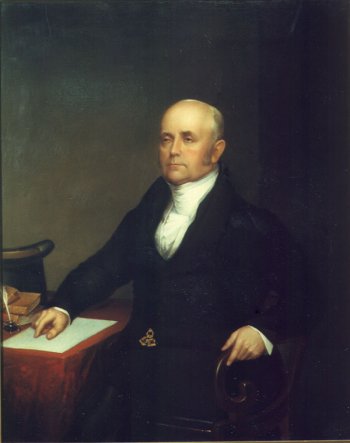
The firm's name is a dating tool in itself. The sequence runs Perkins, Fairman & Heath (Dec 1819) → Perkins & Heath → Perkins & Bacon → Perkins, Bacon & Petch (1834) → Perkins Bacon & Co. (1852).12 So an imprint reading "Perkins & Heath" belongs to the 1820s — and any website attributing a pre-1834 Bank of Bengal note to "Perkins, Bacon & Petch" is wrong, because Petch had not yet joined.
The plate ledgers: India, engraved by the week
The Royal Philatelic Society London holds 17 Engraving Books, 1828–1935, keyword-indexed page by page, with the page images free to view. Book PB136021 is a dated day-by-day log of plates being cut. In the summer of 1830 it reads:13
July 26 — Engrav[in]g … Bank of Bengal. Fifty / 27 — Do. Twenty · Do. Twenty five / July 29 — Engrav[in]g Bank of Bengal. 100 R[upee]s / Aug 6 — Do. 250 R[upee]s / 11 — Engrav[in]g Bank of Bengal 1000 · Do. 500
Perkins Bacon Engraving Book PB136021, p. 27 — 23 July to 13 August 1830
Three weeks; the whole denomination ladder. Earlier pages record "2nd centre die Bank of Bengal" and "Denomination dies Bank of Bengal" (27 April – 13 May 1830), and — for the Bank's rivals — "Water Mark for Hindostan Notes" and "Water marks of the Union Bank notes (numerals)". The same books contain "Bank of Hindostan Native Characters": the multilingual panels of Indian notes were being cut in Fleet Street.
And the firm's own ledgers, transcribed in 1913, record its earliest Indian work — not for the Bank of Bengal: "about April, 1820, a number of plates were made for the Commercial Bank of Calcutta."12
Then, in 1857, the Bank went somewhere else entirely. The Britannia notes carry a different imprint: "Engraver W. H. Lizars, Edinburgh."14 William Home Lizars (1788–1859) was Edinburgh's leading engraver, known for maps, natural-history plates and banknotes for Scottish banks. He died weeks before the latest recorded Bank of Bengal note date of 12 April 1859.
Why the Bank crossed to Edinburgh, nobody has written down. It was not for want of the incumbent: Perkins Bacon was still cutting Bengal note fronts in December 1856 and an unadopted Bank of Bombay design in 1857. The switch was a choice, and it remains one of the genuine unsolved questions in Indian paper money.
Chapter EightMay 1856: the room where it changed
Almost nothing in this story has a documented motive. The Bank's own centenary historian explains why, in his Preface:
"In dealing with the incidents of the Bank's History, comment… has been almost entirely refrained from, and the reader is left to form such opinion as he may from the bare record of events."
Symes Scutt, The History of the Bank of Bengal (1904), Preface1
True to his word, Scutt disposes of the greatest redesign in the Bank's history in nine words, in his annal for the year:
"A new form of Bank Note was adopted in this year."
Scutt 1904, printed p. 54
No reason. No engraver. No mention of colour. But the reason survives elsewhere. Amiya Kumar Bagchi, working from the Bank's own minute books for The Evolution of the State Bank of India, records a committee of May 1856 that resolved on a new note — in the phrase that unlocks this whole chapter — "so as to minimize the risk of forgery."5
One meeting, four changes
The May 1856 committee did not just commission a picture. In a single decision it:
- replaced Commerce with Britannia;
- abolished the named-payee formula — the "pay Mr Morton" wording that had run since 1809 — in favour of "Promise to pay the Bearer";
- dropped the word "Company's" from the denomination;
- and abolished the Rs 15, Rs 20 and Rs 250 denominations.
Four of the changes visible on the 1857 notes, decided in one room, for one stated reason.
And the colour? The Britannia notes are the Bank's first coloured issue, printed in blue and black. In the very same month — 9 May 1856 — Henry Bradbury told the Royal Institution in London what colour was for:
"In cases where the engraving on a note… is exposed to the reproductive powers of these processes, the Anastatic or the Photographic… then the antidote (at least, that in common use) consists in the adoption of printing in different colours."
Henry Bradbury, On the Security and Manufacture of Bank Notes (1856), p. 258
Bradbury's footnote quotes the photographer Antoine Claudet on which colour: "red, orange, yellow, and green, produce black; while blue, indigo, and violet, produce white." Blue was the colour a camera could not see. The Bank of Bengal printed its new reverses in blue.
The delicious part: Bradbury himself disagreed. On the same page — "My own opinion as to the desirability of adopting printing in colours for Bank Note work is rather to avoid it… Fine-Art with admirable execution possesses far higher elements of security than any combination of colour can confer upon Art." Britain's leading authority on banknote security argued against colour, and Calcutta adopted it anyway. The Reserve Bank of India's own museum states the outcome plainly: the Britannia note "had intricate patterns and multiple colours to deter forgeries."19
Chapter Nine1857 — and why Britannia is not about the Mutiny
It is the most attractive story in Indian paper money, and it is false.
Here is the temptation: in 1857 the Bank of Bengal replaces a mild commercial allegory with Britannia and her lion — imperial, martial, unmistakable — on notes dated 31 August 1857, 17 November 1857, 12 April 1859. The Uprising begins at Meerut on 10 May 1857. The inference writes itself: the Empire, shaken, stamps its authority on the money.
The dates refuse it. The committee resolved in May 1856. The plates were being drawn by December 1856. The Uprising began in May 1857 — a full year later.
The design was on paper before the first cartridge was bitten. Whatever Britannia means on these notes, she is not a response to the Mutiny. Say so in print, because almost nobody does.
What is suggestive — offered as inference, not fact
Two presidency banks moved to overtly royal or imperial imagery in the same year, 1857, through two different engravers: Britannia at Bengal (Lizars of Edinburgh), and an unadopted Rs 1,000 with Royal Armorial Bearings at Bombay (Perkins Bacon — the proof survives in the British Library's Philatelic Collections as Philatelic 26/1/9/2).16 That pattern argues the impulse sat in the Calcutta and Bombay boardrooms, not in any engraver's shop. It is a pattern, not a proof.
Chapter TenThe one branch that failed, and what it cost
Here is the hinge of the whole story, and it turns on a single upcountry town.
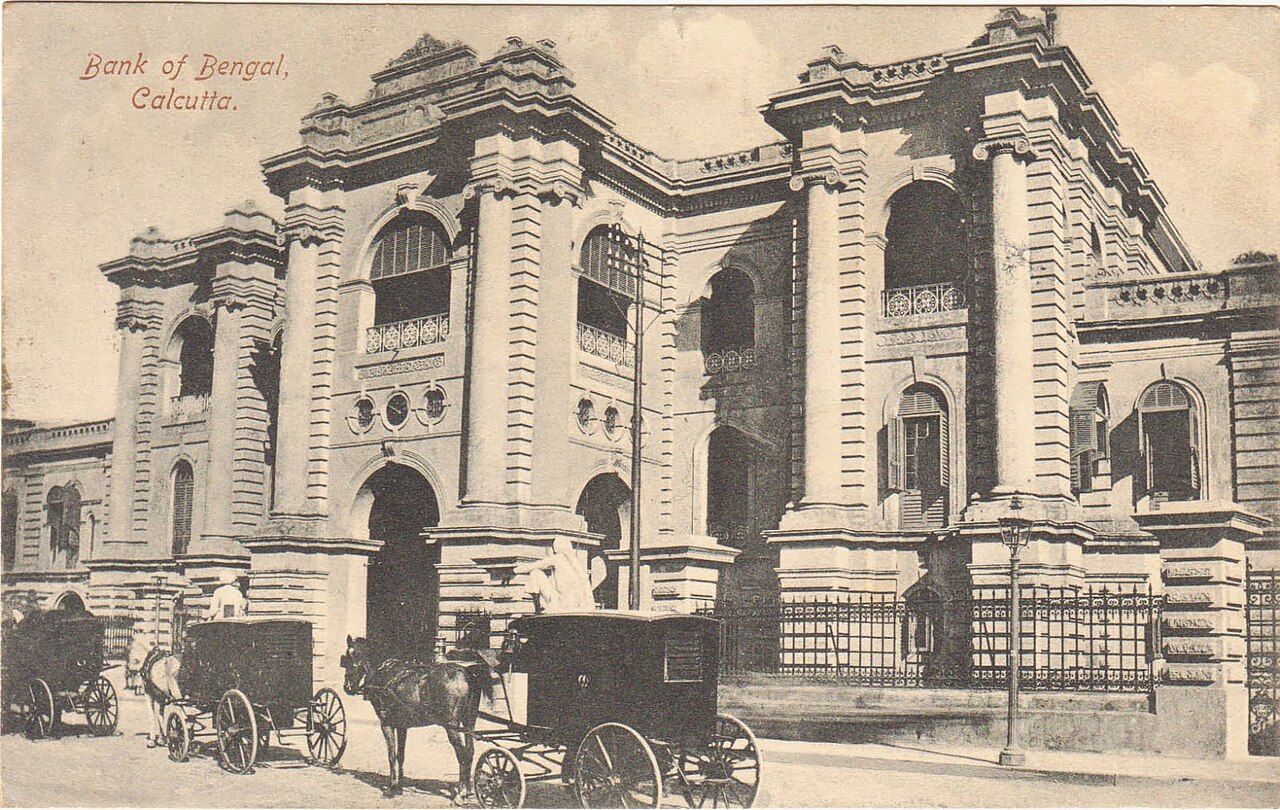
The Bank of Bengal's notes were a Calcutta instrument. Every one of roughly 120 catalogued notes gives the place as Calcutta and nothing else. Brunyate, writing an official memorandum in 1900, confirmed that branch-payable notes were never issued. The Bank had the exclusive right to print India's paper money — and it printed money that was really only good in one city.
It is not that leaving Calcutta never occurred to the Bank. It occurred to it once, twenty years before Mirzapore, and for the wrong reason. When Bombay merchants set about founding a bank of their own in the late 1830s, James Douglas — Sheriff of Bombay, writing in 1899 from the city's newspaper files — compressed the four-year fight into one sentence: "how the great houses of agency frowned upon it; how the Bank of Bengal, strong in the right of primogeniture (1806), viewed its establishment with hostility and threatened to open in Bombay; how the Bengal Government took the same views and imparted them to the Bombay Government; how our Chamber of Commerce remonstrated."29 The threat was competitive, not monetary: a Bombay branch as a weapon against a second bank of issue, floated in a lobbying campaign that failed and never acted on afterwards. The Bank of Bombay opened in April 1840. No Bank of Bengal branch followed it. Twenty years later the Government would take the note issue away precisely because the branches had never been built — and the one place the Bank had once said it would go was the one place a rival went instead.
It tried, once. An agency was opened at Mirzapore. It did not work. And in March 1860, that failure became the argument for taking the note issue away from the Bank altogether.
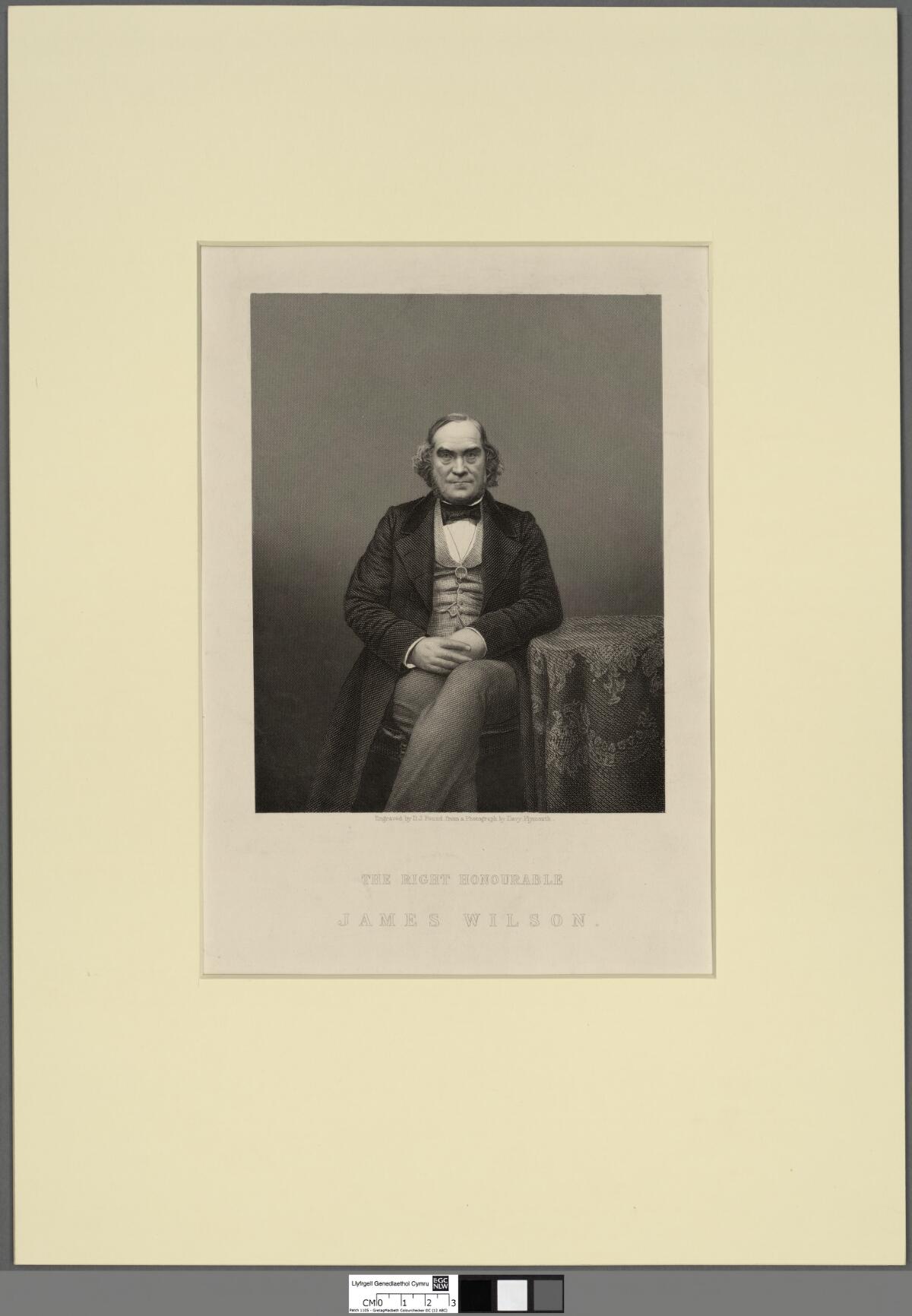
Wilson's Minute, printed as House of Commons paper HC 1860 (183) on 28 March 1860, argues the entire case for a State paper currency from the Bank of Bengal's own record. He notes that Government notes would be received at district treasuries "as is now done in Bengal in respect to Bank of Bengal notes," and that the reserve "would never (judging from results in the Bank of Bengal) be likely to be in excess of ⅓ of the total issues." And then, decisively:
"The question has several times been considered by the directors of the Bank of Bengal, and on one occasion an agency was actually established at Mirzapoor. But it was not found to answer… the only chance of ensuring an immediate extension of paper currency seems to be by the issue of notes on the part of Government."
James Wilson's Minute, HC 1860 (183)9
Read that again. The Bank lost the printing press because it would not open branches. It had a monopoly on Indian paper money and used it to serve one city, and a Government that wanted paper in every district concluded that the only way to get it was to do the job itself.
Chapter ElevenAct XIX of 1861: the last day
The mechanism had been sitting in the Bank's charter all along. Act VI of 1839, section XXXI — the clause that gave the Bank its privilege — reads:
"XXXI. … the said Bank of Bengal may issue Promissory Notes, payable either on demand or at a date not exceeding thirty days after sight… provided always that the total amount of such Notes in circulation at any one time shall not exceed two crores of Rupees, and provided also that no such Note shall be for a smaller amount than ten Rupees."
Act VI of 1839, §XXXI10
Three things hiding in one clause
- The ten-rupee floor is the Bank's, not the State's. Act XIX of 1861 simply carried the Rs 10 minimum across to the Government note. The smallest legal Indian banknote for generations afterwards was a rule a Calcutta bank wrote into its own charter in 1839.
- The two-crore ceiling is statutory, which is why Cooke's remark that circulation once "attained an average maximum of two crores and fifty lacs" describes a breach — legalised retrospectively by a temporary Act, with the Bank paying Government a five per cent commission on the excess.2
- "Thirty days after sight" means a Bank of Bengal promissory note could lawfully be a time instrument. Section XXV.7 of the same Act authorises "the issuing and circulating of Cash Notes and Bank Post Bills" — a whole class of paper the books barely mention. Two specimens are known: one stamped DUPLICATE with "Specimen" written twice on the front (Dix Noonan Webb, 30 April 2009, lot 722), and an unissued sola post bill that sold at Noonans in May 2025 for a hammer price of £60 — the cheapest Bank of Bengal object on record, because the market files it as a "bill" rather than a "note".11
Act XIX of 1861 received assent on 16 July 1861. Act IV of 1862 — the Bank's new charter — received assent on 28 February 1862, repealed Act VI of 1839 outright, and re-enacted no note-issue power at all. The repeal ran "from and after the first day of March 1862."
So the Bank of Bengal's last day as an issuer of money was 28 February 1862 — the very day it received the charter that took the right away.
And then comes the twist that no novelist would dare invent. On 1 March 1862 — the first day of the Government's paper currency — the Bank of Bengal opened branches at Mirzapore, Benares, Patna and Dacca, arranged with Government and enumerated in the Parliamentary papers.9
The branches it would not build to circulate its own notes, it built in a single day to distribute somebody else's.
The other banks that did not make it
The Bank of Bengal survived. Its rivals mostly did not, and their failures are the backdrop to 1861.
- Bank of Hindostan (c. 1770–1832, revived, failed again c. 1866). Its notes circulated alongside the Bank of Bengal's — the 1818 forgery was paid into it. Today its unissued notes are more valuable than any Bank of Bengal note: a 16 Sicca Rupees made ₹15,00,000 at CNG in 2019.
- Commercial Bank of Calcutta (1819–1828, merged into the Union Bank). Perkins & Heath cut its plates in April 1820 — its earliest Indian work. A front proof of its 5 Sicca Rupees, graded PMG 63 EPQ, sold at Stack's Bowers in 2023.
- Union Bank, Calcutta (1828/29–1847/48). Perkins cut its complete plate set — 8 to 1,000 rupees — plus numeral watermarks, in 1830. No photographed survivor is known. The engraving ledger is the only evidence its notes existed.
- The India Bank — Rajkissore Dutt's own creation, dead by 1829, whose leftover notes were being altered to resemble Bank of Bengal notes as late as 1834.
By 1861, of the ten Indian banks that had ever issued notes, the three Presidency banks had the field so completely that when the issue was nationalised, no compensation was even proposed to the others.3
Chapter TwelveThe ten designs, in order
Here is the whole fifty-five years as objects. Ten designs; every image below is a note we hold, photographed by the saleroom that sold it. All quoted descriptions are the cataloguers' own words, not ours — where houses disagree, both readings are given. The line marked the tell is the one feature that separates each design from its neighbours.
Read them in sequence and you watch a document evolve: a blank-backed legal form acquires a picture, then a printed back, then its value on that back, then a new currency name, then typeset serials, then printed dates, then colour — and finally an empire.
Design 1 — The blank back J&R 1A.3.1
It begins with almost nothing. A large sheet of hand-made paper, printed on one side, carrying four languages, a promise, and two signatures. No portrait, no allegory, no picture of any kind — the most valuable object most Calcutta merchants would ever hold, and it looks like a legal form.
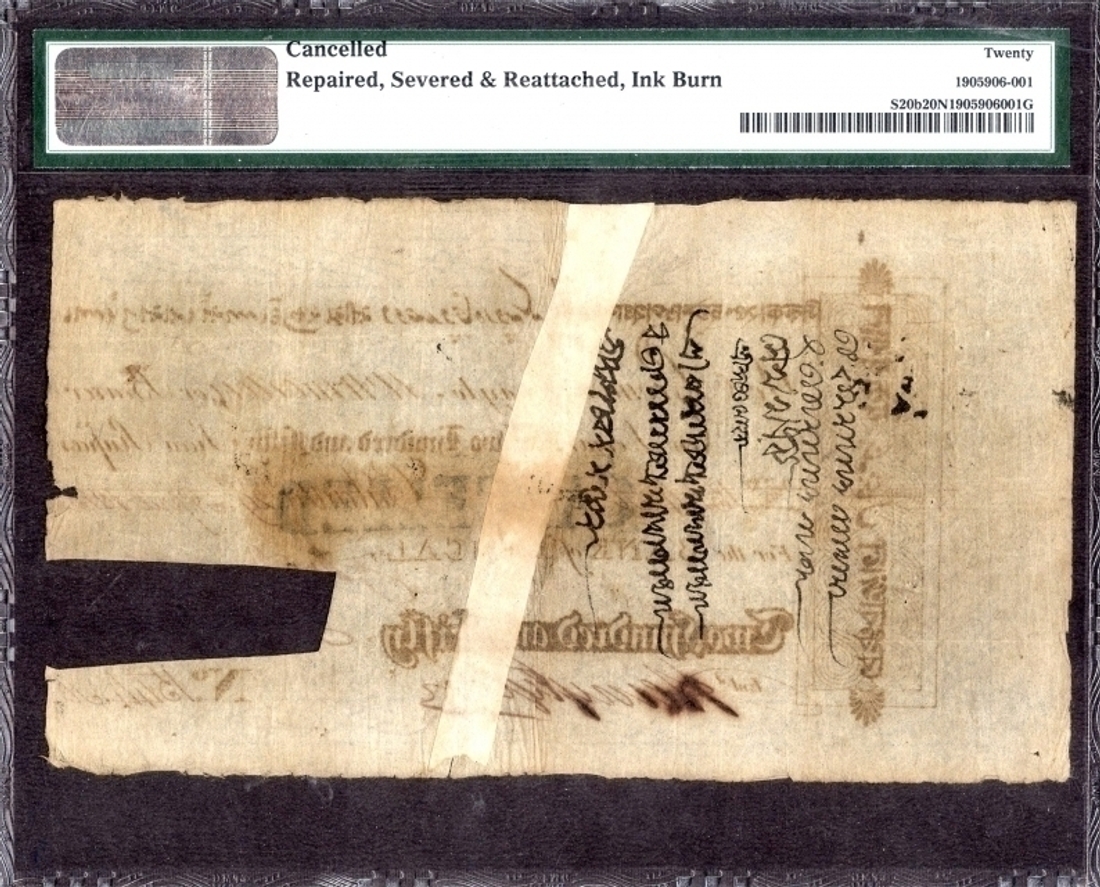
- Denomination
- 250 Sicca Rupees — a colossal sum, and the only value we hold in this design.
- Obverse
- “Bank of Bengal written in ornamented panel on the left in Bangla, Persian and Hindi… denomination in numerals and words in Bangla, Persian and Kaithi above promise text, TWO HUNDRED AND FIFTY in denomination panel on the lower-left”
- Reverse
- “uniface and ink annotation”. Another cataloguer, more bluntly: “Rev: Blank”.
- Vignette
- None whatsoever. No picture, no allegory. Ornament and type.
- The tell
- A blank back and no image. Nothing else in the whole series looks like this.
- Survival
- 22 graded by PMG — the largest surviving population of any Bank of Bengal type, and the only one to reach PMG 40.
Design 2 — Gold mohur money J&R 1A.3.2
The Bank widens its range without touching the design. And the new values tell you how these notes were used: not as round banking amounts but as coin equivalents. Sixteen sicca rupees is one gold mohur. You were not carrying an abstraction; you were carrying a coin you did not have to weigh.
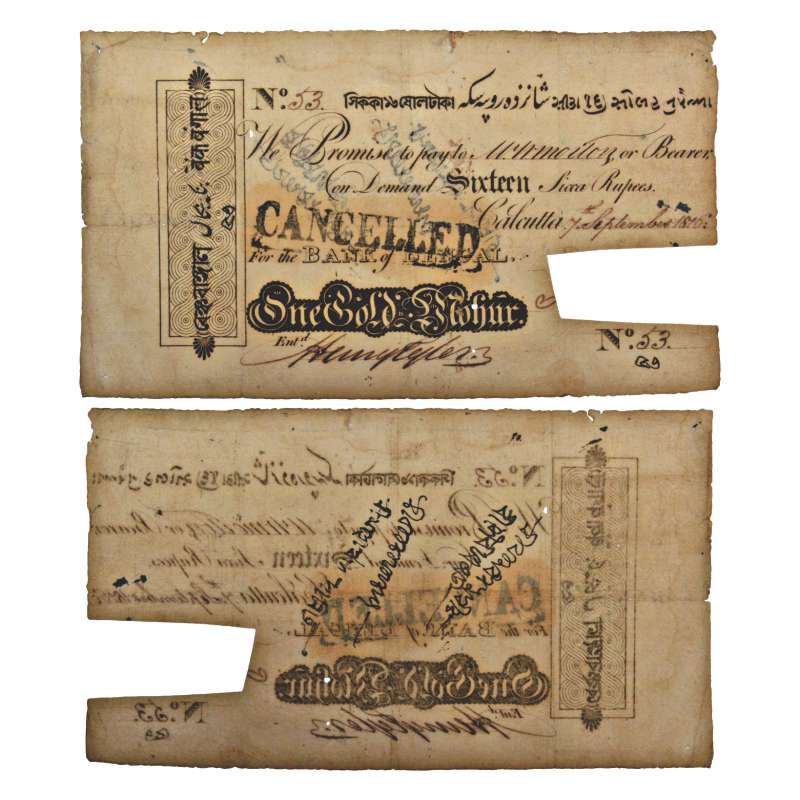
- Denominations
- 1 Gold Mohur (16 Sicca Rupees) and 500 Sicca Rupees.
- Obverse
- Identical in layout to Design 1 — “ONE GOLD MOHUR in denomination panel in lower left”.
- Reverse
- Still blank.
- The tell
- Not a redesign at all: a denomination extension. Rs 16 is the gold mohur, a coin-equivalent value — the note is worth exactly one gold coin.
- Survival
- Rs 16: five graded. Rs 500: one, at PMG 30.
Design 3 — Commerce arrives — and so does a printed back J&R 1A.3.3
Two changes land at once, and they change what a banknote is. First: a picture. Commerce — a seated allegorical figure surrounded by merchandise — takes the centre. Second, and stranger: the back gets printed for the first time. But it does not carry the value. It carries the printer's imprint. Before the Bank of Bengal thought to print what a note was worth on its reverse, it printed who made it.
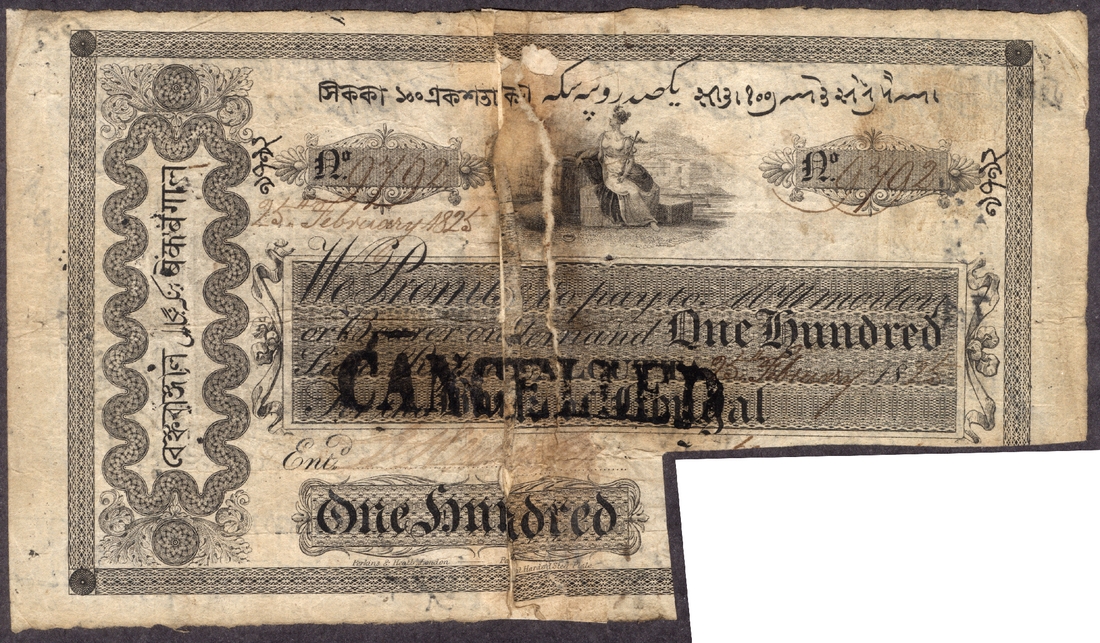
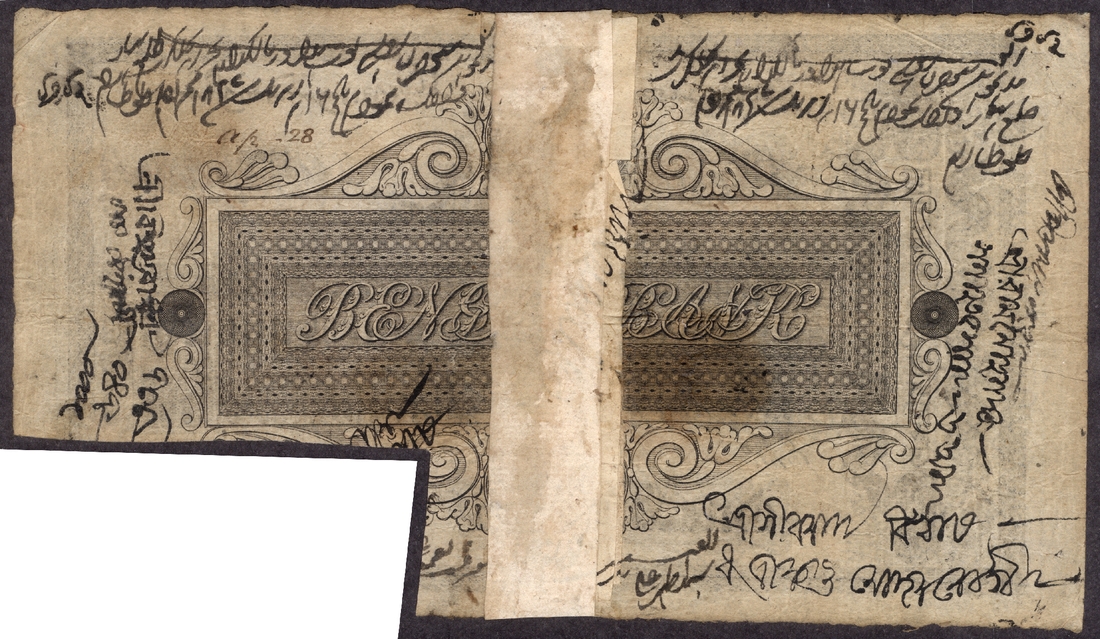
- Denominations
- 10 · 16 · 100 · 500 Sicca.
- Obverse
- “the personification of ‘Commerce’ sitting on articles of merchandise in the center” — a seated allegorical woman amid bales and cargo.
- Reverse
- “legend ‘BENGAL BANK’ in gothic style and name of the printer on the top oval and type of plate in the lower oval within an ornamental panel”. On the 10 Sicca of 2 Dec 1824 it is spelled out: “Printed by Perkins & Heath, London”.
- The tell
- The Gothic imprint back. It appears in exactly seven lot descriptions in our whole corpus, all in Designs 3–4, and nowhere else.
- Caution
- ⚠ Our two best examples of Designs 3 and 4 turn out to be the same physical note, serial 9792, catalogued twice under different type numbers. One of those tags is wrong.
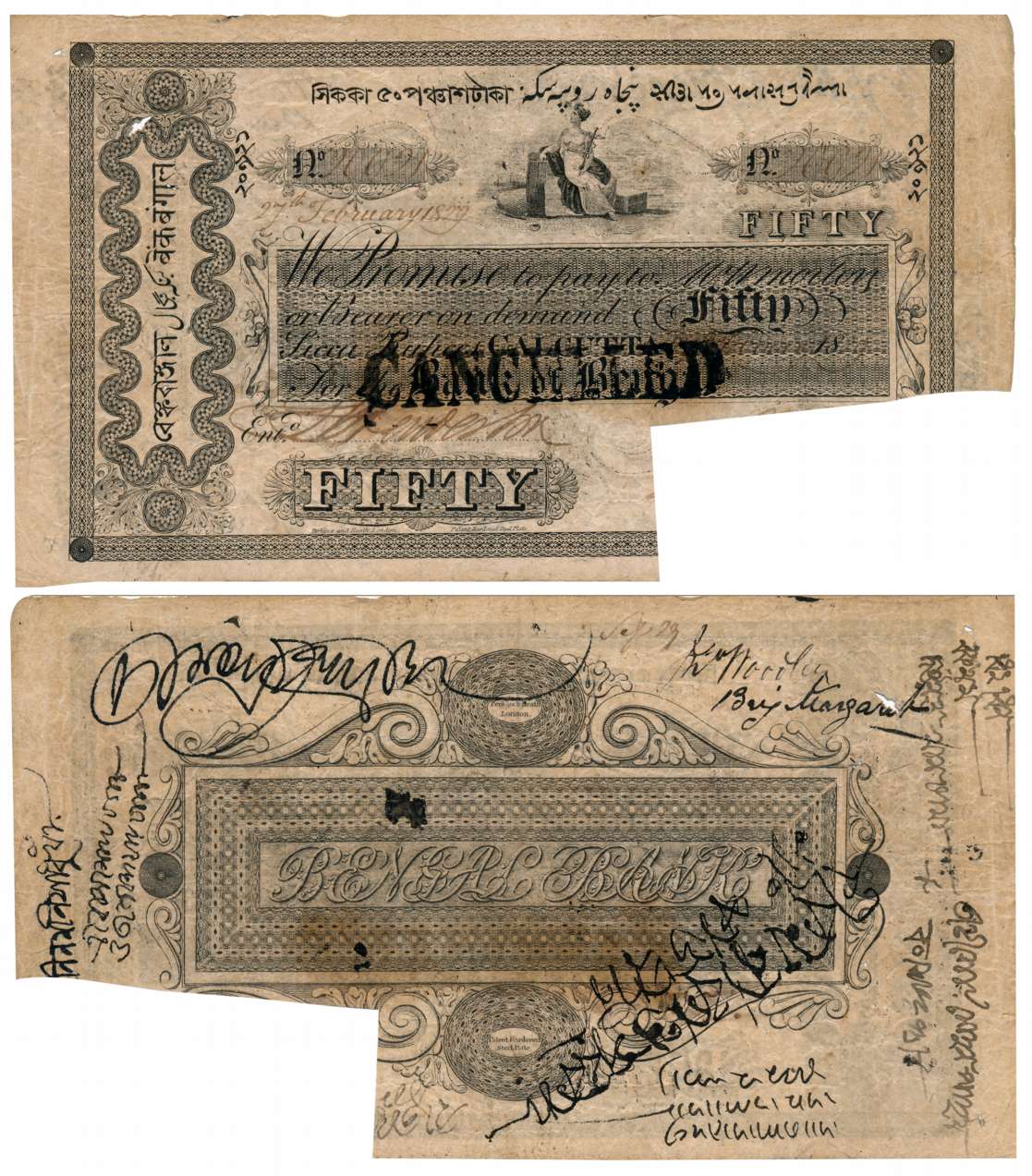
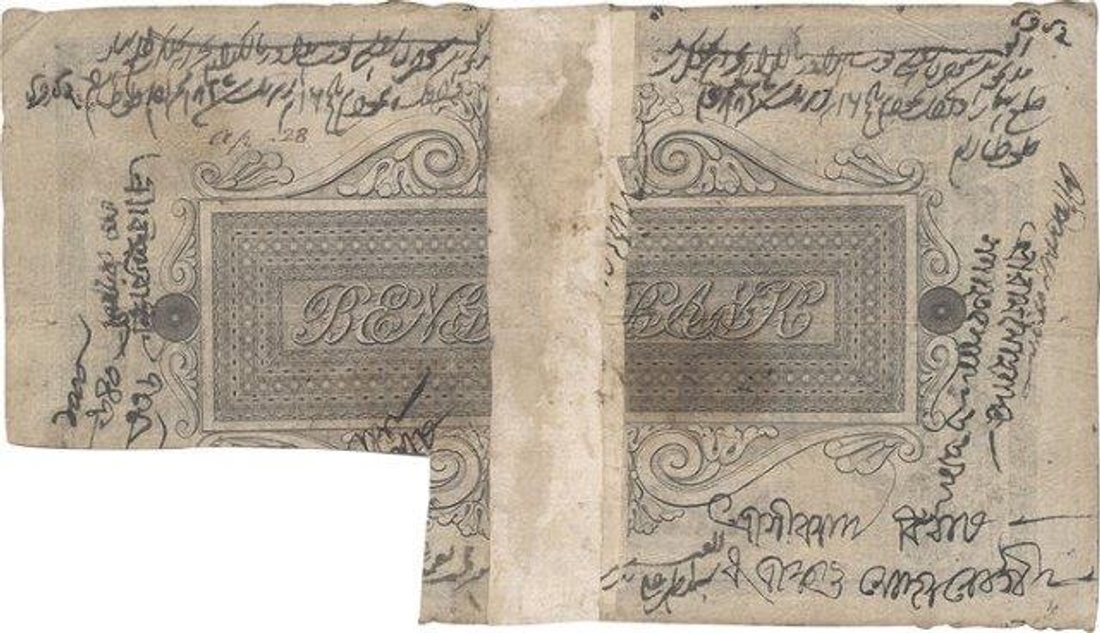
Design 4 — The value crosses to the back — in the vernaculars first J&R 1A.3.4
A small change with a large implication. The denomination migrates onto the reverse — and it goes there in Bangla, Hindi and Persian, sharing the panel with the printer's imprint. Whoever the back of the note was for, it was not primarily the English reader.
- Denominations
- 10 · 50 · 100 Sicca.
- Obverse
- “Personified ‘Commerce’ sitting on articles of Merchandise in centre above the denomination panel. Value in Bengali, Persian & Kaithi above it in words & numerals”
- Reverse
- Gothic imprint plus “denomination written in Bangla, Hindi and Persian scripts”.
- The tell
- The value has arrived on the back — but only in the Indian languages. English does not take the centre of the reverse for another design yet.
- Survival
- Rs 50: two graded, at PMG 4 and 10. Among the worst-surviving notes in the entire series.
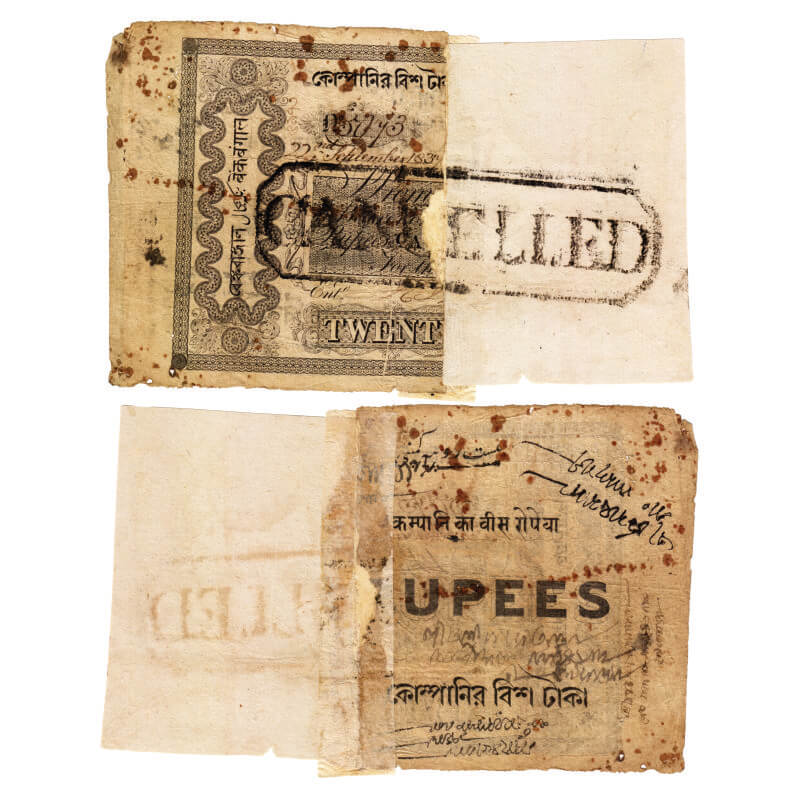
Design 5 — Company ka vees rupeya J&R 1A.3.5
A curiosity, and a linguistically fascinating one. The reverse abandons translation for transliteration: the note does not say “twenty rupees” in Hindi, it says Company ka vees rupeya — the English commercial phrase, spelled phonetically in Devanagari and Bengali. This is how the money was actually spoken about in the bazaar.
- Denomination
- 20 Rupees.
- Obverse
- “Hand written serial number in English placed on top left No 3973, TWENT(Y), Half plain paper stuck overstamped CANCELLED”
- Reverse
- “COMPANY KA VEES RUPEYA in hindi, (TWENTY R)UPEES & Company Vees Taka in bengali script”
- The tell
- A value reverse that is transliterated, not translated — Company ka vees rupeya, Company vees taka. The English words are simply written out in Indian scripts.
- Caution
- ⚠ One record. Three further Rs 20 notes in our corpus sit with their type unresolved and may belong here.
Design 6 — The long reign J&R 1A.3.6
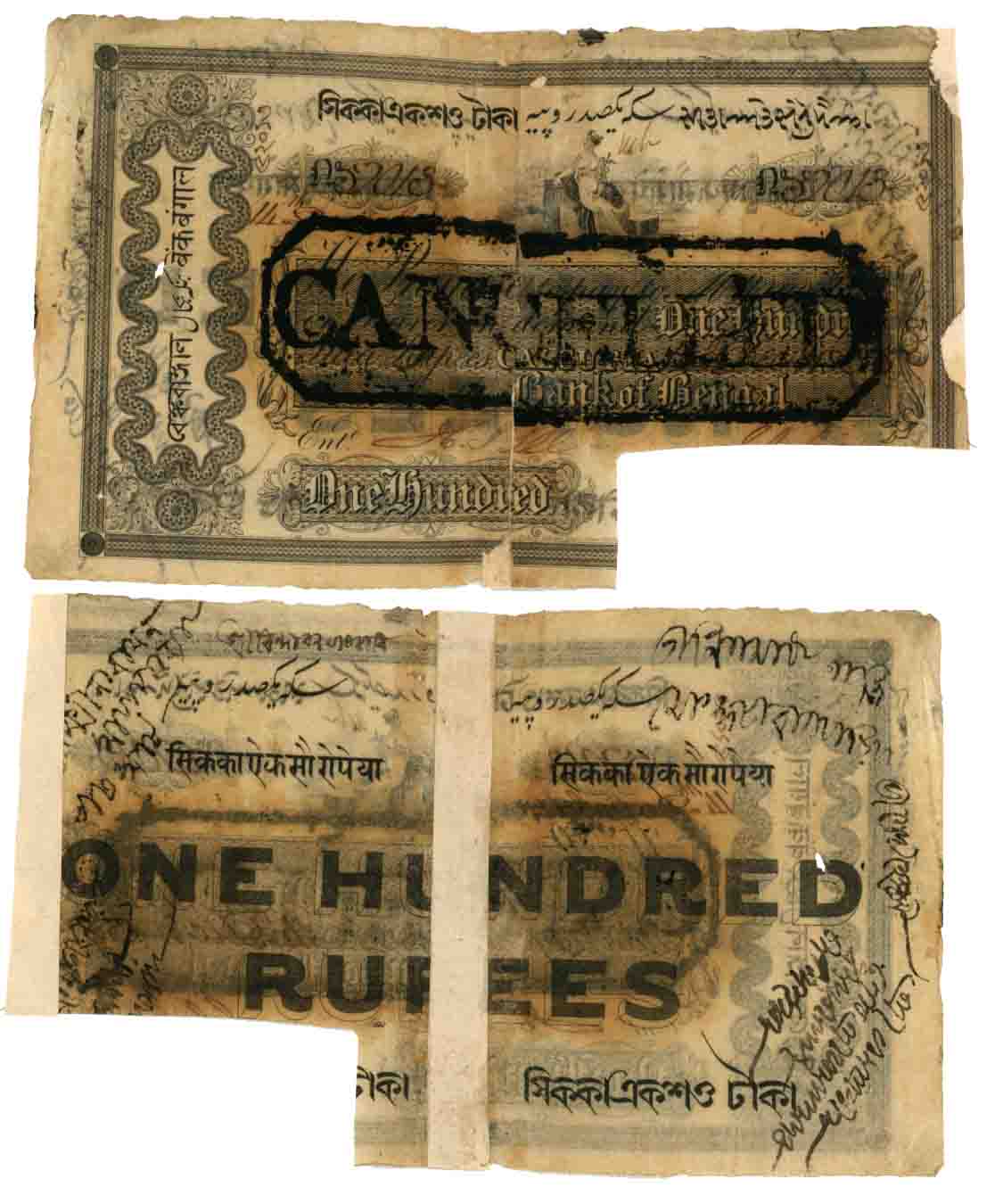
The design that is the Bank of Bengal. The reverse finally becomes what a modern eye expects — the value, large, in English, flanked by the vernaculars. Watch one small detail in the obverse description: “manuscript date with printed year”. The year is now set in type while the day is still written by hand. It is the first crack in the hand-made note, and over the next three designs that crack widens until almost nothing is left of the clerk's pen.
- Denominations
- 10 · 20 · 25 · 50 · 100 · 1000 Sicca — the widest range of any design.
- Obverse
- “‘Bank Of Bengal’ in ornamented panel on the left in Bangla, Persian and Hindi… Manuscript serial number on either side, manuscript date with printed year… Denomination in numerals and words in Bangla, Persian and Kaithi above vignette”
- Reverse
- “Denomination in words in bold English in centre with Persian, Hindi and Bangla below on either side”
- The tell
- English at the centre of the back, three Indian scripts flanking it, and the printer's imprint gone. This is the classic Bank of Bengal note.
- Survival
- The 100 Sicca (Pick S55) is the second-largest population: 12 graded. The Rs 1,000: one.
Design 7 — Company’s Rupees J&R 1A.3.7
The only design change in the whole sequence with a clean, documented, single cause — and it is not aesthetic at all. The currency changed underneath the note. A promise to pay sicca rupees was a promise to pay a coin that no longer existed, so the words had to move. Same picture, same layout, one word different.
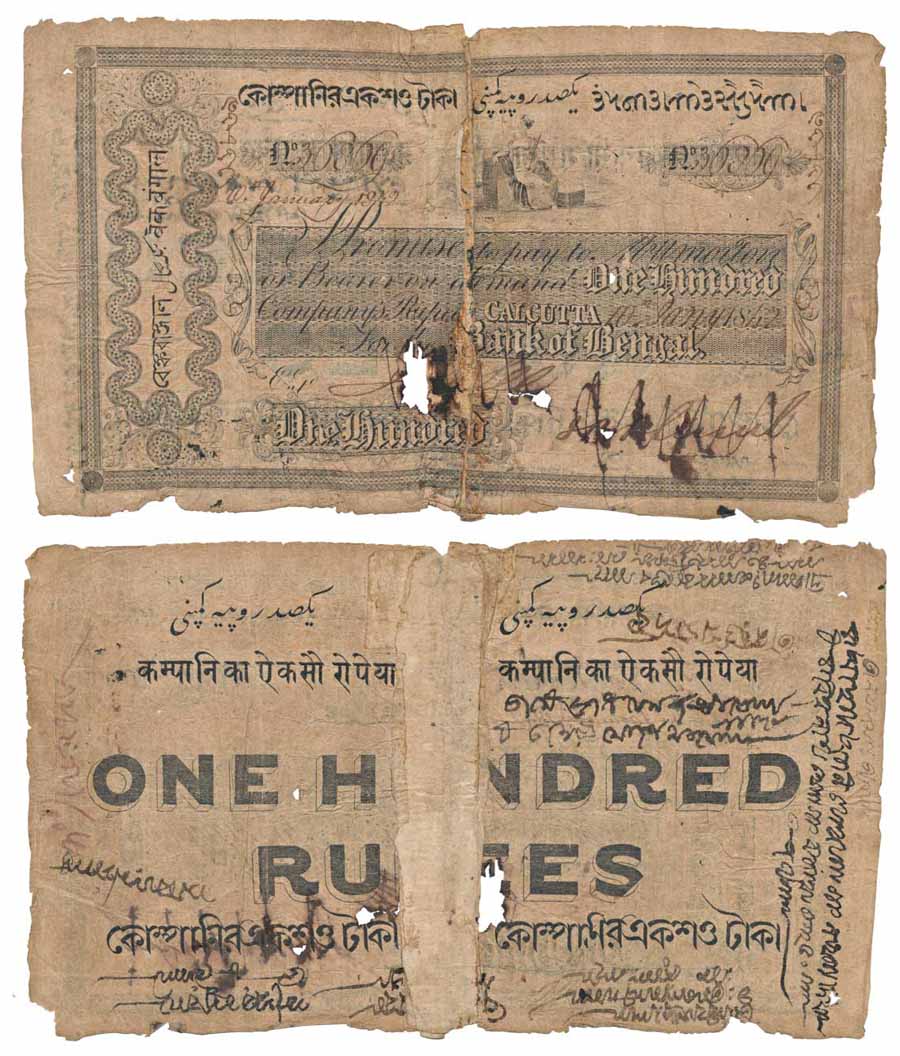
- Denominations
- 10 · 20 · 25 · 100 · 250 · 500 Company Rupees.
- Obverse
- Unchanged in layout from Design 6 — “Personified ‘Commerce’ sitting on articles of merchandise in centre above the central panel, value denoted in Bengali, Persian and Kaithi… hand written serial number in English placed on top right and left corners” — but the promise now reads Company Rupees.
- Reverse
- “denomination in words in bold English in the centre with Bangla, Persian, Hindi”.
- The tell
- One word. “Company” where “Sicca” used to be. In our corpus “Sicca” appears on 38 Design 6 records and “Company Rupees” on seven Design 7 records, with almost no overlap.
- Cause
- Documented. The 1835 coinage reform, executed by the Bank’s resolution of 6 July 1837, which also cut the note from two signatures to one.
Design 8 — The machine takes the pen J&R 1A.3.8
Rs 15. Not a banking number — a sovereign number, the rate at which a gold sovereign passed. The Bank's plate ledgers record a Fifteen Rupee plate being cut in May 1841, and because “Fifteen” misread from “Fifty” is the obvious trap, that ledger line had to be checked against the original manuscript. Here is the note itself, settling it. And with it comes the change that matters more: the serial numbers are no longer written by hand.
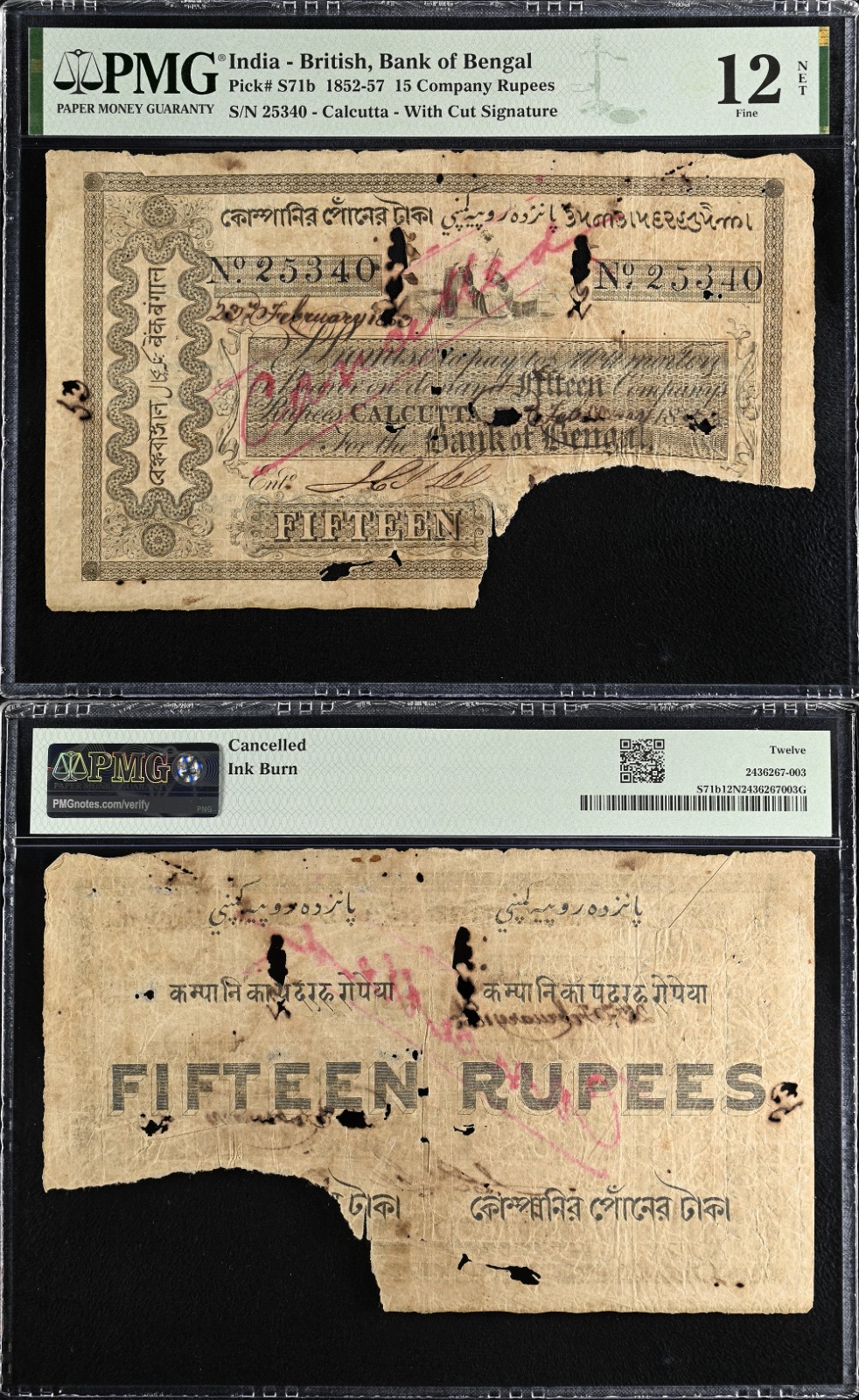
- Denominations
- 15 and 25 Company Rupees — the odd, coin-equivalent values.
- Obverse
- “‘Promise to pay … on demand Fifteen Company’s Rupees’… printed serial number in both upper corners (No. 25340)”
- Reverse
- “FIFTEEN RUPEES with the denomination in Urdu, Devanagari and Bengali”
- The tell
- The serial number is set in type. Another cataloguer: “Serial Numbers printed in Typed script”.
- Caution
- ⚠ This is also where cataloguers start saying “Urdu” and “Devanagari” where they used to say “Persian” and “Hindi”. That may be a change in vocabulary, not in the note.
Design 9 — Almost entirely printed J&R 1A.3.9
The last step of a fifty-year process. With serials already typeset, the pre-printed date means that the only handwriting left on the note is the signature — and the signature is the one thing the Bank cut off with scissors when the note came home to be redeemed. Which is why so few complete Bank of Bengal notes exist: by the end, the only human mark on the paper was the one designed to be destroyed.
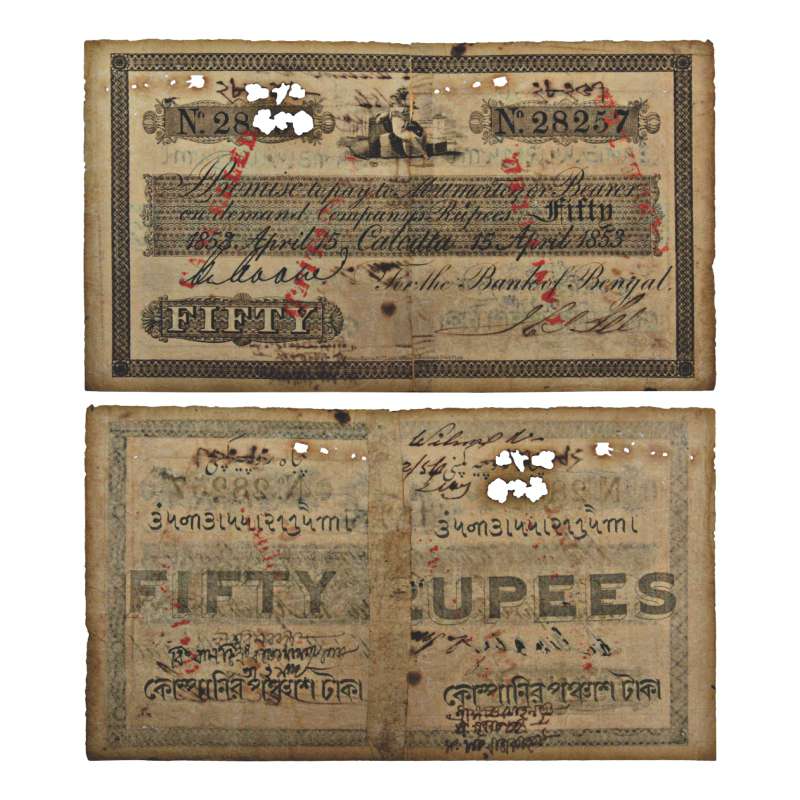
- Denominations
- 10 and 50 in our holdings; PMG records 25 and 1,000 as well.
- Obverse
- “two pre-printed dates in promise text panel on either side, serial number placed on the top-right and left corners”. One lot adds: “printed in England”.
- Reverse
- “denomination in bold English letters in the center with Persian, Kaithi and Bangla on either sides” — though a rival house reads the same panel as “Devanagari, English and Bengali”.
- The tell
- The date is printed too. Serial printed at Design 8, date printed at Design 9.
Design 10 — Britannia, and colour J&R 1A.3.10
The finale. Britannia and her lion take the centre — but look closely at the cataloguing and Commerce is still there, demoted to an attendant on the left. The allegory of trade that had carried the Bank's money for thirty years is not evicted; she is made to stand beside the Empire. The Rs 500 goes further still, setting Britannia in a landscape of palms, elephants, ships and temples. And for the first time, the paper is in colour: blue and black, the blue a Victorian photographic camera could not reproduce.
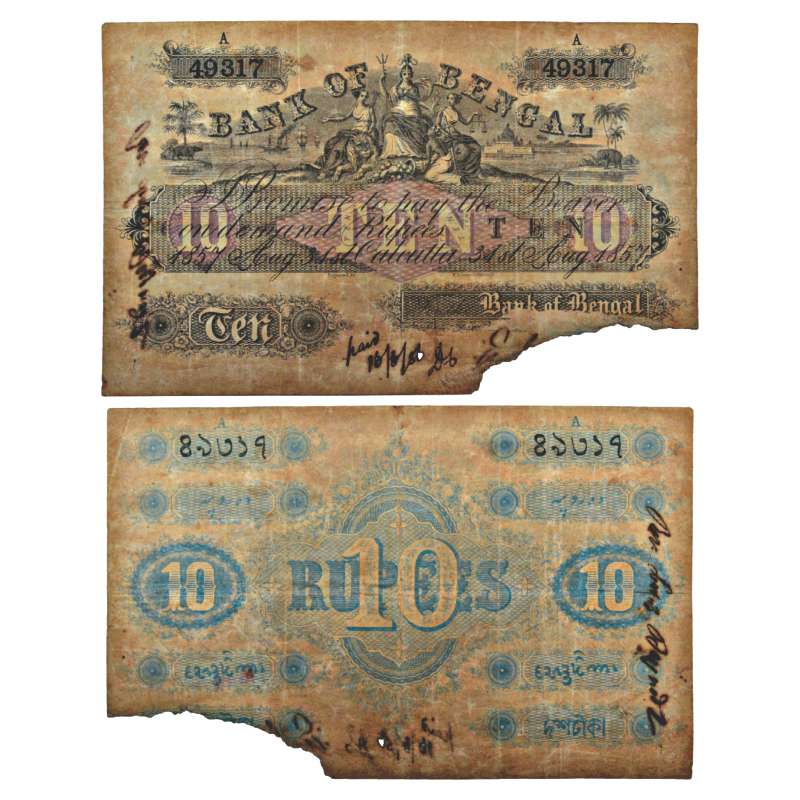
- Denominations
- 10 · 25 · 50 · 100 · 500 · 1000 Rupees.
- Engraver
- W. H. Lizars, Edinburgh — not Perkins Bacon. Why, nobody has ever recorded.
- Obverse
- “Britannia with lion accompanied by personified ‘Commerce’ on left, arched BANK OF BENGAL above vignette”. On the Rs 500: “Britannia seated with allegorical attendants amid palms, elephants, ships and an Indian landscape with temples”.
- Reverse
- “Reverse printed in blue with large ‘R 500 S’ and 500, denomination in Bengali, Devanagari and Urdu, serial in Bengali numerals”.
- The tell
- Britannia, colour, and “the Bearer” — the named-payee formula that ran since 1809 is gone.
- Cause
- Documented. The committee of May 1856, “so as to minimize the risk of forgery”. Not a response to the Uprising, which began a year later.
- Survival
- Seven issued Rs 10 notes graded by PMG, and one set of proofs. Every Britannia denomination survives as a proof at 55–64; the issued notes grade 8–25.
Chapter ThirteenWhy almost none survive
The Bank of Bengal issued paper for fifty-five years, with a circulation that touched two and a half crores of rupees. The total number of Bank of Bengal notes certified by PMG, across all 41 catalogue numbers, is 112.
That is not a typo. One hundred and twelve pieces. And two catalogue numbers hold a third of them.
The reason is not neglect. It is procedure, and the salerooms state it flatly. Notes were cut in half and the halves posted separately, so a thief intercepting one packet got nothing. On redemption the Bank cut out the signature panel and stamped the note CANCELLED. Heritage: "cut cancelled, as is the norm for extant notes from this issuer." Spink: "Generally signature is cut. Notes with uncut signatures are exceedingly rare."
Why halve a banknote at all? Because the post was not safe. Send one half today and the other next week, and a robbed mail bag yields a thief two useless pieces of paper. It worked — and its failure mode has left us two of the most human objects in Indian numismatics.
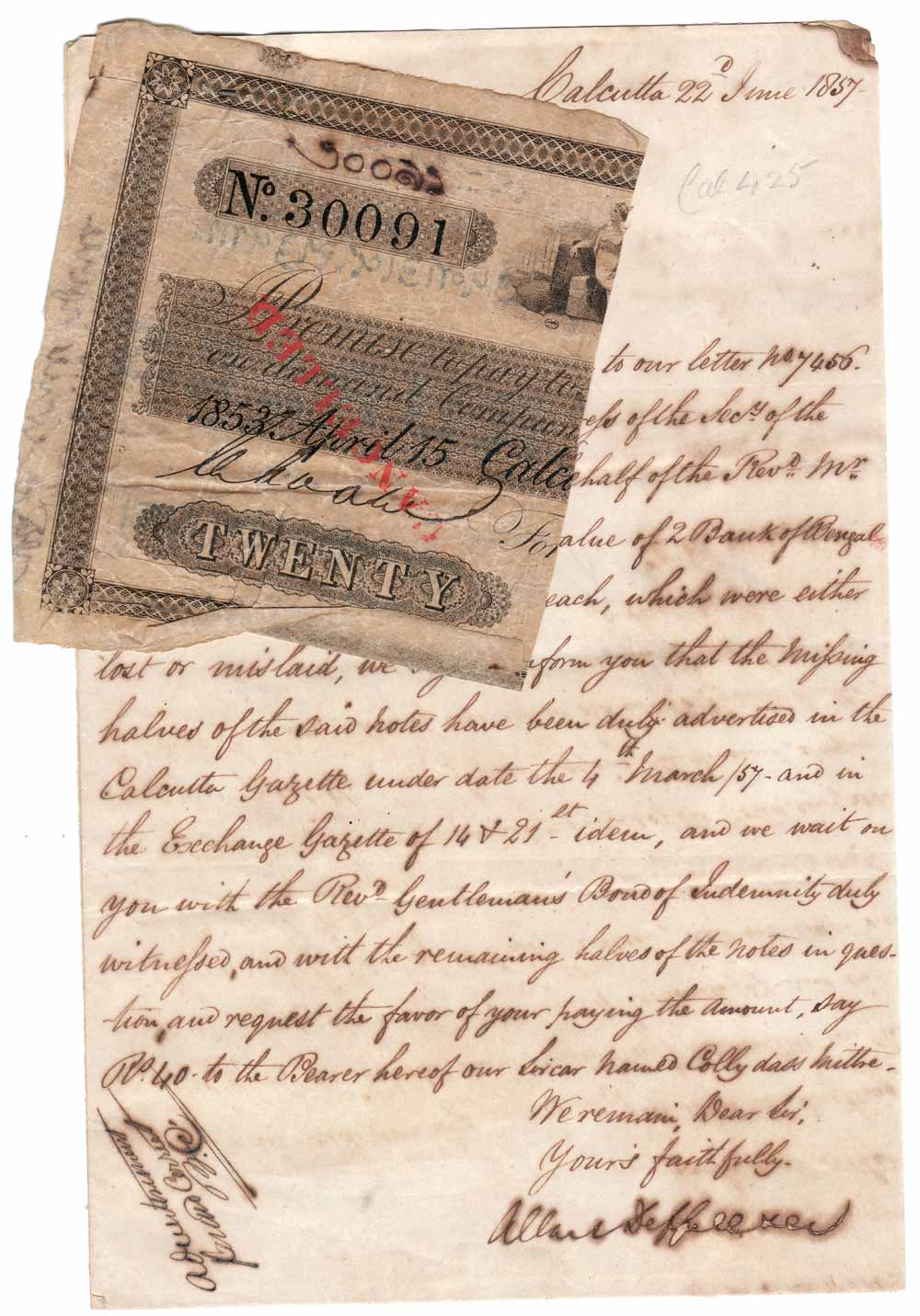
The letter is legible, and it is worth reading. Headed "Calcutta 22d June 1857", it transcribes (uncertain readings marked):
"…value of 2 Bank of Bengal [notes for Rs 20] each, which were either lost or mislaid, we [beg to in]form you that the missing halves of the said notes have been duly advertised in the Calcutta Gazette under date the 4th March /57 — and in the Exchange Gazette of 14 & 21st idem, and we wait on you with the Revd Gentleman's Bond of Indemnity duly witnessed, and with the remaining halves of the notes in question, and request the favor of your paying the amount, say Rs 40 to the Bearer hereof our Sircar named Colly dass Mittre. We remain, Dear Sir, Yours faithfully, Allan Deff[ell & Co.?]"
Four whole procedures sit in that paragraph. The missing halves had to be advertised in the Calcutta Gazette — the very lost-and-stolen-banknote column that ran in that paper for decades, here with a date, 4 March 1857 — and again in the Exchange Gazette. A clergyman's Bond of Indemnity had to be witnessed and produced. The surviving halves had to be surrendered. And the money went not to the owner but to a named intermediary: the firm's sircar, Colly dass Mittre, who walked to the Bank and collected forty rupees.
Oswal Antiques lot 162 — realised ₹35,000. Transcription ours, from the lot photograph; the signature is most likely the Calcutta agency house Allan, Deffell & Co., but that reading is not certain. Four years and two months separate the notes from the claim.And it was not a one-off. A second archive survives, and it is even better documented — because this time the Bank's own officers wrote back.
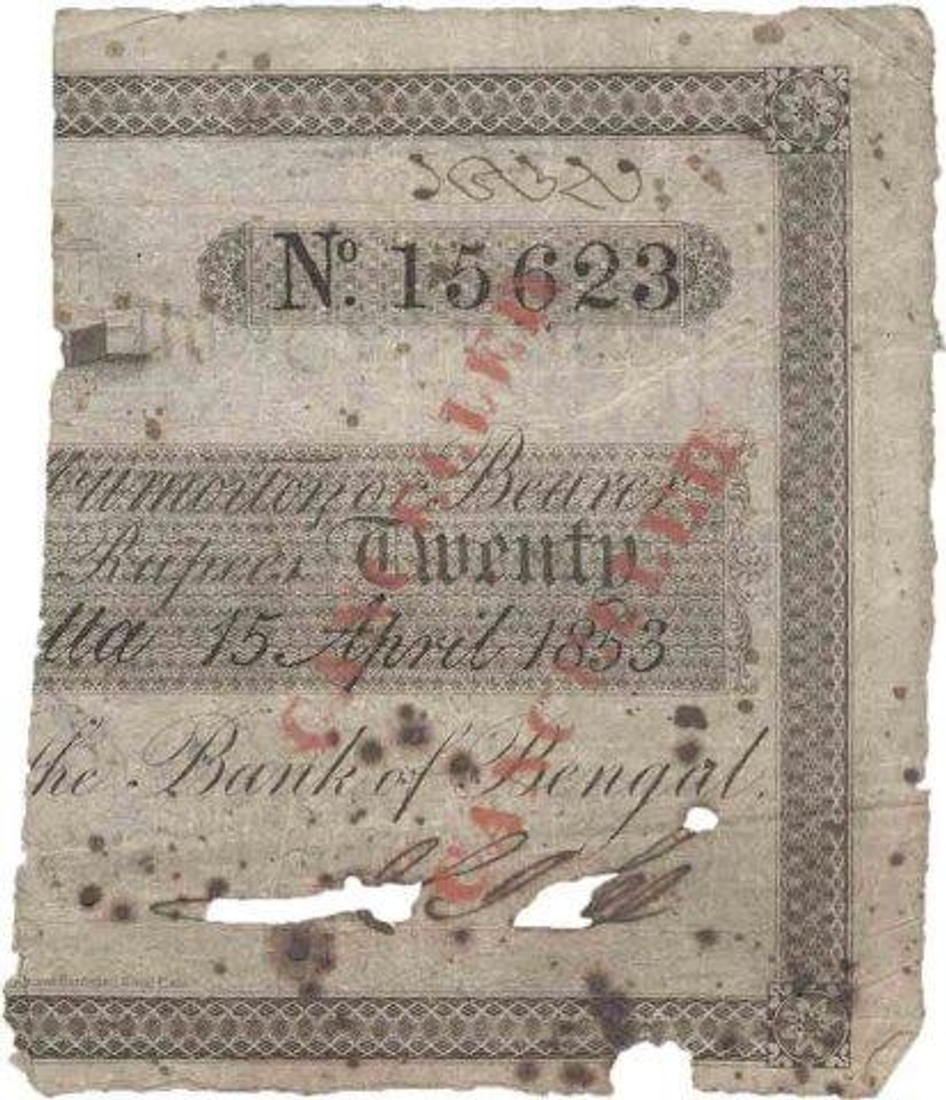
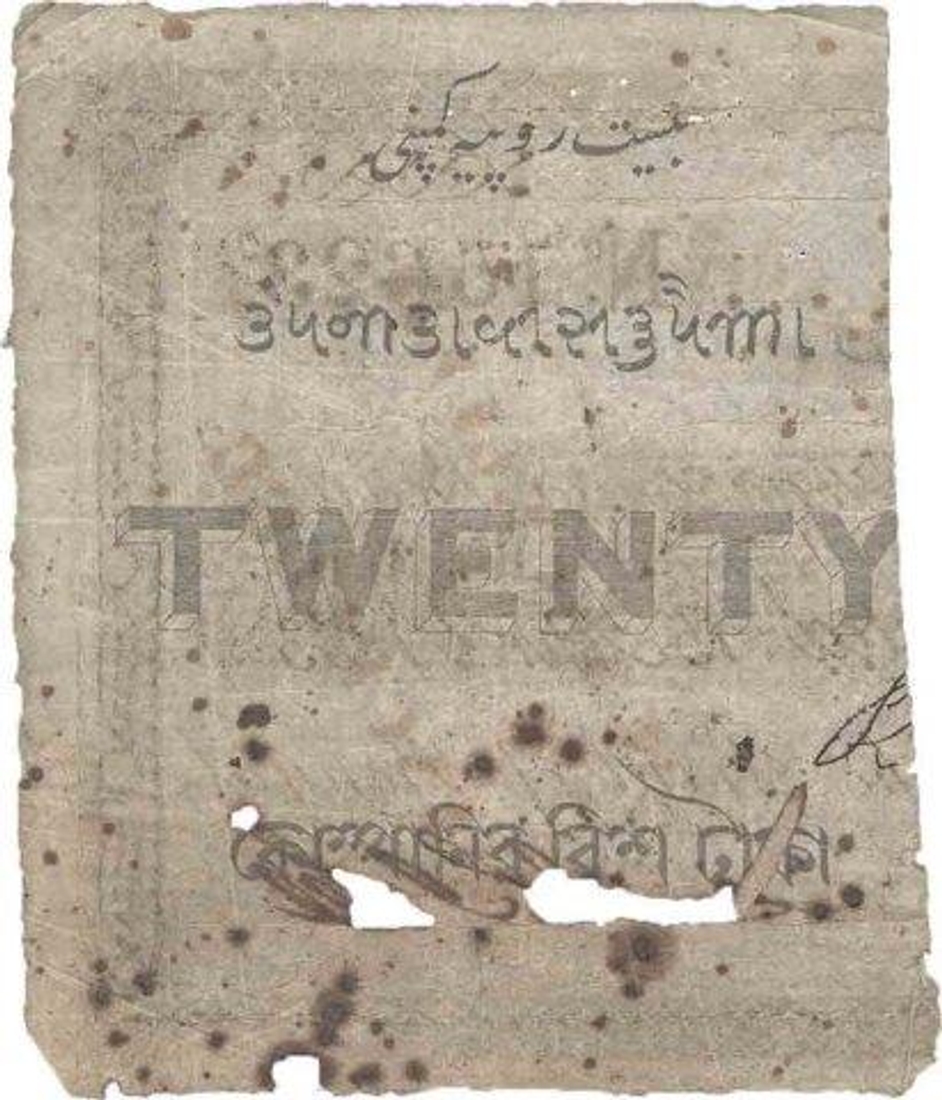
This is the whole procedure, preserved: a half note, a claim between two banks, a named payee, and a bond indemnifying the Bank of Bengal against the missing half ever turning up. Marudhar Arts, auction 15, lot 853 — hammer price login-gated. Catalogued at J&R 1A.3.x, i.e. the type is unresolved; the 1853 date and 1856–57 correspondence place it in the Design 6/7 era.
What the two archives establish together
Between them, these lots document the entire lifecycle that destroyed the Bank of Bengal's paper: a note is cut in half for safe transit → one half is lost → the holder writes to the Bank → the Bank requires a Bond of Indemnity before paying → the surviving half is cancelled and stamped, and its signature cut out.
Every step in that chain mutilates the object. It is why the highest-graded issued Bank of Bengal note in the world is a PMG 40, and why the only pieces that survive in collectable condition are proofs that never entered circulation at all.
| What survives | Graded | Grades |
|---|---|---|
| 250 Sicca Rupees, Uniface (Pick S20b) | 22 | 4 · 12×4 · 15×6 · 20×6 · 25×2 · 30×2 · 40 |
| 100 Sicca Rupees, Design 6 (Pick S55) | 12 | 6 · 12×2 · 15×7 · 20×2 |
| 10 Rupees Britannia, issued (Pick S90a) | 7 | 10 · 12×3 · 15×2 · 20 |
| 10 Rupees Britannia, proofs (S90p1/p2) | 2 | 62 · 63 |
| 1 Gold Mohur (Pick S24b) | 5 | 10 · 12 · 15 · 20 · 25 |
| 500 Sicca Rupees, Uniface (Pick S25b) | 1 | 30 |
| 1,000 Sicca Rupees, Design 6 (Pick S58b) | 1 | 20 |
Full census: 41 Pick numbers, 112 pieces, from our pmg_population table | ||
Two patterns leap out of that census. First: the highest-graded issued Bank of Bengal note in the world is a single PMG 40. Nothing else reaches 30. Second: every grade above 50 in the entire table is a proof. The Bank's own file copies outlived the notes the public carried — which is precisely what you would expect of money that was cut in half, cut again on redemption, and stamped dead.
Heritage's cataloguer put the rarity in one sentence in December 2025, describing the 1857 Rs 10: "At the time of writing, PMG has graded only seven issued examples and one set of Proofs." Our own population table says S90a = 7, S90p1 = 1, S90p2 = 1. Two independent sources, the same numbers.20
A bank that printed money for a subcontinent, and you could fit every certified survivor into a single cabinet.
What it costs now
| Piece | Sale | Realised |
|---|---|---|
| 10 Rupees 1857, front + back proofs, PMG 62/63 | Heritage 4057/22390, 7 Dec 2025 | $18,600 |
| 500 Rupees essay, 1855 — unadopted, hand-drawn, "in the style of Bank of England white notes" | Spink 23008/113 | £22,000 |
| 25 Rupees uniface proof, blue & black, Lizars imprint | CNG AUC30/664 | ₹9,00,000 |
| 20 Sicca Rupees, uniface front proof, Pick unlisted | Heritage 4025/28404, 18 Sep 2020 | $7,500 |
| 1,000 Sicca Rupees, 6 June 1832, PMG 20 | Todywalla 130/506 | ₹6,00,000 |
| 1 Gold Mohur 1816, serial 53 | CNG AUC33/584 | ₹2,81,000 |
| 10 Sicca Rupees, fancy serial 33333 | Oswal 72/237 | ₹3,00,000 |
| Unissued sola post bill, 18—, Pick unlisted | Noonans, 28 May 2025, lot 1504 | £60 |
Note the last line, and the first. A proof of a note makes $18,600; an unissued post bill of the same bank makes £60 — because the market files one as a banknote and the other as a "bill". The three most valuable objects here never circulated at all: two proofs and an essay that was never adopted. In this series, the paper that failed to become money is worth more than the money.
The design that never was
In 1855 someone sat down and hand-drew an alternative 500-rupee note for the Bank of Bengal, "executed in the style of Bank of England white notes", in a pattern book inscribed "Batho & Bingley". It was never adopted. It sold at Spink for £22,000 against a £3,000–5,000 estimate — the highest price in this entire story.
A fourth name in the design history, alongside Perkins Bacon and Lizars, and one that nobody has yet traced. The pattern book it was cut from is a real object, somewhere.
Appendix IFifty-five years, in order
The ghosts: General Bank in Bengal and Bahar (1773–75), Bank of Hindostan (c. 1770), General Bank of India (1786), the Bengal Bank — whose note of 15 November 1791, payable to Ramcaunt Dutt and signed Benjamin Mee, survives only as an engraving in Cooke's 1863 book.
The Bank of Calcutta is founded.
Chartered as the Bank of Bengal, with the exclusive privilege of issuing notes. W. Morton becomes Secretary — his name will appear "on all the old notes of the Bank" until 1815.
Serial 108, 250 Sicca Rupees — the oldest surviving Indian banknote.
"Papers regarding forgeries of Bank of Bengal notes" — the earliest forgery file, still unquoted, at the British Library.
Design 2: the gold mohur (16 Sicca) and Rs 500 join the range. Still uniface.
Perkins & Heath of London cut plates for the Commercial Bank of Calcutta — the firm's earliest recorded Indian banknote work.
Design 3: Commerce arrives on the obverse, and the reverse is printed for the first time — carrying "Printed by Perkins & Heath, London".
The Bengal Hurkaru publishes the raising technique in full: cut out the value in German text, alter the Persian and Bengali, tear the note and paste it back.
Eighteen arrested for altering notes "five rupees to 500, one gold mohur to 1,000" on the Bank of Bengal and the Calcutta Bank.
The Rajkissore Dutt trials. A first grand jury refuses to indict; he is convicted of uttering forged Company's Paper; his partner is acquitted; the approver is pardoned. The Bank, as lender, eventually writes off Sa.Rs 3,50,000 after losing before the Privy Council.
In three weeks, Perkins & Heath cut the whole Bank of Bengal ladder: Fifty, Twenty, Twenty-five, 100, 250, 500, 1000.
The coinage reform. The sicca rupee gives way to the Company's rupee. Every note in circulation now promises a coin that no longer exists.
Perkins re-cuts the "native character" panels in a single concentrated campaign.
The Bank resolves: "Sicca" becomes "Company's Rupees", and two signatures become one. Design 7.
Government orders every Bank of Bengal note endorsed by collectors. J. A. Dorin, the Bank's treasurer, objects that it "uselessly spoil[s] the notes."
Act VI of 1839 — the Rs 10 floor, the two-crore ceiling, "thirty days after sight", and authority for Bank Post Bills. The agency at Mirzapore is tried, and fails.
A Fifteen Rupee plate is cut — front and back. Design 8; serials begin to be printed.
"Vast numbers of forged Bank of Bengal notes are in circulation."
The Union Bank of Calcutta collapses.
Design 9: pre-printed dates. Only the signature is still written by hand.
The committee. A new note is resolved on "so as to minimize the risk of forgery": Britannia replaces Commerce, "the Bearer" replaces the named payee, "Company's" is dropped, and Rs 15, 20 and 250 are abolished. Same month, in London, Henry Bradbury lectures the Royal Institution on colour as the antidote to photographic forgery.
The new plates are being drawn.
The Uprising begins at Meerut — a year after the redesign was resolved.
The Britannia notes are issued, engraved by W. H. Lizars of Edinburgh. The Bank's first coloured money.
The Director's signature is dropped from the notes.
The latest recorded Bank of Bengal note date. W. H. Lizars had died on 30 March.
James Wilson's Minute is printed: the Mirzapore agency "was not found to answer", therefore the State must issue.
Wilson dies in Calcutta, before the Act.
Act XIX of 1861 receives assent — the Government Paper Currency Act.
The last day. Act IV of 1862 receives assent, repeals Act VI of 1839, and re-enacts no note-issue power. The Bank of Bengal's fifty-three years as an issuer of money end at midnight.
The Government's paper currency begins — and the Bank opens branches at Mirzapore, Benares, Patna and Dacca.
Merged with the Banks of Bombay and Madras into the Imperial Bank of India; renamed the State Bank of India.
Appendix IIWhose names are on the money
Almost nobody's, and that is the point — the signature panel was cut out on redemption, so a note that still carries a signature is a rarity worth a multiple. What survives:
| Name | Role | Evidence |
|---|---|---|
| W. Morton, c.s. | Secretary, Jan 1809 – Mar 1815 | Cooke, p. 96: "whose name appeared on all the old notes of the Bank". The payee named in the promise text of the earliest issues.2 |
| H. I. Lee | Accountant | Named by Spink's cataloguer on the 100 Sicca Rupees of 24 April 1834, serial 41629 — "Signed by accountant H. I. Lee and two unknown signatures". One of the very few signed survivors. |
| C. N. Cooke | Accountant from 1853; later Deputy Secretary & Treasurer | The author of the 1863 history this article leans on. If the collector-attested succession Tyler → Henderson → Lee → Cooke holds, the man who signed the Bank's notes wrote its first history. unverified |
| J. A. Dorin | Treasurer of the Bank of Bengal, 1829 | Named in the Dutt trial reports; in 1837 objects to Government endorsement of the Bank's notes.6 |
| Henry Tyler · H. Henderson | First and second Accountants | Collector-attested succession only. unverified |
Appendix IIIEvery denomination the Bank is known to have issued
| Value | Designs | Note |
|---|---|---|
| Rs 10 | 3, 4, 6, 7, 8, 9, 10 | The statutory floor from 1839. The longest-running value. |
| Rs 15 | 8 | Odd, coin-equivalent (the sovereign rate). Plate cut May 1841; abolished by the 1856 committee. |
| Rs 16 | 2, 3 | One gold mohur. A note worth exactly one gold coin. |
| Rs 20 | 5, 6, 7 | Also abolished in 1856. |
| Rs 25 | 6, 7, 8, 10 | |
| Rs 50 | 4, 6, 9, 10 | |
| Rs 100 | 3, 4, 6, 7, 8, 10 | The best-surviving Commerce value (12 graded). |
| Rs 250 | 1, 7 | The Uniface flagship. Plate cut 6 Aug 1830 and re-cut in 1836, yet no issued Commerce Rs 250 is known. Abolished 1856. |
| Rs 500 | 2, 3, 7, 10 | The Britannia Rs 500 shows Britannia amid palms, elephants, ships and temples. |
| Rs 1,000 | 6, 8, 9, 10 | The highest value physically recorded. |
| Rs 10,000 | — | Authorised by the 1809 charter and recorded in the plate ledgers, but no example has ever surfaced. A director testified in 1832 that notes ran "from 10 rupees up to 20,000" — a figure no other source supports and which the surviving record flatly contradicts.21 |
Appendix IVWhat is still not known
An honest article says where the evidence stops. Six things in this story have no documented explanation, and pretending otherwise would be the easiest way to get it wrong.
- Why the Bank left Perkins Bacon for Lizars of Edinburgh in 1857. Perkins was still working for it in December 1856. The switch was a choice, and no source records the reason.
- Why Kaithi. The chain of circumstance is strong — a village script in Bihar, a merchant and banker hand, one of three scripts on the Calcutta Supreme Court's own seal — but no source states why a bank put it on a note. And the RBI's own description of these notes says "Urdu, Bengali and Nagri" instead.
- Why the reverse became a printed denomination panel between Designs 4 and 6, and why manuscript serials gave way to printed ones at Design 8. Both unexplained.
- Whether the Rs 20,000 note ever existed. Holt Mackenzie, an ex officio director, told a Commons committee in February 1832 that the notes ran "from 10 rupees up to 20,000". The 1809 charter caps them at Rs 10,000. Nothing above Rs 1,000 has ever been seen.
- The 1841 fraud in the Bank-note Department. Cooke describes it. Fifty-seven volumes of the Asiatic Journal were searched for it and returned nothing. Cooke remains the only witness.
- What the Bank's own minute books say. Bagchi read them for the May 1856 committee. They are at the SBI Archives, Kolkata — which has no published catalogue, no access policy and no documented route in for an outside researcher. Everything unexplained above is probably in there.
Appendix VSources
Everything asserted above comes from one of the following. Where a claim rests on a single source, or on a source that contradicts another, the text says so.
Books
- bookG. P. Symes Scutt, The History of the Bank of
Bengal. Calcutta: printed by A. J. Tobias at the Bank of Bengal Press, 1904. 192 pp. The Bank's
own centenary history. Full text on archive.org (
cu31924022945129). Note: A. J. Tobias printed the book, not the notes — a conflation that appears on several websites. - bookC. N. Cooke, The Rise, Progress, and Present
Condition of Banking in India. Calcutta, 1863. Written by an officer of the Bank. Printed p. 96
for W. Morton; p. 200 for the 1819 Bank of Hindostan forgery notice; p. 391 for the 1791 Bengal Bank
note facsimile reproduced above; and the appendix reprints of Act XIX and Act XXIV of 1861.
archive.org
riseprogressand00cookgoog. - bookN. K. Sinha / H. Sinha (Das Gupta), Early European Banking in India. 1927. The 1809–1836 circulation series; the sicca rupee at 173 grains; p. 61 for the General Bank of India's 1789 watermark notice, "probably for the first time in India".
- bookJ. B. Brunyate, An Account of the Presidency Banks. Government of India, 1900. Chapter V, "The Note Issues of the Presidency Banks" — the authority for branch notes never having been issued.
- bookAmiya Kumar Bagchi, The Evolution of the State Bank of India, vol. 1. 1987. §11.5, pp. 299–300 — the May 1856 committee and the phrase "so as to minimize the risk of forgery": the single most important citation in this article. Also on archive.org.
- bookShib Chunder Bose, The Hindoos as They Are. 1881, pp. 141–42 — Rajkissore Dutt's gold tongue for Kali, the ~20 lakh of forged Company's Paper, and the banknotes that rotted inside a wall. Project Gutenberg #37722.
- bookHenry Bradbury, On the Security and Manufacture of
Bank Notes. Royal Institution lecture, 9 May 1856; p. 25 for colour as the antidote to
photographic forgery, the Claudet footnote, and Bradbury's own dissent. archive.org
onsecuritymanufa00brad. - bookJ. D. Heath (ed.), Records of the Heath
Family, 1913 — the Perkins partnership ledgers, including "about April, 1820, a number of plates
were made for the Commercial Bank of Calcutta", and the firm-name chronology. Transcribed at
jjhc.info/perkinsbaconandco. - bookRezwan Razack & Kishore Jhunjhunwalla, The Revised Standard Reference Guide to Indian Paper Money. The source of every "J&R" type number used here, and the authority every auction house cites. Razack's own collection holds the 1812 serial 108 note.
- bookAlbert Pick, Standard Catalog of World Paper Money, General Issues 1368–1960. The "Pick S…" numbers.
Journals and periodicals
- journalThe Asiatic Journal and Monthly Register,
1818–1840. The single richest source for this story, reprinting the Calcutta press and the Supreme
Court reports. Used here for: the India Gazette of 7 Dec 1818; the Bengal Hurkaru
of 18 March 1824 and the raising technique; the 1824 stolen-types gang; the Oriental
Observer of 11 March 1827; the Rajkissore Dutt trial reports (N.S. Vol. 2, May–Aug 1830,
archive.org
asiaticjournala33unkngoog); the Bank's half-yearly statement of Jan–Apr 1835 with the Privy Council write-off and the Rs 50,000 of lapsed notes (asiaticjournala38unkngoog); the 1834 India Bank altered notes; the 1837 Dorin endorsement objection; the May 1840 "vast numbers"; and the Penang Gazette report of Dutt at liberty, via the Bengal Hurkaru of 1 Dec 1834 (N.S. Vol. 17, 1835, p. 93). - journalIBNS Journal (International Bank Note Society), 258 issues surveyed. Issue 56-4 on Perkins siderography; 58-3 on forgery driving the redesign of the Government of India Queen Victoria portrait notes — the documented parallel that makes the Bank of Bengal's silence a real absence.
- articlePeter Symes, Bank Post Bills and Post
Notes, November 2009 —
pjsymes.com.au/articles/PostNotes.htm. Transcribes the Bank of Bengal post bill and cites the DNW sale of 30 April 2009, lot 722. Also the origin of the term: the Bank of England's "Sola Bill of Exchange" of October 1728.
Statutes, Parliamentary papers and gazettes
- parliamentaryHC 1860 (183), printed 28 March 1860 —
correspondence on establishing a paper currency in India, including James Wilson's Minute and
the Mirzapore passage. Also HC 1862 (215) (6 May 1862), which enumerates the "Arrangements with
the Bank of Bengal for establishing branch Banks at Mirzapore, Benares, Patna, Dacca and Rangoon";
HC 1864 (109); HC 1865 (79). All four bound together, free and full-view, in HathiTrust
chi.097199117, Sundry returns: Indian mints & currency, 1846–69. - statuteAct VI of 1839 (Bank of Bengal Act) §XXXI, §XXV.7,
§XXVI; Act XIX of 1836; Act XIX of 1861 (Government Paper Currency, assent 16 July 1861);
Act XXIV of 1861; Act IV of 1862 (assent 28 February 1862). All free facsimiles at
indiacode.nic.in/repealedfileopen?rfilename=<code>.pdf. The annual Acts of the Legislative Council of India volumes are on archive.org. - parliamentaryMinutes of Evidence, Select Committee on the
Affairs of the East India Company, II. Finance and Accounts — Trade, Part 1, ordered 16 August
1832. Holt Mackenzie, "ex officio director of the Bank of Bengal", examined 23 and 25 February
1832: Q463, Q492, Q514 (the "10 rupees up to 20,000" claim), Q511. archive.org
10213507bsb. - gazetteThe Calcutta Gazette, 1834–1900, "Published by Authority" — Acts, notifications, published bank balance sheets, and the classified columns in which the Calcutta public advertised lost and stolen banknotes by denomination and serial number, week after week. On archive.org under the subject "The Kolkata Gazette".
- officialCapt. Thornton, English Version of the Oordoo
or Hindostanee Exposition of the New Indian Paper Currency, for the Information of the Natives of
India. Calcutta: Home Secretariat, 1860, ¶5 — the two-tier language rule. archive.org
wbsl.53.
Archives
- archivePerkins Bacon Archive, Royal Philatelic Society
London — 17 Engraving Books, refs PB136021–PB136036, 1828–1935, keyword-indexed page by page with
free page images. Book PB136021 p. 27 (23 July – 13 August 1830) for the Bank of Bengal
denomination ladder; p. 24 for the centre and denomination dies; pp. 19–23 for the Bank of Hindostan
watermark and "Native Characters"; PB136022 pp. 110 and 118 for the Sep–Dec 1836 panel
re-cutting.
rpsl.org.uk/Quick-Links/Perkins-Bacon-Archive-Keywords-Browse - archiveIndia Office Records, British Library. Cited here:
IOR/F/4/364/9085, "Papers regarding forgeries of Bank of Bengal notes", Jan–Jul 1811;IOR/F/4/298/6890, circulation of the Calcutta Bank's paper currency, 1808–09;IOR/V/27/331/5, the printed Charter of the Bank of Bengal (Calcutta: Church Mission Press, 1834) — digitised nowhere;IOR/Z/E/4/16/F161, "Bank of Bengal Notes and Post Bills, instructions respecting";Photo 1081/2(10)and others, the Strand Road premises; andPhilatelic 26/1/9/2, the unadopted Bank of Bombay Rs 1,000 proof of 1857 with Royal Armorial Bearings. - archiveSBI Archives & Museum, Kolkata — successor to the Bank of Bengal and holder of its minute books. 11th Floor, Block 'B', Samriddhi Bhavan, 1 Strand Road, Kolkata 700001. No published catalogue or documented access route; the largest single gap in this account.
- archiveNegative findings worth recording. The De La Rue
archive at the University of Reading (
MS 937) contains no Bank of Bengal material and no 19th-century Indian banknote production records at all. The National Archives at Kew hold Perkins Bacon postage-stamp contracts only. The British Library's "Perkins Bacon Paper Money Collection" is Bank of Bombay only.
Museums, databases and online sources
- museumReserve Bank of India, Monetary Museum — "Early
Issues",
rbi.org.in/Scripts/pm_earlyissues.aspx: "Around the mid nineteenth century, the motif 'Commerce' was replaced by 'Britannia'. The note had intricate patterns and multiple colours to deter forgeries." Undated and unfootnoted; and its script list ("Urdu, Bengali and Nagri") conflicts with the catalogues. - museumPennsylvania Academy of the Fine Arts, accession 1985.x.388, Charles Toppan Collection — "[Bank of Bengal] One Thousand Siccu Rupees [note]", Perkins & Heath, steel engraving with stipple and etching, chine collé, 9.8 × 17.0 cm. The printer's own file impression of the top denomination.
- referenceAnshuman Pandey, Proposal to Encode the Kaithi Script, Unicode L2/07-199, §4.5–4.7 — the Calcutta Supreme Court seal; Henry Beverley on Bengal's script policy; the Education Commission of 1884 on Kaithi in "every village in Behar"; and Kaithi as mahājanī and sarrāfī, the merchant and banker hands.
- auctionsAuction catalogues and results, from which every note image and every design description in this article is drawn: Classical Numismatic Gallery (CNG), Marudhar Arts, Oswal Antiques, Todywalla Auctions, Bombay Auctions, Spink, Stack's Bowers, Noonans (formerly Dix Noonan Webb) and Heritage Auctions. Individual lot numbers are given at each figure.
- dataPMG Population Report, India — British
(
pmgnotes.com), 41 Bank of Bengal Pick numbers, 112 pieces, with grade breakdowns. Cited throughout for survival figures, and independently confirming Heritage's published rarity statement for Pick S90. - imagesWikimedia Commons, all public domain, for: the 1812 serial-108 note; the Bank of Bengal building as illustrated in The Builder, 9 January 1858, and photographed in 1900; the portrait of James Wilson (Welsh Portrait Collection, National Library of Wales); Jacob Perkins, c. 1824; and Dwarkanath Tagore.
- contemporaryJames Douglas, Glimpses of Old Bombay and Western India, with Other Papers, London: Sampson Low, Marston, 1899, printed p. 112 — the Sheriff of Bombay, compiling Part II of his book out of the Bombay newspaper files, on the Bank of Bengal's hostility to the founding of the Bank of Bombay and its threat to open there. The only record of that episode we have found in any source. Douglas is a compiler, not a historian: the documents he reprints are stronger than his own asides. archive.org
A note on method
Every banknote image in this article is one we hold — 220 mirrored image files across 37 Razack & Jhunjhunwalla sub-types, from a corpus of 159 Bank of Bengal records. The design descriptions are quoted from the salerooms that catalogued them, not paraphrased; where two houses describe the same panel differently, both readings are printed.
The photographs of people and buildings are public-domain images from Wikimedia Commons, credited individually. The 1791 Bengal Bank facsimile is cropped at 400 dpi from the scan of Cooke's 1863 book.
Nothing in this article is invented. Where a cause is documented, it is quoted and attributed. Where it is inferred from chronology, the text says "inference". Where it is simply unknown — which is more often than a good story would like — the text says that too.
Bank of Bengal · Calcutta · 1806–1862 · Razack & Jhunjhunwalla group 1A.3 · ten designs · 112 certified survivors