This is the story of a bank that failed so completely that its own successor has written it out of its history. It begins with a public meeting in a merchant's counting-house and ends with a Royal Commission sitting in the very building engraved on the bank's own banknotes. In between: a rival bank that tried to destroy its currency with a rubber stamp, eight thousand rupees of badly-forged paper that halved the circulation in six days, a broker who was handed a book of blank promissory notes, a single deleted clause, and a loss of Rs 1,88,99,331 that the House of Commons twice refused to make good.
There is no published study of Bank of Bombay notes. The International Bank Note Society journal — sixty-eight converted India articles — contains a detailed Bank of Madras study and no Bombay equivalent; between them the two largest coin-and-currency auction archives in the world hold one Bank of Bombay note in over 1.3 million lots.19 Almost everything below about the paper itself is assembled here for the first time, from the printer's own day-books in London, from the Bombay directories, and from the eleven notes we hold records of.
What follows
- The bank nobody wanted
- Two dead governors on the money
- The rival that stamped the notes to death
- Eight thousand rupees of bad paper
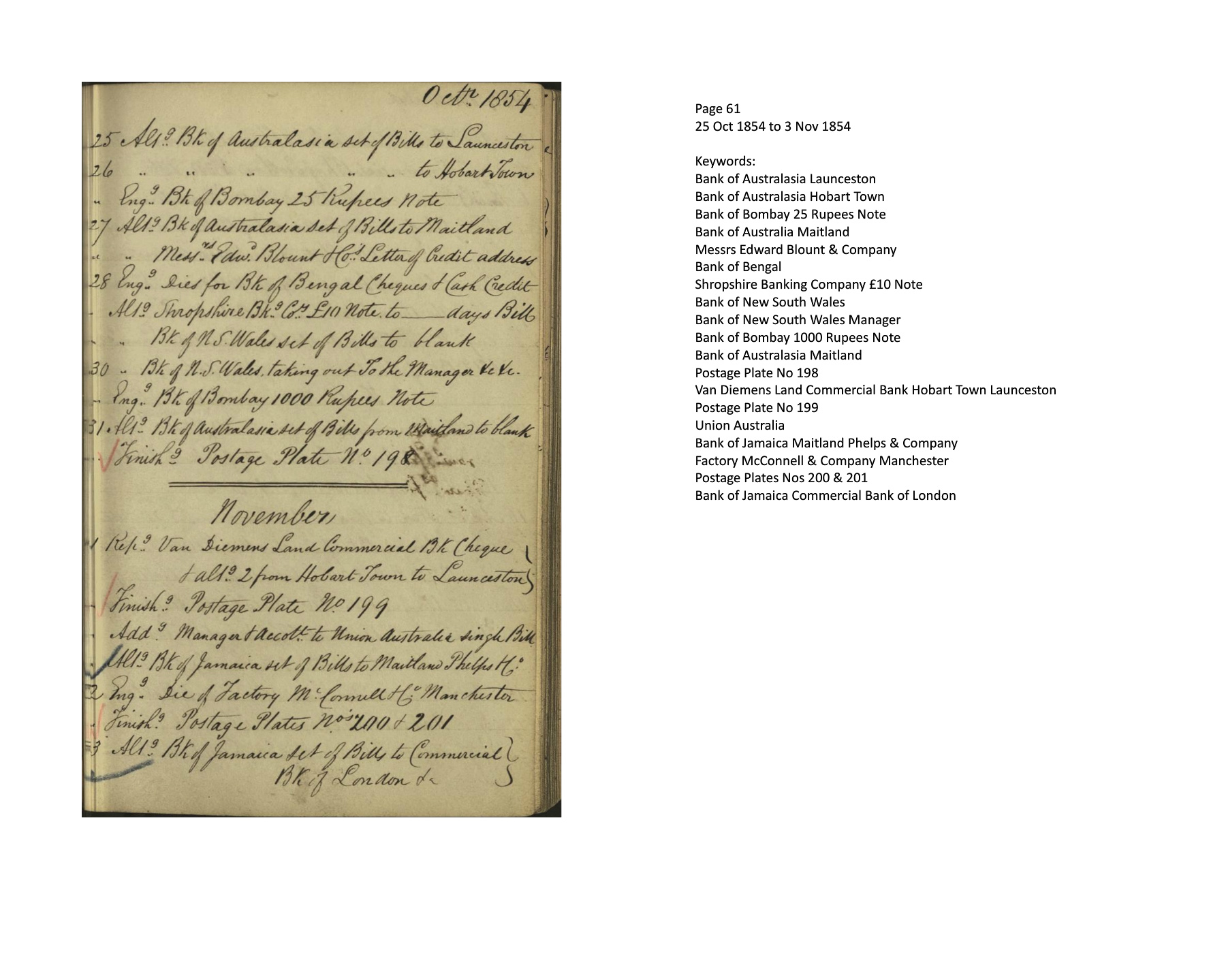
- October 1854: a pencil line and a London day-book
- 1856: "native char", and the four corners
- An island currency
- 1 March 1862: the press is taken away
- The clause
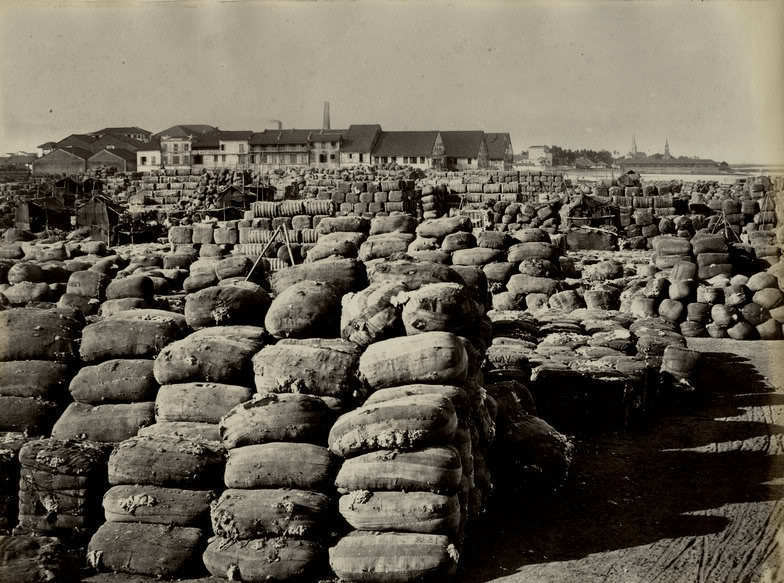
- Cotton
- The man who owned the bank
- The Black Day of Bombay
- Seven in the morning, on the porch
- The last two runs
- The Durbar Room
- Westminster says no, twice
- Afterlife — and a tower
- The three designs, in order
- Why almost none survive
- What it should have taught them
- What still needs checking
- Sources
Chapter OneThe bank nobody wanted
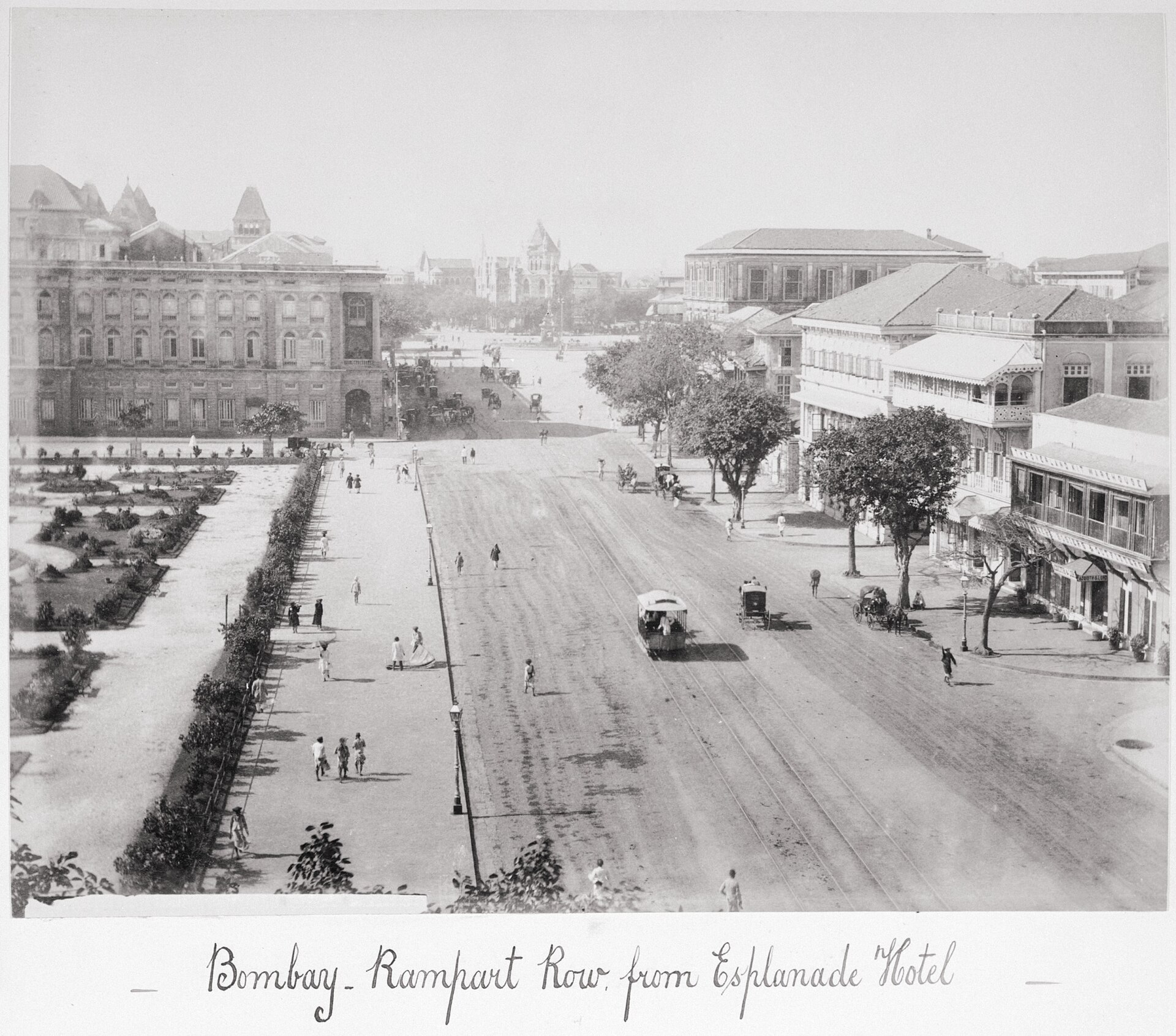
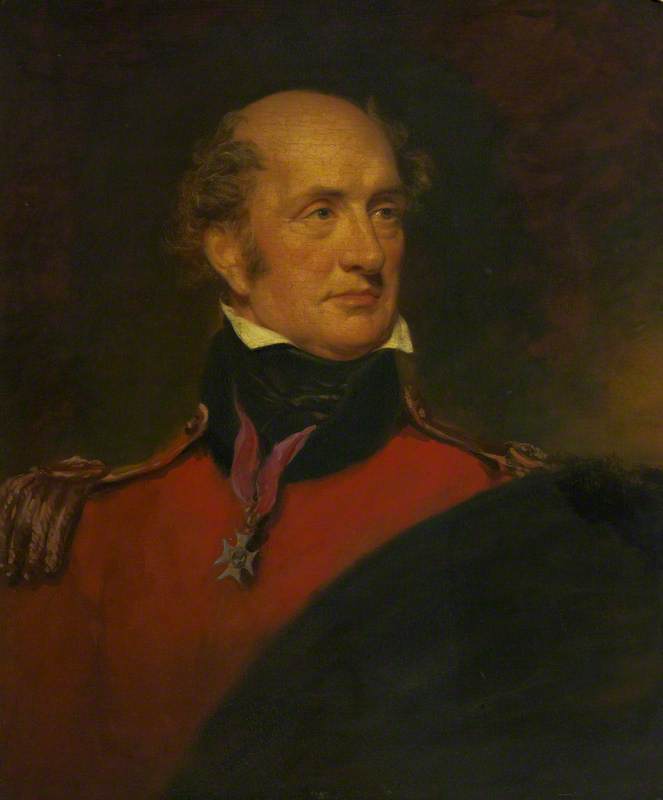
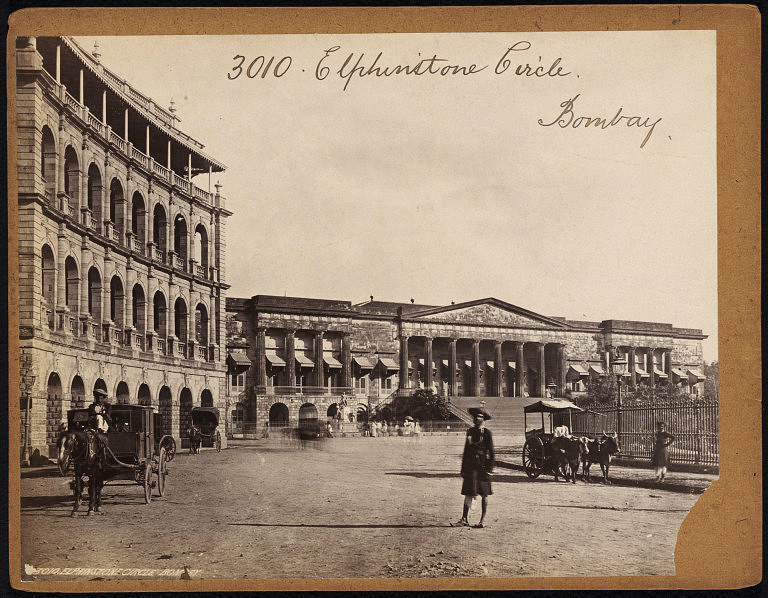
Not to be confused with No. 1 Rampart Row — the stone building the bank moved to around 1860, which Government later took over as the Currency Office, and which is the subject of a contradiction the Gazetteer never resolves. LACMA via Wikimedia Commons, public domain; LACMA dates it to the 1870s. Note the horse tramway in the roadway — Bombay's opened in 1874, so the view is from after the bank had gone.
Calcutta had a public bank from 1770. Bombay did not get one until 1840. Charles Northcote Cooke, writing in 1863 as a banker inside the system, found this genuinely strange: "it is a remarkable circumstance… that although a public Bank was established in Calcutta in 1770, no attempt, that we are aware of, was made to establish a similar institution in Bombay until more than sixty years afterwards."1
What finally forced it was not ambition but a withdrawn convenience. For years a handful of Bombay merchant houses had kept an average of over 20 lakhs of rupees on deposit at the Government Treasury, making transfers between themselves across its books. Government withdrew the privilege. On 26 December 1836, in the office of Messrs John Skinner & Co., a public meeting adopted "a prospectus for a bank for the Presidency of Bombay" and appointed a provisional committee to obtain a charter.2
Then it took nearly four years, and the delay is the most revealing part of the founding.
The secret petition
The Court of Directors in London stalled for almost two years. Cooke explains why, and it is not in any modern account of the bank: Bombay's three oldest mercantile houses, who between them had enjoyed "almost the whole business appertaining legitimately to a public Banking institution", secretly petitioned Government instead for an issue of Treasury notes payable on demand — arguing that "no advantage can flow from the establishment of a Bank."
Government rejected it. The public backlash carried the scheme.1 The Bank of Bombay was born over the objection of the men who most stood to lose from it — one of whom, Jamsetjee Jejeebhoy & Sons, appears in Bagchi's account among the opponents of December 1836.8 Hold that name. He is on the board within seven years.
The opposition was not only local, and this is the part no account of the bank records. James Douglas — Sheriff of Bombay, writing in 1899 with the city's newspaper files in front of him — compressed the whole four-year fight into one sentence: "how the great houses of agency frowned upon it; how the Bank of Bengal, strong in the right of primogeniture (1806), viewed its establishment with hostility and threatened to open in Bombay; how the Bengal Government took the same views and imparted them to the Bombay Government; how our Chamber of Commerce remonstrated."26 The senior Presidency bank, which held the sole right to print paper money in India, lobbied against a second bank of issue and let it be known that it would come to Bombay itself if one were founded. It never did — and the branch it would not build is the hinge of the Bank of Bengal's own story. Douglas also names the four men who "did duty in succession as honorary secretaries" — Ashburner, Finlay, Johnson and John Smith — and records that Ashburner was sent to London to secure the charter.
The subscribers eventually lost patience. On 20 March 1838 they resolved that if the charter were not sanctioned by 1 October they would abandon it and form an ordinary joint-stock bank instead. The Court signed the sanctioning despatch on 29 September 1838 — one day before the deadline.2 A further year went in arguing whether the original subscribers or a public auction should get the shares. Act III of 1840 was passed by the Government of India on 17 February 1840, and the Bank commenced business on 15 April 1840, "nearly four years after it was first projected."1
The numbers it opened with
The intended capital was 30 lakhs, then 50. Demand blew through both. Cooke: "such was the demand for shares, that the Provisional Committee was obliged to increase the amount to Rupees 52,25,000… divided into 5,225 shares of one thousand rupees each." The contemporary directory masthead confirms it word for word: "INCORPORATED BY ACT III OF 1840. (Established April 1840.) Capital, Rupees 52,25,000, in Shares of 1,000 Rupees each."11
| Bank of Bengal | Bank of Bombay | Bank of Madras | |
|---|---|---|---|
| Constituted | 1806 / chartered 1809 | Act III of 1840; opened 15 Apr 1840 | Act IX of 1843; opened 1 Jul 1843 |
| Founding capital | 50 lakh sicca rupees | Rs 52,25,000 | Rs 30,00,000 |
| Government subscription | Rs 10 lakh sicca (1809) | Rs 3,00,000 — 300 shares, ≈5.7% | Rs 3,00,000 (10%) |
| Board | 9, of whom 3 Government | 9, of whom 3 Government | 9, of whom 3 Government |
| Statutory note ceiling | Rs 2 crore | Rs 2 crore | Rs 1 crore |
| Minimum cash : demand liabilities | one-fourth (from 1822) | one-fourth (§26) | one-fourth |
Sources: Cooke 1863 pp. 151–1681 · Bagchi vol. 1 pp. 267–270, 325, 327, 3738 · Gazetteer 1909 III p. 2132
Note the Government's stake: 5.7 per cent, and three seats out of nine. That ratio is the seed of everything in Chapter Sixteen. State Bank of India's own published history says the presidency banks' capital was "four-fifth… privately subscribed and the rest owned by the provincial government" — a twenty per cent Government stake. For Bombay that overstates the reality by more than three times. ⚑ disputed
Who owned it — and who did not sit on the board
Cooke prints the shareholder register for 1840 and 1848, and it is the single best answer to "whose bank was this?"1
| Class | 1840 holders | 1840 shares | 1848 holders | 1848 shares |
|---|---|---|---|---|
| Europeans resident in India | 173 | 3,261 | 91 | 1,473 |
| Europeans non-resident | — | — | 95 | 2,365 |
| Native Christians | 12 | 49 | 13 | 62 |
| Mahomedans | 3 | 55 | 1 | 18 |
| Parsees | 109 | 1,233 | 88 | 877 |
| Hindoos | 35 | 327 | 25 | 130 |
| The Bombay Government | — | 300 | — | 300 |
| Total | 332 | 5,225 | 313 | 5,225 |
At founding, Parsis were a third of the shareholders by headcount (109 of 332) and held about 24 per cent of the capital. Indian holdings overall came to 1,964 of 5,225 shares — 37.6 per cent — and fell to 1,387 by 1848.8 Cooke predicted, correctly, that "in the course of a few years the largest proportion of the capital will be held by parties resident in England."
A question this article can close
It is repeated all over the web that Sir Jamsetjee Jejeebhoy was appointed a Director of the Bank of Bombay in 1843, the first Indian to be so honoured — always without a source, and the claim is in neither his Dictionary of National Biography entry nor the standard biographies. Our own open-web research slice concluded, reasonably, that it should be treated as unverified.
The Bombay directories settle it. The 1843 volume prints the board twice — once in the Part III establishment entry and again in the Part V civil list — and both name "Sir Jamsetjee Jeejeebhoy, Knight" among the directors elected by the proprietors. He is there again in 1850, and the 1851 volume's own name index puts him on the Bank of Bombay page.11 Bagchi independently reproduces a Chinnery portrait of him captioned as a director of the bank.8
So the claim is true. ✓ now verified Two caveats worth keeping: whether he was the first Indian director depends on the founding board, and Bagchi puts the Parsi merchant Framjee Cowasjee on it in April 1840 — three years earlier.8 ⚑ disputed And the man elected in 1843 had, in 1836, been among those trying to stop the bank existing at all.
Chapter TwoTwo dead governors on the money
Before the drama, the object.
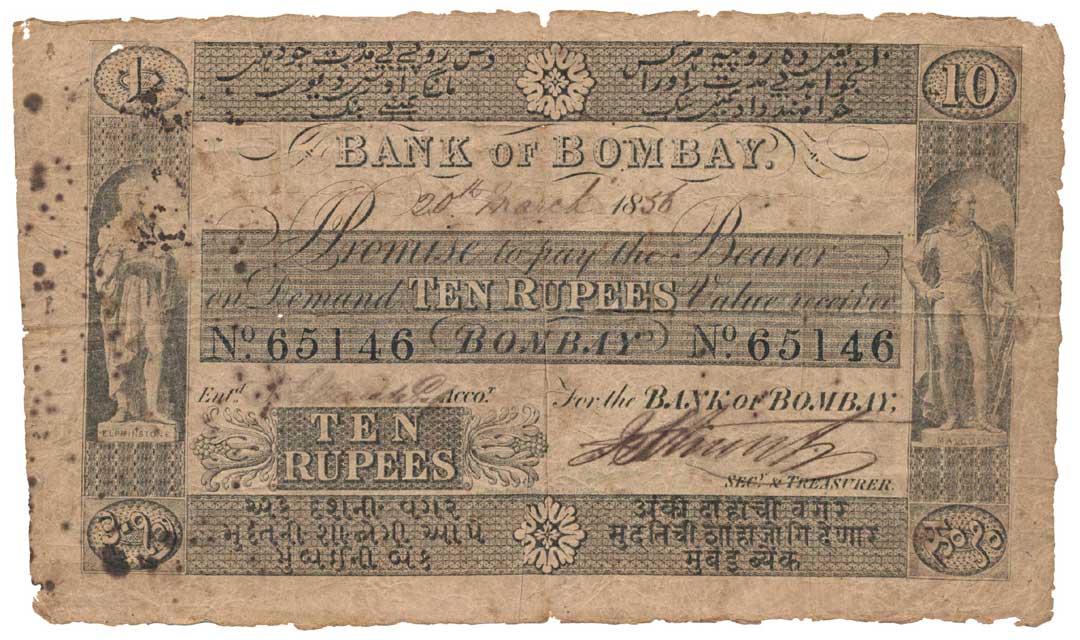
A Bank of Bombay note is a horizontal sheet of handmade paper carrying, on either side of the
text, two full-length statues on pedestals: a robed civilian at the left labelled
ELPHINSTONE, a military figure at the right labelled MALCOLM. Between them,
BANK of BOMBAY, the engraved promise — "Promise to pay the Bearer on Demand TEN
RUPEES value received" — and BOMBAY in script beneath. The denomination appears in
numerals at the four corners in Persian, English, Marathi and Gujarati; the promise text runs in
four quadrants in Sindhi, Persian, Marathi and Gujarati.15
The choice is worth pausing on, because it is a decision about what a currency is for. Calcutta put allegory on its money — a seated figure of Commerce, later Britannia and her lion. Bombay put two named, recently dead colonial administrators on its money, as statues, as though the note were a civic square. Madras did the same thing with Sir Thomas Munro.16 Neither of the two articles that record these facts draws the comparison; it is drawn here. The presidency that ran on allegory was the one that never failed.
Elphinstone left Bombay in 1827 and Malcolm in 1830. By the time the bank existed, both were monuments. It put its monuments on its money, and no living person's face ever appeared on a Bank of Bombay note.
The London end
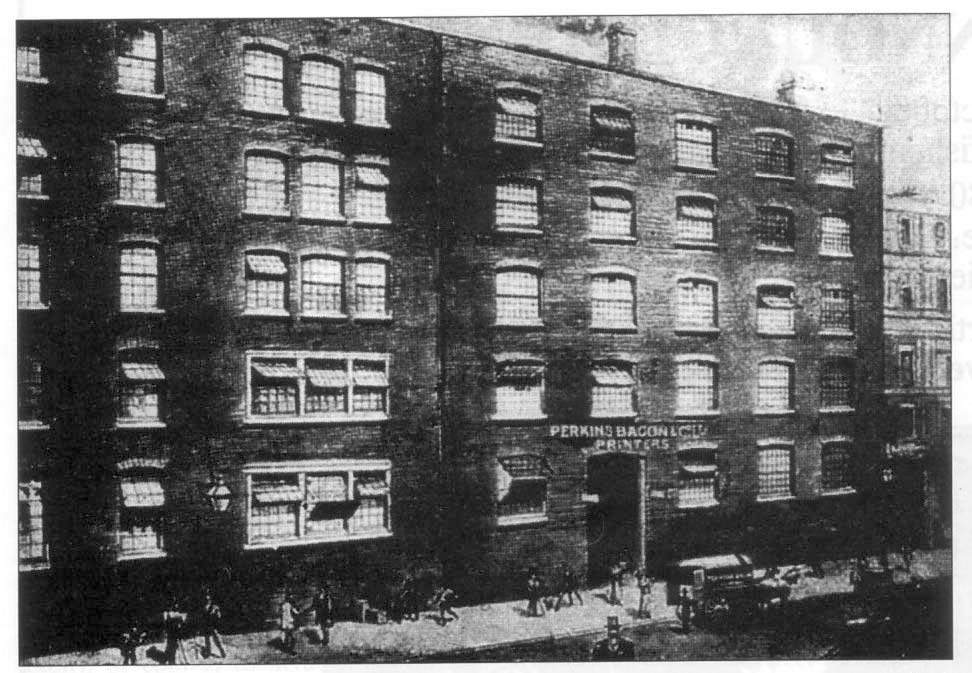
The printer is not in doubt. The firm's name is engraved on the notes themselves, and it doubles as a dating tool, because the partnership kept changing: Perkins, Bacon & Petch until it became Perkins, Bacon & Co. in 1852. The Type 1 notes carry Petch; Types 2 and 3 carry & Co. That is a hard terminus post quem on the redesign, and it is one of the few places where a Bank of Bombay note can be dated from its own face.15
Who signed them
Two manuscript signatures, and they are not two co-equal officers — a point every published
account gets slightly wrong. At the lower right, beneath the engraved line
For the BANK OF BOMBAY and above the engraved title SEC.Y & TREASURER.,
signs the Secretary and Treasurer. At the lower left, on a line reading
Ent[ere]d ______ Acco[unta]nt, signs the man who entered the note in the
books.19
The published literature names the Secretaries and contradicts itself doing so: one IBNS article gives James Blair as both "(1860–65)" and "(1855–1865)" five lines apart, and dates the bank itself three different ways in one piece.16 The Bombay directories settle that too. John Stuart is Secretary and Treasurer in 1843, 1848, 1850, 1853, 1855 and 1856, with a residents'-directory cross-entry each year. Blair appears in 1855 as Head Accountant and in 1856 as "Deputy Secy. and Head Accountant" — he succeeded Stuart around 1860, not 1855.11 A collector examining a Rs 50 of 1846 and a Rs 10 of 1859 reached the same conclusion from the paper alone: the same Secretary's hand runs "right through 1859."16
| Year | Secretary & Treasurer | Head Accountant | Head Shroff |
|---|---|---|---|
| 1842 | W. W. Cargill | John Stuart | Sorabjee Furdonjee |
| 1843 | John Stuart (acting) | Wm. Smyttan | Sorabjee Furdoonjee |
| 1848 | John Stuart | Wm. Smyttan | Sorabjee Furdoonjee |
| 1850 | John Stuart | Wm. Smyttan | Dhunjeebhoy Byramjee Rana |
| 1853 | John Stuart | Walter Taylor | Dhunjeebhoy Byramjee Rana |
| 1855 | John Stuart | J. Blair | Dhunjeebhoy Byramjee Rana |
| 1856 | John Stuart | James Blair (also Deputy Secretary) | Hormusjee Byramjee |
From the twelve Bombay Calendar and Almanac volumes, 1822–1856. The 1851 and 1852 establishment entries are missing from the scans; 1851 is reconstructed from that volume's own name index.11
Cargill's exit is worth a sentence. W. W. Cargill, the bank's first Secretary and Treasurer, resigned on 25 June 1842 — and on 18 July 1842 became managing director of the Bank of Western India, the rival that had just been formed to do the exchange business Act III of 1840 forbade the Bank of Bombay.8 Two years later that same rival would try to destroy the Bank of Bombay's currency.
Both dates are confirmed independently, from the Bombay newspapers rather than the bank's own records: Douglas gives the resignation as 25 June and the signature as Managing Director of the Western on 18 July, and adds that Cargill "had already been over two years in that office" when he went.26 That fixes the start of the series. Cargill signs the Bank Committee's public notice of 27 January 1840 — the one announcing that the Vice-President of the Council had postponed the Charter Act — as Secretary, eleven weeks before the bank opened. So the officer whose title is engraved on every Bank of Bombay note held that post from the opening in April 1840 until June 1842, and no published account of the notes names him. Any Bank of Bombay paper of 1840–42 should carry Cargill's signature, not Stuart's. None is known: the earliest Bombay note reproduced anywhere is the one dated 15 April 1843 in Bagchi's plate 19,8 and the earliest catalogued example is the Rs 50 of 15 April 1846.16 But it is the right thing to look for.
Chapter ThreeThe rival that stamped the notes to death
This episode appears in no popular account of the bank, and it is one of the strangest things in Indian monetary history.
In July 1842 the Bank of Western India was formed at Bombay with a capital of fifty lakhs. Its stated object was "to supply the want of a Bank for the conduct of Exchange and other legitimate Banking business, from which the Bank of Bombay was excluded by its Charter."1 The exclusion was real and it lasted: the three presidency banks were barred from foreign exchange until the Reserve Bank of India was created in 1935.21 The Bank of Western India exists because of a clause in the Bank of Bombay's charter. Read it as evidence about Bombay, not as a rival biography — and do not confuse the two banks, which the catalogues occasionally do.
It began as a boycott, and it ran both ways. The Western opened for business on 6 October 1842, and Douglas — again from the newspapers — describes what happened to the two currencies at once:
"They drew upon the Union Bank of London, and issued notes. The notes were refused in payment at the Bank of Bombay and also at the Government Treasury. The "Western" retaliated, and refused payment of Bombay Bank notes, and so the war went on."
James Douglas, Glimpses of Old Bombay and Western India, 1899, printed p. 11626
Three things are in that sentence. The Bank of Western India issued its own notes — an unchartered private bank putting paper into Bombay alongside the Government-constituted bank's own, which is why its surviving proofs are catalogued as currency at all. The Government Treasury would not take them, which is the state taking a side before any of the correspondence below. And Bank of Bombay notes were being turned away over a Bombay counter within two and a half years of the bank opening — the earliest evidence we have that its paper circulated widely enough to be worth refusing. What happened in July 1844 was not the start of the quarrel. It was the escalation of one that had been running for nearly two years, after mutual refusal had failed to shift anything.
Then, in the summer of 1844, the rival went after the currency itself. On 22 July 1844 John Stuart complained to Government that the Bank of Western India had begun stamping every Bank of Bombay note brought across its counter with the words "Received payment: Bank of Western India" in large characters. A defaced note could not be reissued. Between 1 and 22 July 1844 alone, Rs 7,04,860 of notes had been destroyed this way — on a circulation then running at four or five million rupees.8
Stuart feared that "in a short time the whole notes … in circulation … [would] in like manner, be destroyed", and asked the government whether it was for the public benefit "that notes should be issued in India by other than the Government chartered banks."
Bagchi, from the Bombay Archives, on the correspondence of July–September 18448
The Advocate-General found no legal remedy. The Government of India, on 6 September 1844, called the practice "contrary to any banking practice the Government of India [was] acquainted with" and then did nothing — recommending only that the bank reissue the defaced notes, "since their value was not in reality diminished", and that the directors reassure the mercantile community "and especially the native portion of it, whose fears probably it [was] designed principally to work upon."8
That last clause is the whole attack in nine words. The Bank of Western India was not trying to bankrupt its rival. It was trying to make Bombay's Indian merchants distrust a piece of paper. And the artefact survives: Bagchi's plate 19 reproduces a Bank of Bombay promissory note dated 15 April 1843, defaced by a stamp of the Bank of Western India.8
How the story ends for the aggressor
In May 1845 the Bank of Western India's shareholders re-formed by fresh deed as The Oriental Bank to obtain Royal Letters Patent, moved governance to London, and after absorbing the Bank of Ceylon became the Oriental Bank Corporation — for a while the greatest of the eastern exchange banks.1 Six years after the stamping campaign, it was the Oriental Bank's own Bombay vault that was robbed of Bank of Bombay notes, and the Bank of Bombay that quietly paid for them. See the next chapter.
Chapter FourEight thousand rupees of bad paper
On 8 November 1848 forged Bank of Bombay notes were discovered in the bazaar. The forgeries were, in Bagchi's phrase from the bank's own record, "apparently very indifferently executed", and the total value of forged paper "probably not more than Rs 8,000". Precisely two of them — a Rs 5,000 and a Rs 1,000 — ever reached the bank's assistant shroff, and the man passing them was arrested by the police.8
It did not matter in the slightest.
Note circulation stands at Rs 51,65,400.
Forged notes found in the bazaar. Distrust "was at first confined, according to the secretary and treasurer, to the Marwaris, but later spread to other holders of notes."
Circulation Rs 25,46,100. Halved in six days. Cash falls from Rs 55,56,446 to Rs 32,54,763.
The directors apply formally to Government for help. They refuse all fresh advances, raise rates on existing ones by 2 per cent, and call in outstandings.
The run stops.
A contemporary report puts the scene in the street: "an extraordinary 'run' upon the Bank of Bombay… The total amount of the forgeries was only Rs. 8,000, yet such was the panic, that, in the course of two or three days, the 'run' was to the extent of nearly 25 lakhs… The parties who flocked to the bank to get their notes cashed were almost all Marwarries." The Bombay commercial report of 16 November called it "an absurd panic… The forgeries are only to a very limited amount, but the natives in their fears have magnified the evil."14
Two things follow from this that matter for everything after.
First: the bank refused to pay. Lovell states it flatly — "In November 1848 it faced a short panic caused by a few forged notes being put into circulation. Payment of these notes was refused by the Bank."7 That is the exact opposite of what the Bank of Bengal had decided in February 1811, when it chose to honour forgeries presented by fair holders. Bombay chose the other way, and its circulation halved in a week.
Second: Government read the balance sheet and did not like it. The Government of India's reply of 2 December 1848 noted that this was already the third time the Bank of Bombay's position had come before it, and observed that "By far too large a proportion of the capital of the Bank of Bombay, in fact nearly its whole capital, [was] invested in Government securities, their amount being upwards of 49½ lakhs out of a capital of 52½ lakhs." It called it "absolutely essential" that holdings be cut to less than half the capital, "at whatever sacrifice." Bagchi's verdict on compliance: the directive "was obviously only partially attended to."8
Twenty years before the collapse, the Government of India told the Bank of Bombay to change how it invested, and the Bank of Bombay did not. Nobody made it.
February 1851 — the robbery that is not a forgery
On 8 February 1851, Rs 95,900 of Bank of Bombay notes were stolen in a robbery at the Oriental Bank in Bombay — the former Bank of Western India. The Oriental advertised that payment had been stopped and printed the stopped numbers in English only. A delegation of leading shroffs — Javerchund Atmaram, Wukutchand Khoosalchund, Tricomdass Mathooradass and others — went to see Stuart, who assured them that "as all bank notes were payable to the 'Bearer', he could not refuse payment of them to any innocent holder." It was too late: average circulation fell from Rs 45,75,114 to Rs 33,37,595, "the lowest figure ever reached after 1842 and before the withdrawal of the right to issue notes."8
Two corrections to the standard account of Bombay's forgeries
1. There was one forgery episode, not two. Cooke's single sentence — "Extensive forgeries of the bank's notes were detected in the years 1848 and 1851, whereby at least four-fifths of the entire circulation was temporarily reduced" — is the load-bearing quote in every retelling, and two of its three claims do not survive checking. A full-text search of Allen's Indian Mail for 1851 turns up no report of forged Bank of Bombay notes; what 1851 contains is the theft of genuine notes above, plus forged cheques and hoondies drawn on the Oriental Bank. Cooke appears to have compressed the two.14 ⚑ disputed
2. "Four-fifths" is rhetoric. The archival figures give a fall of ~51 per cent in November 1848 and ~27 per cent in 1851. Neither is four-fifths.8
3. There was no Government guarantee of the note issue in 1851. Bagchi's chapter 18 says there was; his own chapter 13 and his footnote 28 both say the guarantee was the indemnity under which the Bank of Bombay honoured the Oriental Bank's stolen notes, and the Oriental's chairman said as much at its AGM of 15 September 1851.814 Cite the footnote, not the text. ⚑ disputed
The damage travelled. In 1849 the Madras Government, refusing to widen the acceptance of bank notes in its own treasuries, "pointed to the confusion into which the monetary system of the Bombay Presidency had been thrown as a result of the recent discovery of some forged notes of the Bank of Bombay."8 One badly-made forgery in a Bombay bazaar narrowed the use of paper money nine hundred miles away.
Chapter FiveOctober 1854: a pencil line and a London day-book
Somewhere around 1854 the Bank of Bombay redrew its notes, and for a century and a half nobody knew when. The catalogues give date bands a decade wide. The bank's own records for the period are not digitised. What survives instead is the printer's day-book, in Fleet Street, in manuscript — and it turns out to name the exact days.
The Royal Philatelic Society London holds seventeen Perkins Bacon Engraving Books, 1828–1935, page-imaged and free to view. Read directly from the page images, the Bank of Bombay entries for 1854 run like this:12
| Date | The clerk's entry | Book / page |
|---|---|---|
| 18 Feb 1854 | Drawᵍ for Altᵍ … Bk of Bombay Rs 500 Note — artwork stage | PB136026 p. 39 |
| 2 Aug 1854 | Engᵍ Die E. I. Coᵗˢ Arms for Bombay Notes | PB136026 p. 54 |
| 5 Oct 1854 | Engᵍ Bk of Bombay 100 Rupees Note | PB136026 p. 59 |
| 12 Oct 1854 | Engᵍ Bk of Bombay 10 Rupees Note | PB136026 p. 60 |
| 26 Oct 1854 | Engᵍ Bk of Bombay 25 Rupees Note | PB136026 p. 61 |
| 30 Oct 1854 | Engᵍ Bk of Bombay 1000 Rupees Note | PB136026 p. 61 |
Four denominations — 10, 25, 100 and 1000 — engraved new in twenty-five days, preceded by a die for the East India Company arms. The published catalogue lists Type 2 as existing in exactly those four denominations: 10, 25, 100, 1000.15 Four of four. The redesign is an October 1854 event.
And then a note in a Bombay saleroom agrees to the day
This is the strongest single piece of evidence in the study, and so far as we can establish it is unpublished.
We hold the record of a Bank of Bombay Rs 25 Type 2 specimen on card — Todywalla sale
number 17, 9 December 2006, lot 187; unsold against an estimate of ₹600,000. Its date field is the
engraved blank 18__, never filled in. Below that field, in pencil, someone wrote a
date.
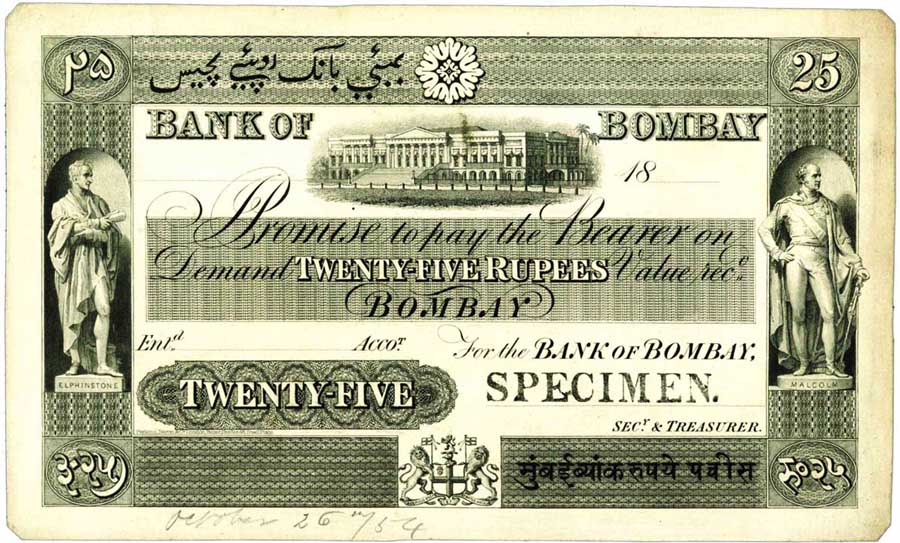
18__ date field never completed. Enlarged
at 400 dpi, the pencil annotation in the lower margin reads October 26ᵗʰ /54:
the superscript th and the two-digit year are both legible.The Perkins Bacon Engraving Book for 26 October 1854 reads
Engᵍ Bk of Bombay 25 Rupees Note. A London day-book and a Bombay auction lot, in
different hands, a century and a half apart, agreeing to the day — and Perkins Bacon's documented
practice was exactly this: pull a proof when a plate passed, mark it with the acceptance date, file
it. The same image independently confirms the piece is Type 2, not Type 3, from the
two-of-four corner pattern.
Todywalla, sale 17, lot 187 · 9 December 2006 · ledger:
RPSL PB136026 p. 61.1219
What actually changed on the note
Set the two designs side by side and the 1854 redesign is a list of four changes, three additions and one deletion:
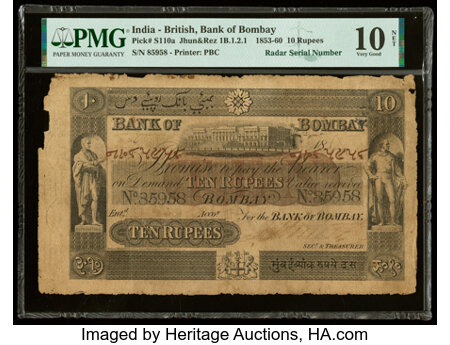
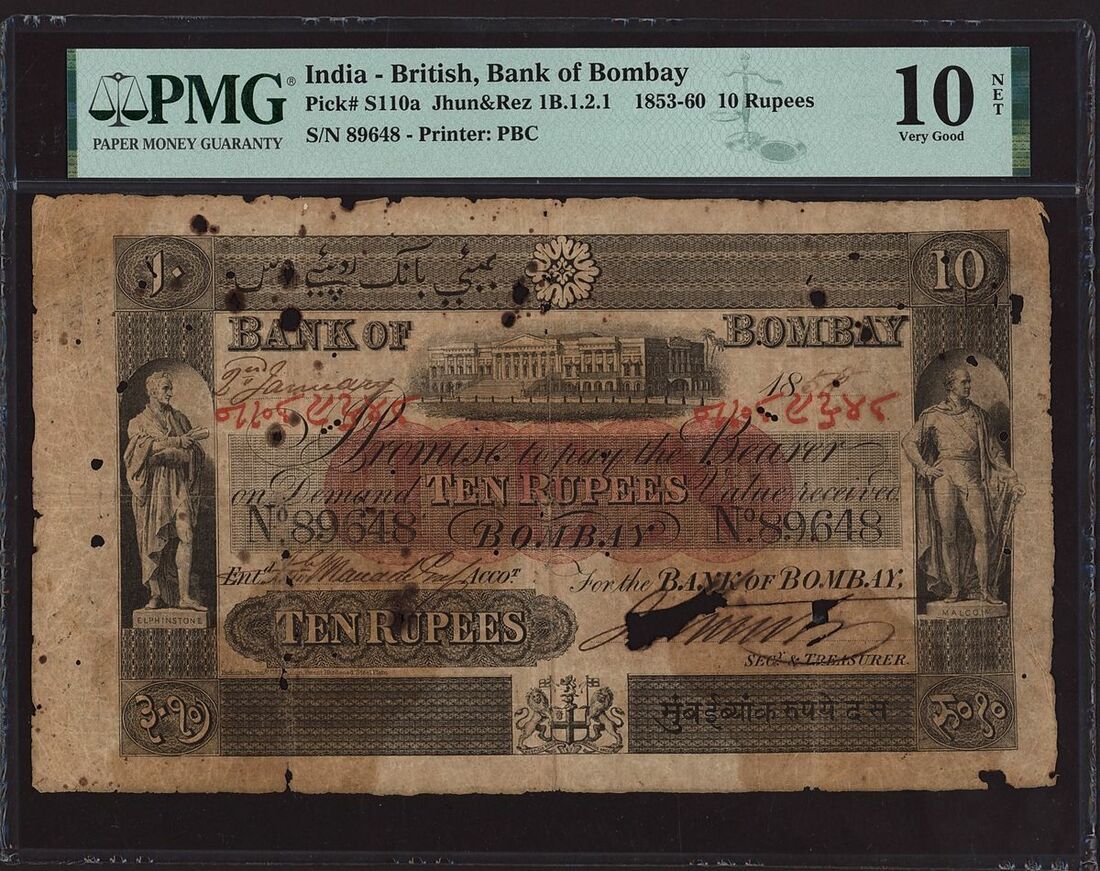
- Added: the Town Hall of Bombay, engraved above the promise text, with the date set into the vignette.
- Added: the East India Company coat of arms, bottom centre — from a die cut on 2 August 1854.
- Added: a coloured concentric-circle underprint, and a different colour for each denomination — Rs 10 reddish brown, Rs 25 brownish maroon, Rs 100 greenish blue.15
- Removed: the printed reverse. Type 1 is the only Bank of Bombay type with anything on the
back —
BANK OF BOMBAY, the denomination in words in English, and a promise line in Arabic. Types 2 and 3 are uniface.
Why? The honest answer, and the good argument
No source states a reason. Not a book, not a journal, not an archive catalogue, not the open web. That should be said plainly rather than papered over. But the devices the bank chose are not neutral, and they point somewhere specific.
The anti-raising reading ≈ inference
A coloured underprint that is a different colour for each denomination is not what you do to stop someone copying a note. One colour would do that. Per-denomination colour defeats exactly one crime: taking a genuine low-value note and altering it into a high one.
And a contemporary Indian source names that as the method. Reporting the Bank of Bengal's own redesign, Allen's Indian Mail wrote in 1856:
"Each denomination will have a separate water-mark, and a separate size… The figures, moreover, are to be printed in colours… In Calcutta, forgery is usually effected by changing a low to a high denomination. This is now effectually prevented."
Allen's Indian Mail, 185614
Bengal's answer to note-raising was to differentiate denominations by watermark, size and colour. Bombay had already differentiated by colour, in October 1854 — and Type 3, two years later, adds the other classic anti-raising device: the denomination in words in all four corners, so a raiser must forge four vernacular legends instead of altering two numerals.
This is inference and must be read as such. No source connects the Bombay colours to raising. What the evidence gives is: the colours demonstrably vary by denomination; a contemporary source names raising as the usual Indian method and colour-by-denomination as the fix; and Bombay adopted that fix first. On dates Bombay leads Bengal by eighteen months — but do not conclude that Bengal copied Bombay. There is no evidence of contact, and both banks used London printers reading the same trade press. Common source, not influence, is the safe reading.
The problem with the argument, stated honestly. If the redesign were a response to forgery, the response took a very long time. Once Cooke's "1851 forgeries" is set aside as a conflation, the bank's only documented note-forgery episode is November 1848. The artwork begins February 1854 and the plates are cut in October 1854 — a gap of six years. Nobody in 1848 wrote down that the notes needed hardening; the Governor called the forgeries "so ill executed that it is almost impossible that any one could be deceived by them", and the institutional response was liquidity management, not new plates.8
There is also a mundane alternative that deserves equal billing: the 1854 campaign cut a Rs 1,000 plate and worked on a Rs 500, the top of the range, at a moment when circulation was recovering. A bank extending its denomination range has to cut new plates anyway, and a design refresh rides along for free. Two questions are in play and they have different answers:
| Question | Best answer | Confidence |
|---|---|---|
| What prompted the bank to place an order in 1853–54? | Probably not a panic. A denomination expansion is at least as likely, and may be the whole of it | ≈ inference |
| Once an order was being placed, what were the new devices for? | Anti-raising. Per-denomination colour and four-corner denomination words target one specific crime | ≈ strong inference |
| When were the plates cut? | October 1854, to the day | ✓ demonstrated |
Three explanations that do not survive contact with the dates
- "The 1852 rename dates the redesign to 1852." No. The plates were cut in October 1854, two years after Perkins Bacon & Petch became Perkins Bacon & Co. The imprint is a consequence of when the plates happened to be cut. It gives a floor, not a date.
- "The East India Company arms were added for political reasons." The arms arrive in 1854; the Crown takes over in 1858. The sequence is backwards for any Crown-transfer explanation. The natural reading is a chartered bank displaying the arms of the government that chartered it.
- "It is an anti-photographic safety tint." Henry Bradbury formulated anti-photographic two-colour printing at the Royal Institution on 9 May 1856 — eighteen months after the Bombay plates were cut. The Bombay underprint cannot be an anti-photographic measure. It is an anti-hand-copying measure.
A coincidence that will tempt somebody, so here it is defused
The Engraving Books show Bank of Bombay work in exactly the week of the 1848 panic —
Engᵍ … Bank of Bombay Back 15 Rs on 17 November 1848 and
Bank of Bombay Fifteen Rupees Note on 20 November 1848. The Bombay run began on
8 November and the mail took roughly a month to reach London. London could not yet have
known. It is a coincidence, not a causal link.12 It does,
incidentally, put a Rs 15 Bank of Bombay note on the record, front and back.
Chapter Six1856: "native char", and the four corners
Sixteen months after the Type 2 plates were finished, the same clerk in the same book recorded the bank altering them again — and this time he wrote down why, in two abbreviated words.12
| Date | Entry | Page |
|---|---|---|
| 29 Feb 1856 | Altᵍ Bk of Bombay 10 Rupees Note native char[acters] | PB136026 p. 98 |
| 19 Mar 1856 | Altᵍ … Bk of Bombay 25 Rupees | PB136026 p. 100 |
| 4 Apr 1856 | Altᵍ & Repᵍ Bk. of Bombay Rs 100 Note | PB136026 p. 101 |
| 17 Jun 1856 | Repᵍ Bk of Bombay Rs 25 | PB136026 p. 107 |
Three denominations — 10, 25, 100 — and the published catalogue lists Type 3 in exactly those three. Three of three. The verb is altering, not engraving: these are the Type 2 plates being modified, which is precisely what the catalogue's "As Type 1B.1.2 except…" construction implies.15
And the alteration is vernacular script. What Type 3 adds is BOMBAY BANK and
the denomination in words in all four corners, in Urdu, Arabic, Marathi and Gujarati, where
Type 2 filled only two of the four panels and left the other two as blank guilloche. That two-of-four
against four-of-four is still the quickest way to tell the types apart by eye, and our own images
confirm the diagnostic literally.
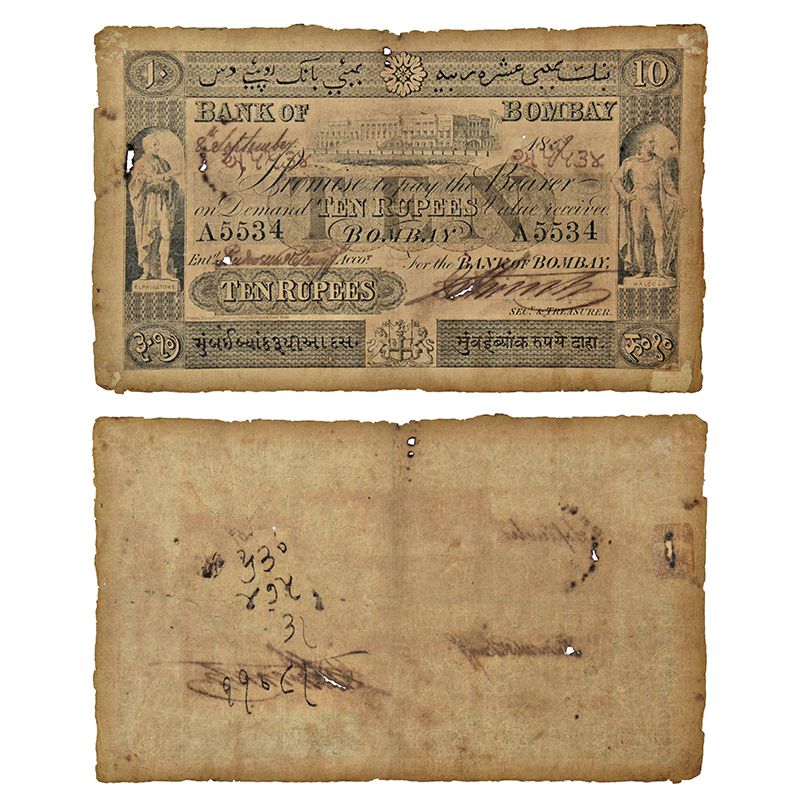
BOMBAY BANK and the denomination in words, and the serial has acquired a
prefix A. This is the last design the Bank of Bombay ever issued; it had about thirty months
to run.
Classical Numismatic Gallery, AUC42, lot 919 · 6 August 2022. CNG graded it "Very fine" — which,
since no Type 3 issued note has ever been submitted to PMG, would make this the finest known issued
example of the type. ⚠ unverified
There was a real user demand behind it. When the Government's own currency notes appeared a few years later without native characters, the Bombay Chamber of Commerce protested — so the vernacular panels were not decoration, and a bank that widened them in 1856 was answering something its customers cared about.2
Two cautions about these ledger readings
The transcriptions are ours, read from the page images with vision — not OCR, and not the
Royal Philatelic Society's own index. The RPSL keyword index corroborates the customer names and the
date windows; the wording is our reading. The load-bearing phrase native char
was re-read at roughly 4× magnification on a crop of the original scan and is unambiguous, but the
RPSL indexed that page only as the bare "Bank of Bombay", so the wording is uncorroborated by the
archive's metadata. Die E. I. Coᵗˢ Arms for Bombay Notes
is corroborated — the RPSL indexed it as "East India Company Arms Bombay".
⚑ our reading
These are plate-cutting dates in London, not issue dates in Bombay. Notes were dated by hand at issue and old stock kept being signed out. Our own holdings prove the lag: Type 1 notes carry manuscript dates of 20 March 1856 and 1857 — up to three years after the Type 2 plates were cut, and the March 1856 one is contemporaneous with the Type 3 alterations. The three types are a plate sequence, not a clean chronology of what was in people's hands.
What the surviving paper says about the changeover
Because the Rs 10 serial run is continuous, the dates on ten surviving notes bracket both transitions tightly. Unlike the Bank of Bengal — whose serials reset, so a Bengal serial cannot date a note — Bombay's Rs 10 numbering runs unbroken straight through the Type 1 → Type 2 change, and resets exactly once, at Type 3, which is when the A prefix appears.
| Serial | Date on the note | Type | The lot — house, sale, lot number |
|---|---|---|---|
| 11996 | 15 Apr 184x / 14.8.184x — sources conflict | 1 | Todywalla, sale 5, lot 92 · 19 Apr 2003 |
| 49774 | 5 Jan 1854 | 1 | Todywalla, sale 125, lot 1 · 20 Sep 2019 |
| 60257 | 1854–56 | 1 | Heritage, New York Signature sale 363, lot 23425 · 10 Jan 2005 |
| 65146 | 20 Mar 1856 | 1 | Todywalla, sale 49, lot 262 · 18 Dec 2010 |
| 67232 | 10 Oct 1856 | 1 | numismondo, Ram Kumar collection · not an auction record25 |
| 73879 | 1857 | 1 | Todywalla, sale 87, lot 1281 · 20 Apr 2014 |
| 85958 | undated (faded) | 2 | Heritage, sale 4035, lot 28213 · 13 Jan 2022 · PMG 10 Net |
| 89648 | 2 Jan 1858 | 2 | Oswal Antiques, sale 72 (Mumbai), lot 239 · 21 Apr 2018 · raw resold: Spink, sale 23009, lot 197 · 26 Sep 2023 · PMG 10 NET |
| A5534 | 8 Sep 1859 | 3 | Classical Numismatic Gallery, AUC42, lot 919 · 6 Aug 2022 |
| A14518 | 1 Nov 1860 | 3 | numismondo, Nilaish Sharma collection · not an auction record25 |
Monotonic without a single exception, across ten pieces and sixteen years. Two conclusions follow:
- Type 1 → Type 2 happened inside 1857, between serial 73879 and serial 85958 — probably the second half of the year. The hard bracket from dated notes alone is 10 October 1856 to 2 January 1858.
- Type 2 → Type 3 happened between January 1858 and September 1859. Running the Type 3 issue rate backwards (A5534 → A14518 is 8,984 notes in 13.8 months, about 650 a month) puts A0001 at roughly early 1859 — a modelled estimate, not a reading.
Which means something useful to any collector: a Bank of Bombay Rs 10 serial can date a note to within a few months, anywhere in the run. That is not true of Bengal, and it has not been said in print before.
The catalogue date-bands are wrong, and here is how to tell
PMG's series strings give Type 1 as 1854-56 and Type 2 as 1853-60 — which would make Type 2 begin before Type 1. They are inherited Pick date-bands, not readings of the graded notes: the Type 2 Rs 25 band runs to 1866, five years past the Paper Currency Act, and Heritage's own lot text headlines "10 Rupees 1853-60" for a note whose manuscript date is "mostly faded from view". Where a dated note and a catalogue band disagree, the note wins. On that rule the three types are strictly sequential with no demonstrated overlap.
Chapter SevenAn island currency
Here is the fact that decides the whole story, and it is buried in a reply the Bank of Bombay's directors sent to the Bank of Madras around 1848.
"The circulation of Bank of Bombay notes in the interior was very limited. Estimating the total circulation at Rs 35 lakhs, perhaps not more than 1 lakh was in circulation beyond the limits of the island."
Three per cent. Ninety-seven rupees in every hundred of the Bank of Bombay's paper money never left Bombay Island. The average aggregate held in all provincial treasuries in the Presidency, the directors added, "the year before was only Rs 30,000."8
And it was not for want of official permission. Bombay had the most liberal acceptance rule of the three presidencies — "All Collectors, Paymasters and other officers of Government are authorised to receive as cash Bank of Bombay Notes when tendered in payment of sums due to Government" — with, Bombay's Accountant-General told Madras in 1849, "no restriction to receive the notes of the Bank of Bombay in the treasuries of the Native Aumils and Custom Servants, provided that they [were] satisfied that the bank notes [were] genuine."8 The widest formal acceptance of the three, and it made almost no difference.
Bagchi's own check eight years later says the same thing. Of Rs 5,86,760 of Bank of Bombay notes held in every government treasury in the Presidency on 1 April 1856, Rs 4,95,445 sat in Bombay town and its suburbs, "leaving less than Rs 1 lakh for the rest of the presidency."8
Where the notes did travel is a small map of the cotton economy: "Bank notes were used as a remittance to Poona for the payment of the troops, etc. and also as a remittance to Surat and Broach for the purchase of cotton, and by these means got into circulation in the Bombay Deccan and Gujarat."8 Where the money went, the paper went. It is the same geography that will kill the bank fifteen years later.
How much paper was ever out there
The statutory ceiling was Rs 2 crore. The bank never came close for two decades, and then came close only at the very end.
| Date | Notes and post bills in circulation |
|---|---|
| 30 Dec 1843 (peak of the first decade) | Rs 63,54,530 |
| 7 Nov 1848 (eve of the forgery panic) | Rs 51,65,400 |
| 13 Nov 1848 (six days later) | Rs 25,46,100 |
| 30 Jun 1852 (average) | Rs 35,00,000 |
| 30 Jun 1853 | Rs 33,73,189 |
| 31 Dec 1857 | Rs 89,74,038 |
| 30 Jun 1860 | Rs 94,19,087 |
| 31 Dec 1860 | Rs 1,23,52,590 — the peak in Bagchi's table |
| 30 Jun 1861 (last figure recorded) | ~Rs 1,00,60,7xx |
Bagchi vol. 1, Tables 13.3 and 13.9, from the Bombay Archives and the Bankers' Magazine; all OCR-grade.8 Cooke, writing in 1863, gives the all-time peak as Rs 1,28,12,0001 — close to, but not the same as, Bagchi's 31 December 1860 figure. ⚑ disputed
So: roughly 1.24 to 1.28 crore against a 2 crore ceiling, reached only in the bank's final full year of issue. Even at the top it was about two and a half times the bank's paid-up capital — and the 1868 Commission named the note issue as a pillar of the bank's prosperity: "Another element of prosperity was the power to issue so large an amount of notes."2
State Bank of India's own history explains why bankers valued it so much, in a sentence that is the hinge of this article: the note issue "meant an accretion to the capital of the banks, a capital on which the proprietors did not have to pay any interest… for a long time… bank notes and government balances made up the bulk of the investible resources of the banks."21
Free money. A crore and a quarter of interest-free funding, created by printing it. In 1861 the Government took it away.
A footnote that is really a warning
In 1841 the Bank of Bombay had tried to open a branch in Calcutta. It had Rs 33 lakhs lying idle; it had already offered the money to the Bank of Bengal at 6 per cent (refused) and to the Government at 5 per cent (declined). The Court of Directors rejected the branch on 26 July 1843, on the ground that it was "inadvisable to encourage the use and circulation of any paper currency other than that of the Bank of Bengal within the limits in which the notes of that bank were then accredited."8
So the Bank of Bombay had no branches at all until 1862. Its issue was an island issue, by policy as much as by habit. When the Government of India came to decide, in 1860, whether the presidency banks should keep the right to print money, the thing it looked at was whether their notes had reached the country. They had not.
Chapter Eight1 March 1862: the press is taken away
The idea did not begin with James Wilson, and it did not begin after the Mutiny. In the September–October 1857 clash inside the Bank of Bengal, the government directors had already warned their mercantile colleagues that "the government would be warranted in taking steps to render themselves independent of the Bank altogether by the issue of notes of its own." The Madras Governor had gone further years earlier, calling it "an error in principle for the Government to divest itself of the power of issuing a paper currency, and to give that privilege to any other body."8
Wilson announced the intention on 3 March 1860. Act XIX of 1861 received the Governor-General's assent on 16 July 1861 and took effect on 1 March 1862; from that date the presidency banks were barred from issuing notes payable on demand, and the Government of India held the monopoly.22 Cooke, writing within a year: the Bombay circulation "continued to increase until February 1862, when it was withdrawn by Government."1
A dating trap worth naming
Both Bombay Gazetteers, and the Maharashtra State Gazetteer after them, say the bank issued notes "until the establishment of a Government Paper Currency Office in 1860". Bagchi gives 1861 in two places and 1862 in two others. The 1860 date is when the policy decision was taken. The Act is 1861; the issue was wound up through 1862. Use those. ⚑ disputed
What Bombay was promised, and what it got
This is the causal hinge of the entire story, and the Bombay Bank Commission put it in one sentence:
"in 1860 the Government of India determined to deprive the Bank of this power and establish a paper currency of its own. As compensation for this, Government proposed to entrust the management of the General Treasuries, Pay Offices and Currency Department, with their respective cash balances, to the Bank. But this proposal was subsequently modified, and only the Treasuries and Pay Offices were transferred to the charge of the Bank."
Report of the Bombay Bank Commission, quoted at Gazetteer 1909 III p. 213 n.2
Read the second half again. The bank surrendered a crore and a quarter of interest-free funding in exchange for three things, and then one of the three — the Currency Department, with its cash balances — was quietly withdrawn from the deal.
There was one immediate, visible consequence, and it is the one thing the presidency banks did right in the 1860s. Once assured of the free use of government treasury balances at places where they opened branches, all three began to expand at speed. Cooke's 1863 directory of officers lists, under the heading "Branches — Established in 1862":1
- Ahmedabad — William Wilson, Agent
- Poona — William F. Hunter, Agent
- Surat — William Watson, Agent
plus a new head-office post of Inspector of Branches. Bhavnagar followed in 1864. In twenty-two years of note issue the bank had opened none; within a year of losing the issue it opened three. One popular reference work states that Bank of Bombay branches opened at Ahmedabad and Poona "by the mid-1870s". Cooke, a contemporary and a primary source, has them in 1862. That reference is wrong by more than a decade.
And the bank did the arithmetic on what it had lost. Wacha, who worked inside it, is explicit that the capital increases of 1863–64 were "warranted by the larger demand for money, specially after the power of circulating its own notes was withdrawn by reason of the institution of the State currency in 1862."4 The Commission itself accepted that the first increase "was necessary and did no more than supply the deficiency occasioned by the Bank's loss of their note circulation."2
The Bank of Bombay did not fail because it printed money. It failed because it stopped.
Chapter NineThe clause
Everything so far has been prologue. What follows took four years and destroyed the bank, and the Commission that investigated it put a single legislative act at the head of its list of causes.
The old Act III of 1840 was a straitjacket, and deliberately so. Advances were capped at Rs 3 lakh to any one person, repayable in three months. There were no advances on personal security at all — a cash credit required Government paper, guaranteed railway shares or bullion. The bank had to hold cash equal to at least one-fourth of all demand claims against it. No overdrafts. Establishment spending capped at Rs 60,000 a year without a general meeting.1
In 1861, "in consequence of new arrangements for the note issue", the board resolved to seek a new Act. What it got, as Bombay Act X of 1863, differed from the old charter in this way — the Gazetteer lists the changes as clauses (a) to (h):2
"(a) it allowed the discount of any negotiable security; (b) it allowed advances to be made on the security of shares in public companies in India and did not require that all the calls on such shares should be paid up; (c) it allowed an advance to any one firm for a larger amount than 3 lakhs and for a longer period than 3 months; (d) it allowed advances on all goods and merchandise, whether perishable or not; (e) it contained no definite provision against the overdraft of accounts; (f) it contained no provision prohibiting any discount or loan unless the cash in the bank equalled one-fourth of all the claims outstanding; and (h) it empowered the proprietors to increase the capital… provided such increase did not exceed 2 crores and 10 lakhs."
Gazetteer of Bombay City and Island, vol. III, p. 2142
Every single prudential restraint, removed at once. Clause (b) is the famous one — the Commission's own comparison with Calcutta reduced the difference between the two banks to it:
"the only practical difference between the charter granted to this bank and that granted to the Bank of Bengal is that contained in section 32 of Bombay Act X of 1863, authorizing advances being made on shares."
The Commission, quoted by Lovell, printed p. 827
A caution on "section 32"
The substance is double-sourced — clause (b) in the Gazetteer, and Hansard's summary that the new Act "gave power to the directors to make advances to any amount to any individual on promissory notes, and on the security of shares in public companies, whether guaranteed or not."13 The section number is not. No digitised text of Bombay Act X of 1863 has been located, and no source outside the Commission quotation attaches the number "32" to that clause. There is a further trap: Bagchi records a §32 in the 1840 Act, being the bar on foreign-exchange business the bank tried to have modified in 1852 — a different Act and a different subject.8 Do not print "section 32" as an independently sourced fact until somebody reads the Act itself. ⚠ unverified
Who deleted the words
The restrictive wording did not fall out of the draft by accident, and the India Office named the men responsible on the floor of the House of Commons:
"Who was it who struck out of the original draft the words, the absence of which afterwards led to so much mischief?… They were two commercial Directors, Messrs. Scott and Foggo. They were appointed to be a Committee for the preparation of the Act by the Directors, not by the Government."
Mountstuart Grant Duff, Under-Secretary for India, HC Deb 3 May 187213
Michael Scott of Ritchie, Steuart & Co. and George Foggo of Forbes & Co. — two of the bank's own merchant directors. Their deletion was ratified by a special general meeting of the shareholders on 28 November 1861.23 And there was a second deletion. The draft Act carried a schedule of by-laws; these were dropped at the suggestion of the mercantile members Michael Scott and Tristram, on the understanding that the Directors would make them themselves.
"They never were made, which left a free hand to the executive officers."
Nor did the Government insist. Gregory, moving the shareholders' case in 1872, made the same point from the other side: the substituted power to make by-laws "was never enforced, the Government never taking the trouble to see that it was exercised."13
And the lawyer told everybody it was fine
The bank's solicitor, Mr Kelly of Kelly & Hore, advised Government that the draft followed "the phraseology of the English Joint Stock Acts." The Commission checked:
"A comparison of all the English Acts with the draft shows the statement as without a shadow of foundation, the Acts being entirely dissimilar" — one of many instances of "the reckless manner in which the legal business of the Bank was done."
The Commission, quoted by Wacha, ch. XI4
Wacha adds, in passing, that Frewen Kelly of the same firm was himself a co-founder of the Alliance Bank with two Bhattia cotton merchants.4 The bank's solicitor was a bank promoter.
Then they trebled the capital
A special general meeting doubles the capital, issuing 5,225 new Rs 1,000 shares. Paid-up capital reaches Rs 104.5 lakh. The Commission later called this increase necessary.
A further Rs 52.25 lakh proposed — "suggested by Mr. Cowasji Jehangir" — and carried unanimously. The Commission called this one largely justified.
That resolution is rescinded in favour of one new share for every old share. Paid-up capital goes to Rs 209 lakh. The Commission: "The final increase of capital by 104½ lakhs was clearly unwise."
In sterling: from £520,000 to £2,000,000 in nine months.13 The bank now had four times the capital, no lending limits, no by-laws, no cash-ratio rule, and no note issue to invest it in. It had to find somewhere to put two million pounds.
Chapter TenCotton
On 12 April 1861 Confederate guns opened on Fort Sumter, and within two years the price of Indian cotton in Liverpool had quadrupled. Lovell states the mechanism in one breath:
"When the American Civil War broke out and cut off the chief source of cotton to the European trade, the price of cotton rose and merchants and cotton dealers in Bombay were given the opportunity of realizing profits previously unheard of. These profits as they returned to Bombay, produced a plethora of wealth far beyond the requirements of a bona fide trade. Therefore an extraordinary means of investment became a necessity… Bombay went mad with the spirit of speculation."
Carol Grace Lovell, The Failure of the Bank of Bombay (1971), abstract7
The numbers behind that sentence: Surat cotton went from 3–5d a pound to 20–24d; Bombay exports from about 528,000 bales a year to 1.2 million in 1865; total Bombay exports to 40.52 crore of rupees, of which cotton was about 29 crore — up from roughly 5 crore in 1861. Gold imports rose from 4.23 to 9.83 crore and silver from 5.32 to 10.07 crore, a cumulative inflow of something like 52 crore of rupees into the Presidency between 1861 and 1865.
And yet money was tight: 18 per cent for good borrowers and 23 per cent for bill discounting by the autumn of 1864. That is the paradox that made the mania. There was more cash in Bombay than anyone had ever seen and nowhere legitimate to put it, so it went into paper.
Thirty crores of capital and thirty-seven crores of premia
That is Wacha's own chapter heading, exclamation marks included, and his company-by-company tabulation of the 1864–65 float is the best measure of the bubble that exists:4
| Class of company | Paid-up capital (crore Rs) | Premia at peak (crore Rs) |
|---|---|---|
| 25 Banks | 13.64 | 10.74 |
| 39 Financial Associations | 6.22 | 4.42 |
| 7 Land & Reclamation Companies | 8.34 | 17.56 |
| ~30 Miscellaneous | 1.56 | 5.00 |
| Total | 29.76 | 37.72 |
"Thus on a paid-up capital of 30 crores there was at one time to be realised a profit of nearly 38 crores! Most of the concerns had had hardly a year's existence, while the rest barely enjoyed a life of from three to six months."
The machinery was the time bargain — a forward contract, endlessly re-sold. Wacha watched it work:
"say, Company A out of its own funds bought from B two Back Bay shares for December delivery at 20,000 Rupees each. No sooner was the contract for such purchase completed than A sold to C the identical two shares for Rs. 40,000… Imagine sales of the two identical shares to half-a-dozen persons or institutions. Imagine that fifty financial concerns did the same."
Wacha 1910, ch. VI4
His verdict on the whole apparatus: "pure gambling transactions and no more", and "There was no such thing as banking in the real sense of the term."
Back Bay: the concession that was not a fraud, and became one
The Back Bay Reclamation Company is the emblem of the mania and it did not start as a swindle. The B.B.&C.I. Railway needed to reach a goods terminus at Colaba; Government had guaranteed the land and had no money; so it granted a foreshore concession — 1,500 acres to be reclaimed, of which 300 handed to Government free. Wacha: "had the feverish speculation of 1864-65 been non-existent, the Back Bay Company would have proved one of the soundest commercial concerns."4
Capital was 2,000 shares of Rs 10,000, first call Rs 5,000. Government was offered one-fifth — 400 shares, Rs 20 lakh — and declined. "These shares were afterwards sold at a public auction for a crore and a quarter rupees." Paid-up Rs 5,200 a share; freely traded at Rs 50,000 at the zenith. That refusal, and that auction, become the centre of the shareholders' case against the Government in Chapter Sixteen.
And in the middle of it stood the Bank of Bombay. Wacha, who had no reason to flatter it:
"It was the Presidency Bank and as such was the principal factor in fostering financial speculation."
The tell that separates the real bank from the two dozen imitations floated in its shadow — the Bombay Presidency Bank, the Bank of India, the Union Bank of Bombay, the Imperial Bank of Bombay, all of them extinguished within months — is the share denomination. The mania companies floated on Rs 100–400 shares. The Bank of Bombay's share was Rs 1,000.4 None of these shadow banks had note-issue rights; the Government monopoly had been in force since 1 March 1862. If you meet one of those names in a catalogue, it is not a note issuer.
Chapter ElevenThe man who owned the bank
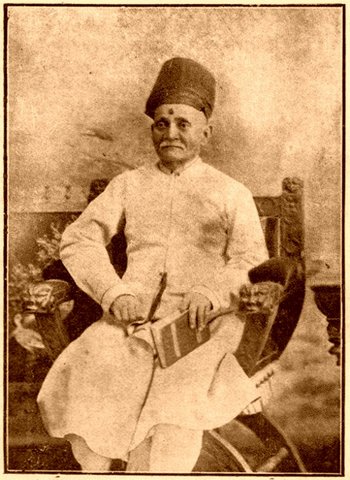
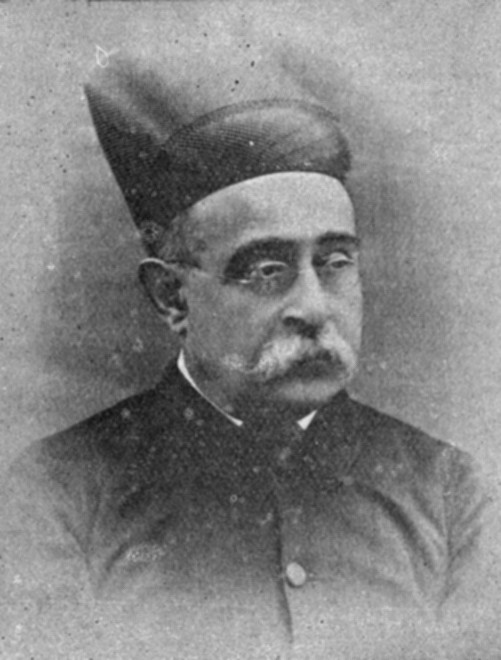
The Commission's own description of him is more generous than anything written since:
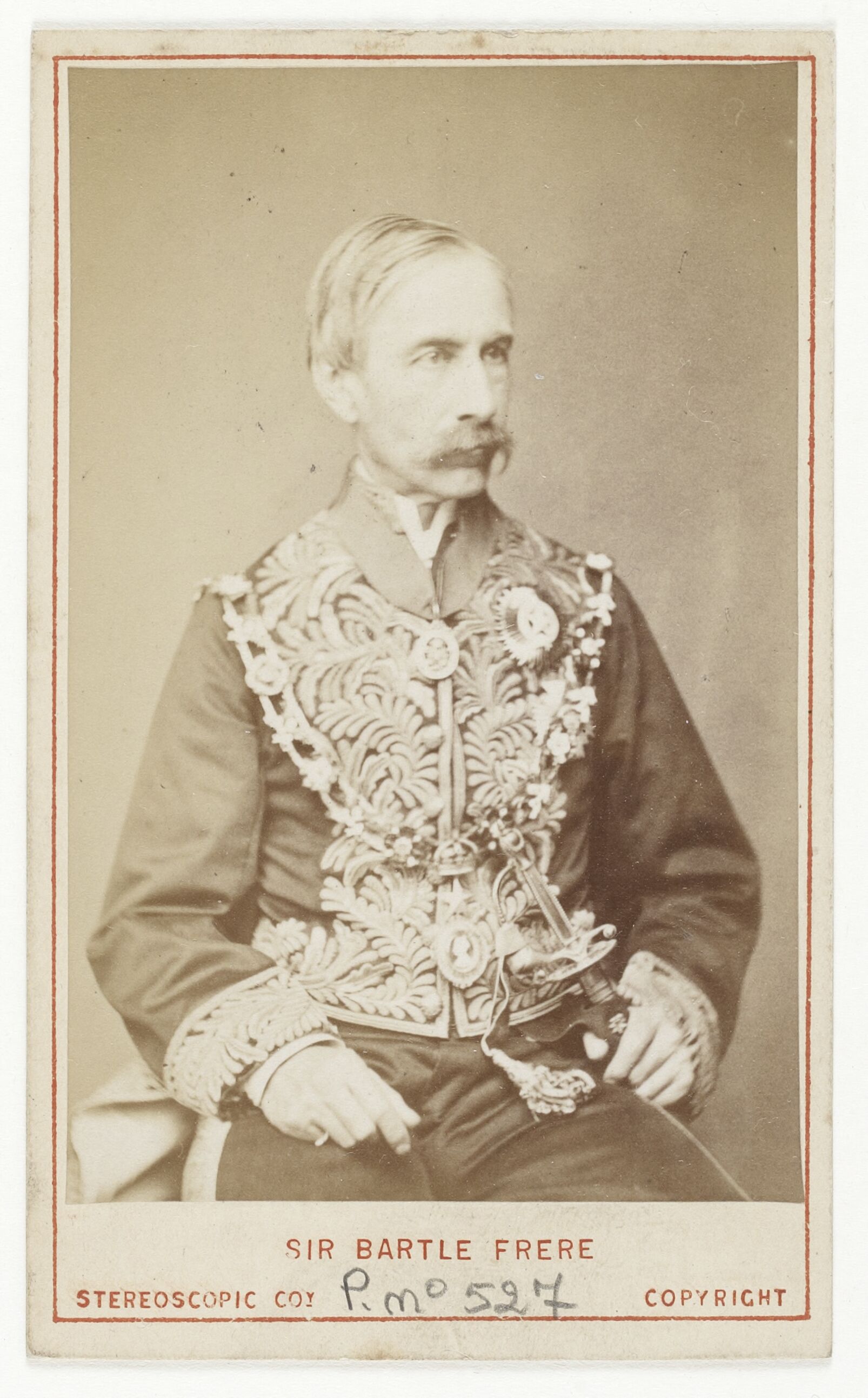
"He was originally a broker in no great business, but he speculated largely in cotton during the progress of the American War and rapidly amassed a large fortune, and when the 'Share Mania,' as it is not inaptly called, set in, he was in such a position that his name and influence were considered essential to the safe launching of the ephemeral schemes of the day… he became the great dispenser of allotments, which he judiciously distributed, first, among the managers of the Banks, and, secondly to the friends of the promoters… he has been called by some of the witnesses 'the key-stone of the commercial prosperity of Bombay'. His charities were munificent and Sir Bartle Frere says that his position was like nothing that he had ever seen or heard of in any other community."
Report of the Bombay Bank Commission, quoted verbatim by Wacha, ch. VII4
Read that middle clause again — first, among the managers of the Banks. It is the whole mechanism in six words.
How he got in
It was Premchand who suggested to James Blair, the Secretary, that if the Bank would lend on personal security he could produce plenty of applicants — because his associates disliked having their names go before the directors. Blair said he would consult the board. He did not, and started the practice anyway. "Coincidently Premchund Roychund and his father Roychund Deepchund were the first to receive cash credit under this new system," and the first such advance was "for a lakh of rupees to Roychund Deepchund, the broker of the Bank and the father of Premchund Roychund."74
Then Blair handed him a book of blank promissory-note forms, to be filled up by Premchand himself with the names of parties he recommended for loans. Wacha calls it what it was: "tantamount to giving him a blank cheque book to enable him to exhaust the Bank's capital at his own will."4
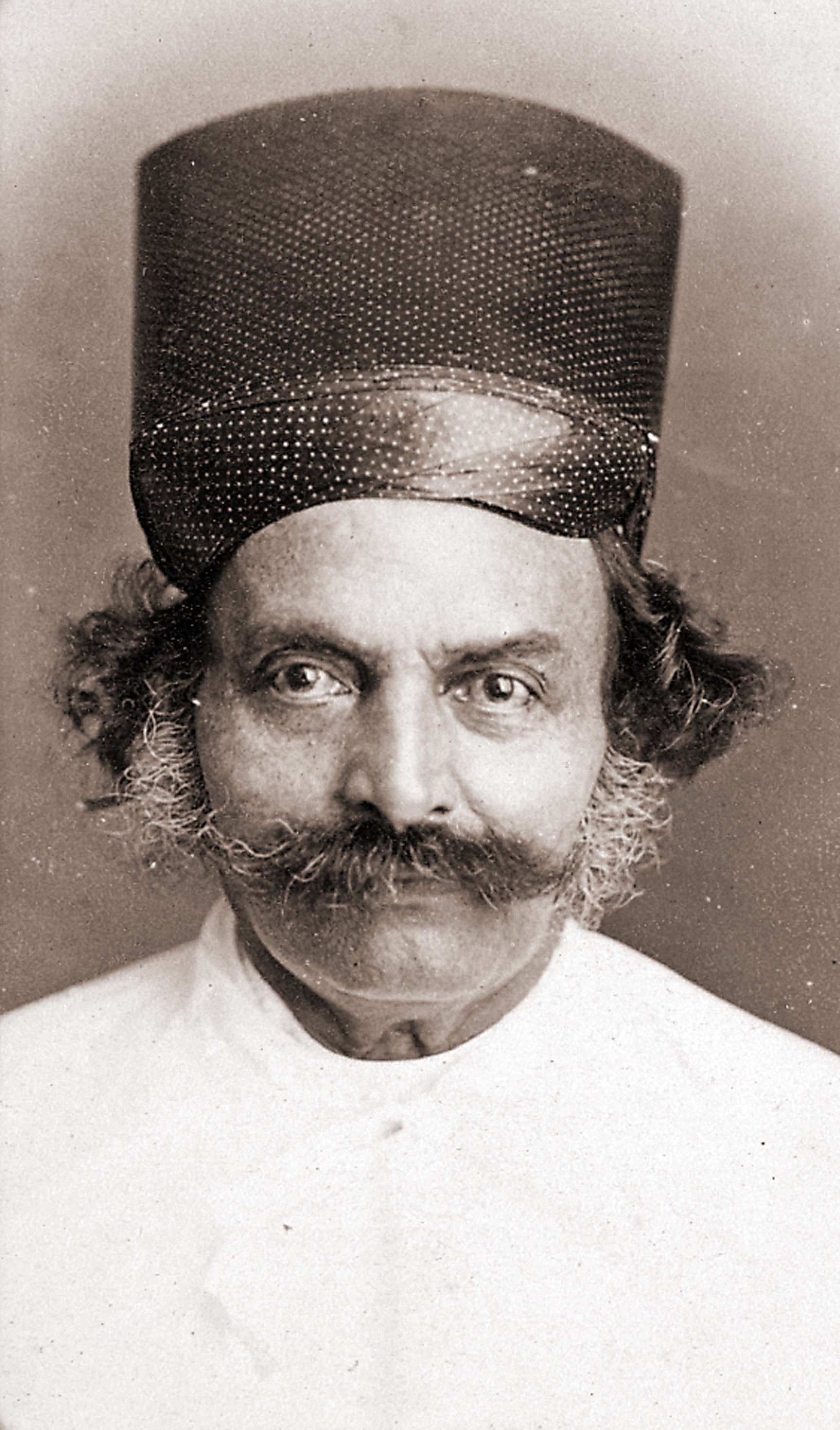
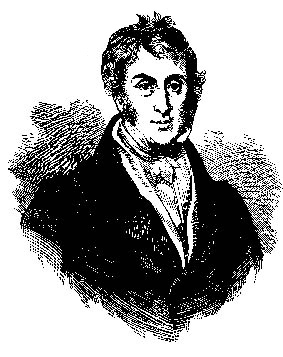
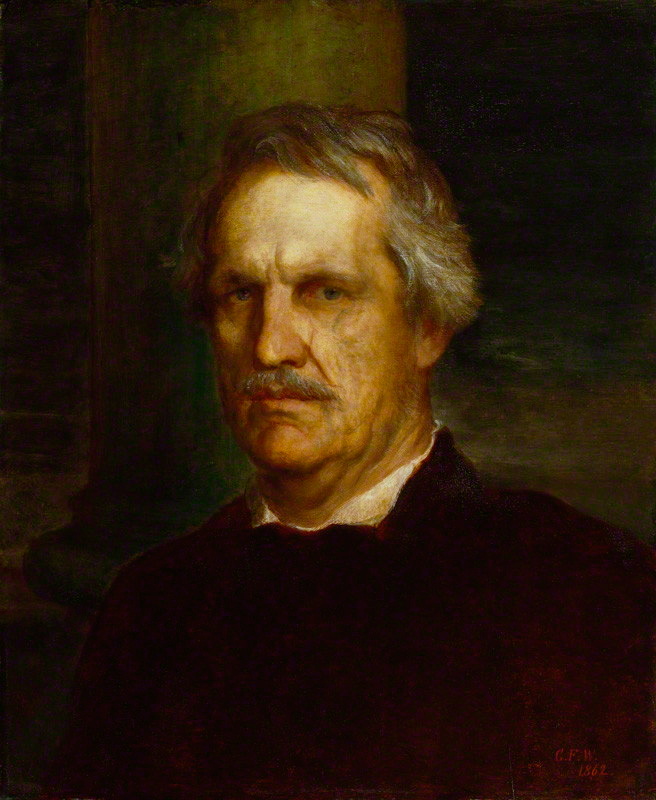
He resigned in June 1864 because he opposed the final capital increase. Premchand Roychand joined the board the following month. By the time the Commission sat, Cowasji was too ill to be examined. Neither his Britannica entry nor his Wikipedia article mentions the directorship — the strongest documented fact about him is the one his biographies omit. Wikimedia Commons, public domain.
With Cowasji gone, there was nothing left between Premchand and the till. The Commission on what followed:
"Intelligent and subtle, Premchund Roychund was not slow to fathom the imbecility and weak moral character of Mr. Blair and soon acquired great influence over him and his subordinates, with complete command of the funds of the Bank. He procured allotments for Mr. Blair and lent him money… Premchund also bought and sold shares for Mr. Blair and entered into joint speculations with him and never charged him a rupee for brokerage. The result was that the Bank became Premchund's."
The Commission, quoted by Wacha ch. XI and by Lovell from the Report Summary p. 1447
And on the mechanics, which are worth setting out because they are so simple:
"If Premchund had a friend to oblige who wanted money, he recommended him for a loan. If Premchund had shares to sell, he would suggest to an acquaintance that he should buy, offering at the same time to 'finance' the purchase money by procuring him a loan from the Bank of Bombay. If Premchund wanted money for a speculation, he would suggest to some friend to join him in it, and then procure a loan in his friend's name for the money required. His influence was felt not only at the head office, but at the branches also, the Agents at Kalbadevi, Broach and Surat all receiving instructions to consult Premchund or his agents respecting advances."
The Commission, quoted by Wacha ch. VII4
The bill
| Item | Rs | £ at Rs 10 = £1 |
|---|---|---|
| His own debt to the Bank | 42 lakh + | £420,000 |
| Loans obtained for others who bought shares from him | 66,90,000 | £669,000 |
| — of which irrecoverably lost | 43,45,478 | £434,547 |
| Procured for partners in speculation / his own purposes | 29,58,938 | £295,893 |
| — never repaid | 13,02,408 | £130,240 |
Wacha's gloss: "with the tills of the old Bank of Bombay at his absolute disposal, he helped himself and his friends to their contents to the tune of one hundred and thirty-eight lakhs of rupees, or more than half its capital."4 On the schedule of advances outstanding at 31 December 1867 he is the largest single name on the list: advances 35.62 lakh, loss 20.78 lakh.
The sentence Wacha wrote to summarise the governance of a chartered bank with three Government directors on its board is the best line in the literature:
"To say that the directors entrusted the destinies of the Bank to the Secretary, that the Secretary left them at the mercy of Mr. Premchund and that Premchund left them to Providence is no exaggeration of the real state of the Bank."
Three specific malpractices, with prices
- Lending against the froth. On 12 April 1865 the directors resolved to advance not only against the nominal value of shares but against the market premium — up to 75 per cent of it. If the shares stood at a £200 premium, the Bank would lend £175 of the premium. Gregory, in the Commons: "contrary to every system of banking which had existed in the world." Loss: £134,716.13
- The illegal branch. The charter forbade a branch in Bombay itself. The directors opened one at Kalbadevi anyway, and Government specially sanctioned it. Loss: £190,000.13
- Directors taking allotments. Sylvester Birch, a Government director and the Bank's President at the launch of the new charter, "received allotments of shares, by which he realized something like £37,000" — the Commission's own figure, via Wacha, is £37,575 "by way of premium or profit." Wacha's question is the right one: "how could the President keep his watchful eye on the Bank when he was indebted to the chief factotum… for fat allotments?"413
The line that explains the Government directors
A newly appointed director, alarmed at what he saw in the loan book, raised it with R. Tracey of Ritchie, Steuart & Co. — a commercial director, and Premchand's business partner. Tracey's reply was read to the House of Commons by Sir Stafford Northcote:
"they had better not discuss the subject then, as the Government Directors were only too apt to take alarm."
HC Deb 3 May 187213
Tracey left England shortly before the Commissioners returned from India, "although he had information that they were about to return, and that the evidence taken in India reflected on his character."4
Chapter TwelveThe Black Day of Bombay
Robert E. Lee surrendered at Appomattox on 9 April 1865. Word that the war was ending reached Bombay before he did so, and the cotton price did what everybody had refused to believe it could do. Wacha: "From 20 pence per pound it fell to 10 pence and even lower by the end of April 1865. That fall tolled at once the death-knell of speculation."4 Wacha's own text dates the news of Lee's surrender in Bombay to March 1865, which cannot be right — the surrender was in April. He is almost certainly compressing the news of the war's collapse; the price movement he describes is not in doubt.
A contemporary journalist, quoted by Wacha, asked the only question that mattered: "Seventy millions came into Bombay and what became of it?"
Byramji Hormusji Cama, the largest cotton shipper in the city, cannot meet re-drafts against his consignments and vests his estate in trustees. He owed the Bank £177,168, "but without security"; his total liabilities were reckoned at nearly 3 crore. Wacha: "The news of this first and most stupendous failure spread like wildfire… In the share market its effect was like that of the most destructive bomb-shell."
A run on the Bank of Bombay. Governor Sir Bartle Frere telegraphs the Viceroy asking whether Government will advance 150 lakh (£1.5m). The run stops the moment it is known the Bank will be supported — and, as Gregory put it, "the necessity for rendering pecuniary assistance never arose." Not a rupee was actually lent.
The Black Day of Bombay.
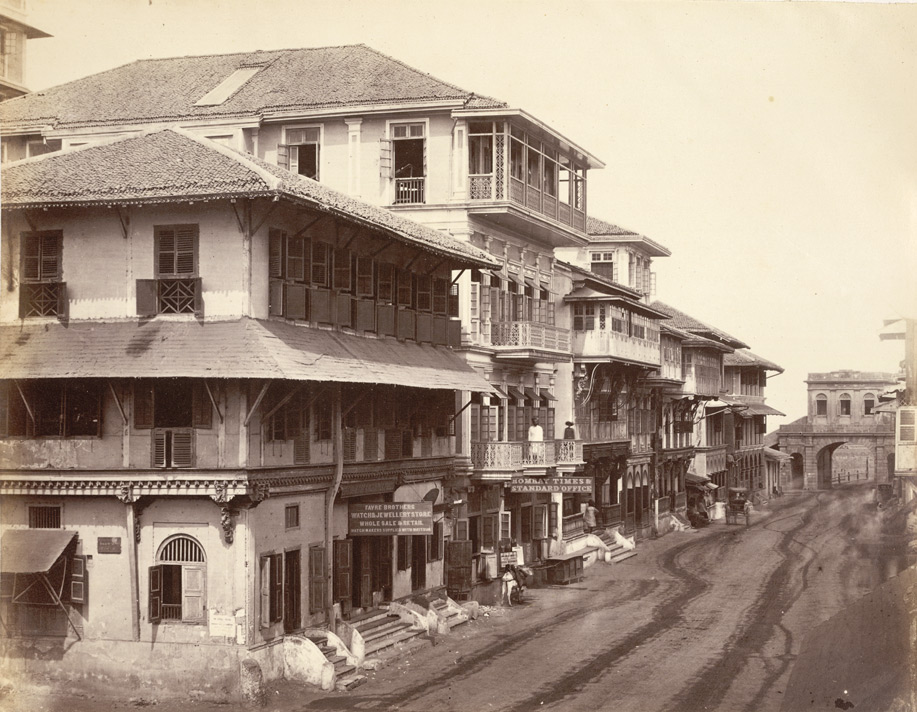
Hundreds of time bargains fell due on the same day, with an aggregate nominal value Wacha puts at "well-nigh seven to eight crore of Rupees." He was there:
"Back-bays, which were sold for Rs. 55,000 for 1st July, were absolutely unsaleable at even their nominal par value of 5,000 Rupees! Bank of Bombay shares, quoted at well-nigh 2,900 Rupees could not be sold even for 500!"
Wacha 1910, ch. XXIV4
"It was apprehended that there might be some squabbles or an economic riot. So the police had taken the precaution to post up an additional posse in the Fort." And: "People conversed in whispers in the streets with woe-begotten looks."
Wacha calls it Bombay's Black Friday, "as much as the 'Black Friday' of London a year later when… Overend & Gurney came to grief." He is right to link them, and the sequence matters: Bombay crashed first, by ten months.
The relief Act that made it worse
Act XXVIII of 1865 was rushed through to take insolvencies over Rs 5 lakh out of the Insolvency Court. It backfired immediately, because it applied only to estates above that threshold: "it indirectly gave great incentive to certain dishonest people to cook up their liabilities up to five lakhs by purchasing from the depressed share market for a song worthless securities and making entries in their books of their cost at the grossly inflated values at which they were quoted during the mania!"4
By September 1868 exactly two estates had been settled under it.7 Wacha: "Act XXVIII of 1865 became a by-word of reproach."
Chapter ThirteenSeven in the morning, on the porch
This is the best-documented scene in the whole affair, reconstructed by Lovell directly from the Commission's sworn evidence, and it deserves to be famous.
26 April 1866. Premchand Roychand needs Rs 25 lakh — £250,000 — by the next day or he stops payment. Donald Robertson, now the Bank's Secretary, tells the President, Francis Lidderdale. Lidderdale calls a special meeting and invites the managers of the Oriental, the Chartered Mercantile, the Asiatic and the Bank of Hindustan, "for everyone felt that Premchund would have to be assisted or else they all would fail with him." No statement of his affairs exists. They adjourn.
27 April 1866, seven o'clock in the morning, at Lidderdale's house. The Comptoir d'Escompte and the Commercial Bank have joined. Seven banks are in the room.
Premchand himself was there — but he remained on the porch, answering questions relayed in and out by Robertson or by Tracey, his own business partner.
A rough, unverified statement of his affairs is drawn up. The security offered is: his jewels (the memorandum values them at 20 lakh; nobody checks), and title deeds to land — valued in the memorandum at 26 lakh, by the Government director G. Norman, as collector of land revenue, at 14 lakh, and by Robertson in a letter at 18 lakh — plus a joint promissory note with his father and two others.7
When Tracey went out to the porch to press him on the securities, Premchand replied that
"if they wanted to make a bother I would rather stop payment, and that if they made any difficulty about these securities I would give them the names of three other parties as guarantees."
Premchand Roychand to R. Tracey, 27 April 1866 — Commission evidence, via Lovell ch. V7
The directors hurried to close. The split agreed: Bank of Bombay 10½ lakh; the Oriental, Chartered Mercantile, Asiatic, Commercial and Comptoir d'Escompte 2½ lakh each; Bank of Hindustan 2 lakh — with the Bank of Bombay advancing the whole sum and being recouped by the others.
Then, in order:
- Kelly, the solicitor, was told to draw a deed. Neither Kelly nor Robertson made any memorandum or minute of the agreement.
- No signatures were taken. Not all the security was handed over.
- Premchand drew the money that same afternoon.
- Robertson had not told the directors that Premchand was already 23½ lakh in debt to the Bank as of the previous day — including a 5-lakh overdraft and a 9-lakh outstanding loan. He and Tracey both knew.
- The other six banks later repudiated their liability. Lord George Hamilton conceded this from the despatch box in 1875; Gregory interjected to agree.
So the Bank of Bombay lent a quarter of a million pounds at seven in the morning to a man standing outside the door, against jewels nobody had seen and land nobody could value, with no minute, no signature and no deed — and ended up carrying the whole of it.
The £250,000 figure, corrected
Gregory in 1872 and 1875, and Barttelot with him, present this as the Bank of Bombay lending Premchand £250,000. It was a syndicate. Rs 25 lakh total, of which the Bank of Bombay's own share was 10½ lakh (£105,000) — the Bank merely fronted the lot. Both accounts are true at different stages, but "£250,000 from the Bank of Bombay" is the misleading shorthand, and it has propagated everywhere.713 ⚑ disputed
Chapter FourteenThe last two runs
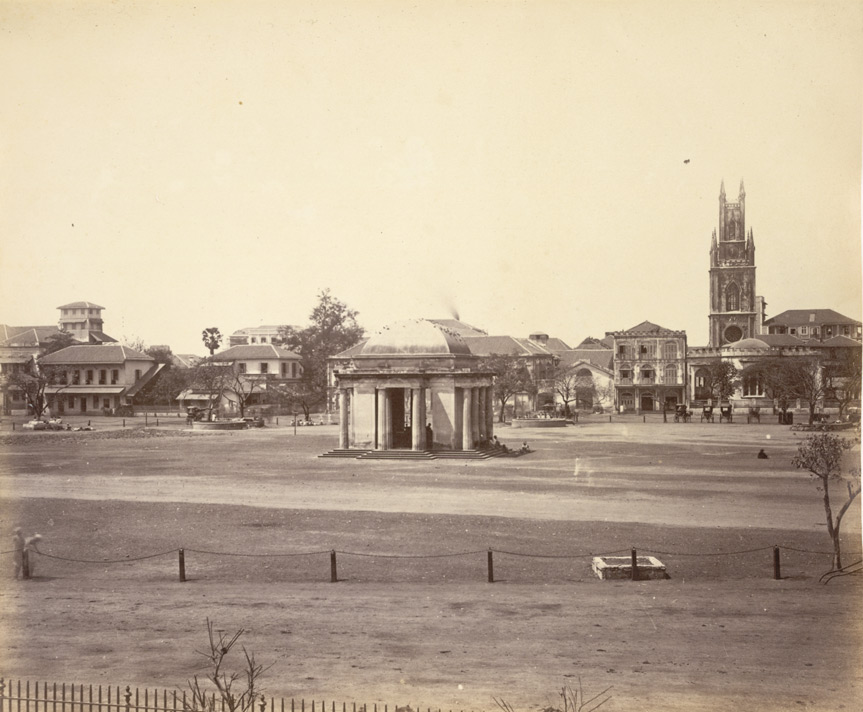
It moved into its grand new premises in the year it was dying. What stands on the site today is not settled — heritage sources conflict on whether the 1866 building survives, was rebuilt in 1924, or was replaced, and none of them is good enough to print. ⚠ unverified Francis Frith, via Wikimedia Commons, public domain.
The Government of India had by now noticed that it could not see inside the bank it part-owned. The despatch of 13 July 1866, in Sir John Lawrence's name, is unusually blunt for the genre:
"The Governor-General-in-Council, though fully sharing in the desire of the Bombay Government to uphold the credit of the Bank, cannot suffer the revenues of India to be indefinitely pledged to the support of an establishment of the affairs of which he is kept in ignorance."
Government of India despatch, 13 July 1866, quoted by Wacha ch. XII4
It then demanded, item by item: the banks, firms and individuals under advance; the dates and amounts; the securities and the sum advanced on each. The Bank stalled until a second despatch in October. The statement finally furnished on 23 November 1866 drew this from the Commission:
It "gave no information from which that Government could form any estimate of the true position of the Bank… It avoided all mention of Premchund's great loan of twenty-five lakhs… It omitted to set forth the large debt of more than nineteen lakhs due from the Asiatic Bank although the cash credit had expired on the 1st September, and the Asiatic Bank had failed on the 26th of that month. A more unsatisfactory statement could scarcely have been framed."
The Commission, quoted by Wacha ch. XII4
Wacha's own conclusion is blunter than the Commission dared be: "it became the common interest of the Bank and the Bombay Government to conspire in withholding all necessary information from Sir John Lawrence."4
The Asiatic Banking Corporation fails, owing the Bank of Bombay more than 19 lakh. It had also been holding 91 lakh on deposit for the Back Bay Company, which goes into liquidation on 18 November.
On Sir Charles Wood's instructions the Bombay Legislative Council passes Act XV of 1866, stripping the Bank of the power to advance on shares. Three years after it was given.
Special meeting. Capital reduced by half: nominal share Rs 1,000 → Rs 500; the market price is Rs 250. Wacha: "simply a blind. It might have been fairly put into liquidation on that day instead of a year later."
A second run. Rs 1,69,00,000 withdrawn within a few days. The Government of India again promises support, and the run stops.
General meeting. The directors estimate the capital lost at one and a half crore.
At a general meeting the shareholders present resolve to wind up voluntarily. John Stuart — the cautious Scot who had run the bank for its first twenty years and retired in 1860 — is recalled from retirement and appointed liquidator.
The liquidator reports. Irretrievable loss: Rs 1,88,99,331.
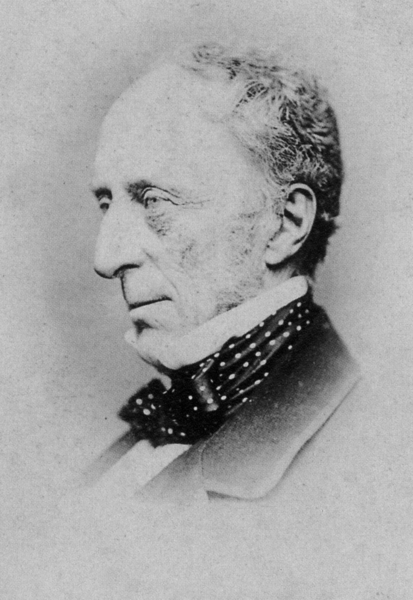
The inquiry that followed was handed to the Government Directors themselves. When Wood directed in September 1865 that there be no further advances on unguaranteed shares, the Bombay Government "referred it to the Directors, by whom it was practically ignored" — and the Directors, Lord George Hamilton later admitted, denounced the instruction "as a most tyrannical interference".13 Wikimedia Commons, public domain.
What the shareholders got
Wacha, twice, and Lovell's text agrees with him: "The Bank of Bombay lost all its capital save a few lakhs which returned to the ruined shareholders about a hundred Rupees for every five hundred Rupees but which were once quoted at nearly 3,000 Rupees."4
Set against a fully-paid share of Rs 1,000, that is one-tenth. Against the reduced nominal of Rs 500 after January 1867, one-fifth. Against the peak market quotation of Rs 2,900–3,000, about one twenty-ninth. The widely repeated "one-fiftieth" comes from the abstract of Lovell's thesis and is contradicted by the body of the same thesis; on the arithmetic it cannot be right. ⚑ disputed
Wacha's reconciliation of the two Secretaries' periods gives the fullest measure of the damage: total advances head office plus branches Rs 3,52,60,662; total loss Rs 2,04,66,991 — a loss ratio of 57.96 per cent. Blair's period cost about 1.5 crore; Robertson's Rs 51,55,589.4
Depositors and creditors, note, lost nothing. Grant Duff in 1872: "no creditor or depositor has lost a penny by the Bank's failure, though the Government, like other shareholders, has lost nearly the whole value of its shares."13 The losses fell entirely on the proprietors — including three hundred shares' worth on the Government of Bombay itself.
Chapter FifteenThe Durbar Room
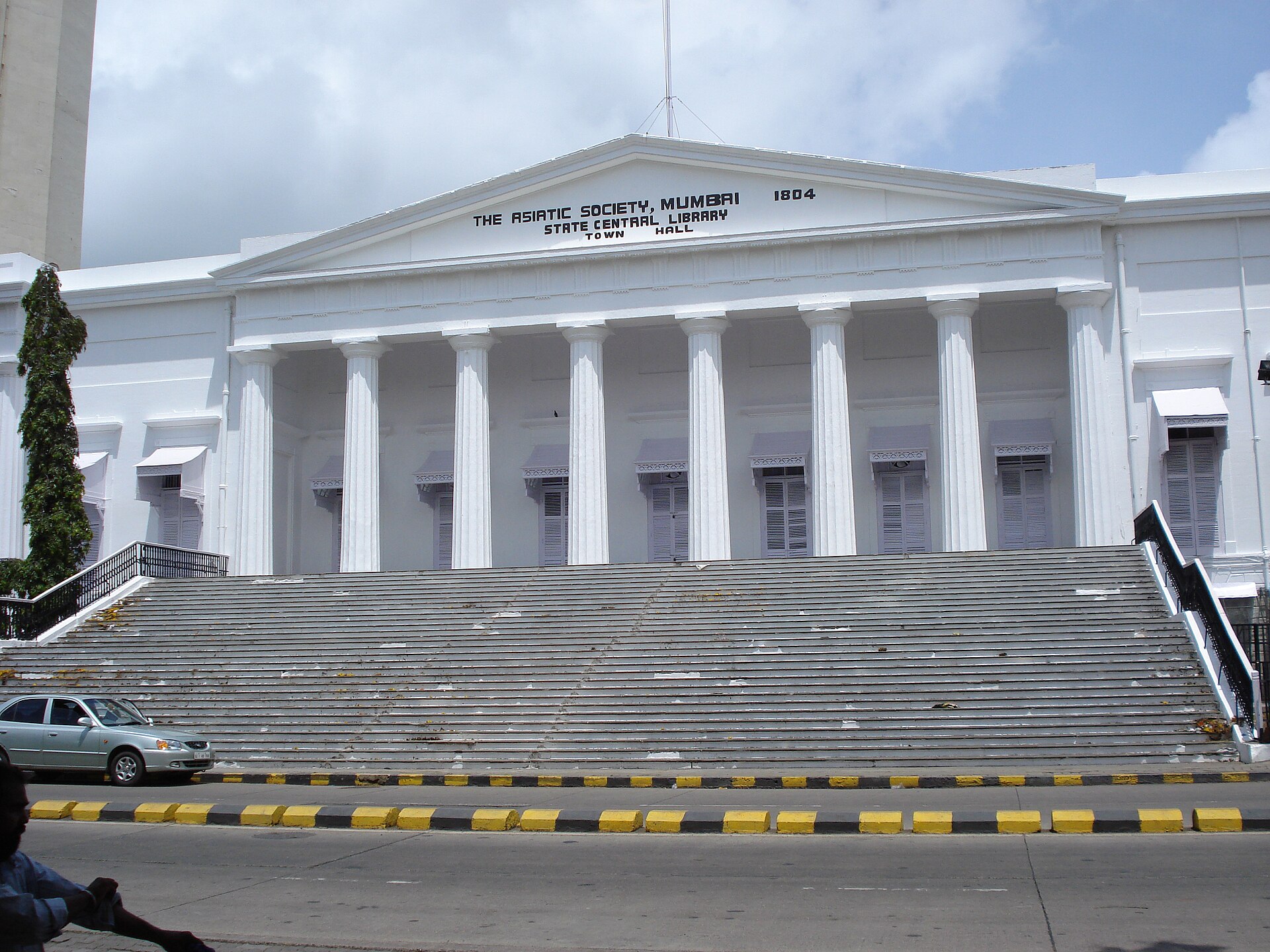
From 29 June to 9 September 1868 the Commission appointed to inquire into the failure of the Bank of Bombay sat in this building's Durbar Room, twenty-four times. The bank had put the place on its money; fourteen years later the place took the bank apart. Wikimedia Commons, CC BY 4.0.
The Commission was established under Act XVII of 1868 on the direction of the Secretary of State. Its president was Sir Charles Jackson, in the 1850s a judge of the Supreme Court of Judicature in Bombay and "known to be a first-rate cross-examiner." With him sat Major MacLeod Innes, Military Accountant-General, and Maxwell Melville of the Bombay Civil Service. The vernacular accounts were translated by Nowroji Furdoonji.4
| Bombay sittings | Durbar Room, Town Hall · 29 June – 9 September 1868 · 24 sittings |
| London sittings | 9 November – 11 December 1868 · 15 sittings |
| Witnesses | 96 in all, 74 of them in Bombay |
| Report submitted | 10 February 1869 |
| Evidence | 787 printed pages of sworn examination — the copy this article draws on3 |
James Blair, by then in England, pleaded ill-health and asked that a written statement be accepted instead. The Commission went to his house in Bayswater and examined him anyway.4
The six causes
The Report itself is a Parliamentary Blue Book that is still not freely available. But Wacha prints the six findings verbatim, Lovell paraphrases them from the Summary, and Mr Dickinson read them into Hansard on 3 May 1872 — three independent witnesses to the same text:
Report of the Commissioners Appointed to Inquire into the Failure of the Bank of Bombay, 1869
- Act X of 1863, which removed many restrictions contained in the former Act, and permitted the Bank to transact business of an unsafe character.
- The abuse of the powers given by Act X of 1863 by weak and unprincipled Secretaries acting under the influence of a designing Native Director, Premchund Roychund.
- That the Presidents and Directors were negligent and failed to do their duty in omitting to pass by-laws, in not exercising proper supervision and control over the Bank and its Secretaries, and particularly in not ascertaining how the business of the Bank was carried out.
- The very exceptional nature of the times, which required more than ordinary vigilance.
- That the Presidents and Directors were not conversant with banking business and were incapable of managing such an institution in difficult times.
- The absence of sound legal advice and assistance.
Wacha ch. XII, verbatim4 · Lovell from Report Summary p. 477 · HC Deb 3 May 187213
And on the Act specifically: "It may be that the old Act was unnecessarily restrictive, but that did not justify the removal of all restrictions… They opened the door to great laxity of practice and a ruinous system of banking, and were in fact the chief cause of the Bank's failure."4
On the practices themselves, the Commission's paragraph is worth reading whole, because it is a description of a bank with no functioning controls at all:
"The most reckless system of advances commenced. The Secretary was virtually unrestricted in the powers he assumed to have, and the President and Directors, although they must have known that enormous sums were flowing out of the Bank, appear to have made no inquiries and to have exercised no supervision. The discount list was discontinued, no loans were brought before the Board or the weekly Committee for their sanction, lakhs of rupees were advanced by Mr. Blair without consulting the Directors, to single individuals, or to the ephemeral companies of the day on no other security than the promissory notes of the parties borrowing, and he appears to have in many instances granted loans although the borrower was already largely indebted to the Bank."
The Commission, quoted by Wacha ch. XI4
Wacha adds the detail that finishes it: "Even the documents taken from the borrowers were never carefully scrutinized. They were of a most informal character, such as in a Court of Law would be considered to be so much waste-paper."
The report that was not published
Colonel Barttelot, in the Commons on 3 May 1872: "Two Reports emanated from that Commission, but one of them only was made public. Where… was the other Report? Was it because it was condemnatory and damnatory of the Government of Bombay that Her Majesty's Government were afraid to produce it?"
Sir Stafford Northcote — who as Secretary of State had recommended the Commission in the first place — answered that he had asked the Commissioners to report on several points which were "matters of opinion, not of fact", so separate Reports were more convenient, and that they contained nothing "which could have led to their being kept back for a purpose." That is consistent with the command paper numbering C.4162, 4162-I, -II, -III. It has never been tested, because the Blue Books are still not online.13 ⚠ unverified
The verdicts on individuals
| Name | Role | What the Commission found |
|---|---|---|
| James Blair | Secretary, Aug 1863 – 1865 | "unequal to the management of such an institution… an easy tool in the hands of a designing man such as Premchund. But his concealment from the Directors of his mode of transacting business and his orders for the omissions from the application book show that he was dishonest and deceived those by whom he was trusted." Wacha: he "escaped penal punishment" |
| Donald Robertson | Deputy Secretary, then Secretary | "He placed himself for his private gain in a position in which his own interests were at variance with his duty to the Bank… by the recklessness of his advances proved himself unfit for such an office." Losses in his period: Rs 51,55,589 |
| Sylvester Birch | Government Director and President, 1863 | Lost the Bank "£1,000,000 or £1,500,000, while he received some £37,000 as a premium on shares" (Gregory). Resigned 1865; examined in London |
| Francis Lidderdale, J. Lushington | Presidents, 1866–68 | Lovell: "Each of these men neglected his duty to the bank and by doing so completed its ruin" |
| John Stuart | Secretary 1842–60; liquidator 1868 | Wacha: "a far-sighted and extremely cautious Manager… there was hardly a bad debt… But for him as the sole liquidator, it is doubtful whether they would have got back even the little return of capital that they ultimately received" |
Wacha's summary of the Commission's value is the reason this article can be written at all: "But for the Commission the monetary world of India would never have known the utterly rotten condition of its management."
Chapter SixteenWestminster says no, twice
The ruined shareholders had one argument, and it was a good one: the Government of Bombay had appointed three of the nine directors, had the power to audit, had been warned three times, and had twice stopped a run by promising public money. If it was not a partner, what was it?
They took it to Parliament. Four times.
8 May 1868 — the reconstruction is attacked before it opens
Ayrton objects that the new bank being set up has the same powers as the one that just failed, and warns against Government shareholding without legislative safeguards. Northcote concedes that Government shareholding in presidency banks is "inexpedient" but says reconstruction is impossible without it, and announces that Sir C. Jackson is going out to India.13
21 July 1870 — nobody will be prosecuted
The single sentence that turned a financial grievance into a political campaign:
"I regret that we have not seen, and do not see, our way to taking effective legal proceedings even against the persons most implicated in the unhappy transactions which led to the fall of the Old Bank of Bombay."
Mountstuart Grant Duff, Under-Secretary for India, HC Deb 21 July 187013
3 May 1872 — the great debate
Nineteen thousand words, and the fullest public narrative of the failure that exists in free text. Mr Gregory moved "That, in the opinion of this House, the case of the Shareholders of the Bank of Bombay is one for the favourable consideration of Her Majesty's Government," and framed it in a way that still reads well:
"The Government in India was despotic… but as a condition of being a despotic Government, it must necessarily be a paternal Government."
His charge: the Government of Bombay committed "acts both of omission and commission"; and "not only was there neglect on the part of the Government of Bombay, but… they deceived the Governor General and the Secretary of State, and further… they deceived themselves and were willing to be deceived."
| For the shareholders | Against |
|---|---|
| Mr Eastwick: "there had been that which some persons might be disposed to term swindling"; asks for money to prosecute the directors | Grant Duff: "the very people who wished for the legislation of 1863, accepted the new charter, and took all the advantages under it, including dividends at the rate of 12½ and 16 per cent, are actually coming whining to Parliament" |
| Mr Henley: the Government had a power of audit which it never used — "Was that not lâches?" And: had Government not propped the Bank up twice, "the loss to the shareholders would not have been one-half what it had been since" | Grant Duff: "those are not the true friends of the widow and the orphan who encourage them to get 16 per cent for their money" |
| Mr Bouverie: the Government Directors "ought to have resisted the gambling propensities of their fellow-Directors… instead of co-operating with them"; "it was a shame to the Indian Government that they seemed never to have taken a single step to prosecute those officials" | The Solicitor General: the Report "only mentioned two of the Directors as having been guilty of moral misconduct", and even as to them he could not see how a criminal prosecution would lie |
| Mr M. Chambers: "he who did a thing by his agent did it by himself" | Mr Denison: "a more scandalous revelation of the conduct of a great institution… had never been placed before Parliament" — but relief would be "offering a premium for any future amount of misconduct" |
Gladstone closed it. Shareholders could not claim "all the delights of dividend mounting up to 16 per cent, and then on the strength of vague presumptions… claim the benefits of a Government guarantee"; the Government Directors' wrong "consisted in their passive conduct, and they were, moreover, the minority; while the Directors appointed by the shareholders were the active wrong-doers, and also the majority."
The House divided: Ayes 116; Noes 78. The resolution was defeated by 38. Several secondary summaries say the motion was withdrawn without a division. The Hansard text records the division. Trust the text — Northcote urged withdrawal; Gregory did not withdraw.
The best exchange of the night
Bouverie read out a passage from Mr Massey, the Finance Member — that after Government support was announced in 1865 "the depositors brought back the moneys they had withdrawn, and the shares rose to 60 premium", though "at that time it had actually lost half its capital", and that the Government of Bombay had by their conduct "made themselves partners and Directors of the Bank."
Gladstone then read out the sentence Bouverie's clerk had cut from the same passage: "But I am far from admitting that such a claim can be sustained… I do say that it is unseemly and impolitic of the Government to place itself in such a position that a question of this kind can be raised." Bouverie apologised to the House.13
9 April 1875 — the land
Gregory came back with the same motion and new material. He had moved for a Return of all lands sold by the Government of Bombay in 1864. It showed a valuation of £145,650 and a realisation of £400,000 — but did not state how much of the purchase money had been advanced by the Bank of Bombay. Gregory inferred that it had, and asked that a sum equal to the Government's profit be voted to the shareholders. Barttelot had put it more aggressively in 1872: powder magazine £400,000 plus esplanade lands £541,000, plus the 400 Back Bay shares Government declined and later auctioned, "which had realized over £1,000,000."
Mr Evelyn Ashley, seconding, produced the two images that stuck:
The facts "could be paralleled only by the loss of a well-found ship in mid-day, through the carelessness, incapacity, or wilful blindness of those in charge of her"; the Government Directors were "in the position of watchmen who deliberately fell asleep or shut their eyes while the spoilers were at work"; and Government had profited "by pandering to the spirit of speculation with the funds of which they were trustees and guardians."
HC Deb 9 April 187513
Lord George Hamilton's reply for the Government is the most precise official statement on record, and it is worth having in full because it is the counter-case:
- The charter changes were initiated by the shareholders at their own special meeting in November 1861, not by Government.
- "out of a total loss of £1,800,000 only a loss of £440,000 was attributable to that alteration. The failure of the Bank was, therefore, attributable not to this alteration in the Bank Act, but to the conduct of the Directors."
- When Wood ordered the share-lending power rescinded, the communication "was denounced by [the Directors] as a most tyrannical interference."
- When Government tried to get a safe director elected, "the shareholders put him aside and chose to elect a speculative Director in his place."
- On the land: "while the expenses connected with that land amounted to £2,500,000, only £750,000 had been received in respect of its sale, thus leaving a deficit on the transaction of £1,750,000."
- And the closing line: "if the House wished… to put a stop to such practices as were revealed in Sir Charles Jackson's Report, it could not do better than reject the proposal."
The House divided: Ayes 104; Noes 37. Defeated by 67 — a wider margin than in 1872.
Net political outcome: no compensation, no prosecution, and one substantive consequence. The Government of India began the process of extricating itself from shareholding in the presidency banks altogether — a process completed by the Presidency Banks Act of 1876.
Chapter SeventeenAfterlife — and a tower
A new bank was already being assembled while the old one was still dying. The prospectus for the New Bank of Bombay, Limited is dated 19 July 1867 — six months before the old bank voted to wind up. Capital Rs 1 crore in 20,000 shares of Rs 500, of which 10,000 issued initially; allotment 16 December 1867; fully paid by March 1868. Of the first 10,000 shares, 8,327 went to old-Bank shareholders at par and 1,673 were sold privately by the Directors at a 19 per cent premium. Government put in 6 lakh and remained a shareholder until 1875, when its shares were sold. The New Bank opened on 14 July 1868.2
The 1921 amalgamation was first attempted in 1867 — and it was Calcutta's idea
This is genuinely under-told. In 1866–67 the Bank of Bengal's Secretary, G. Dickson, proposed either opening a Bombay branch or amalgamating all three presidency banks. The Governor-General in Council approved the amalgamation; the Bombay directors, in Scutt's phrase, "like drowning men clutched at the straw"; and Dickson went to Bombay in May 1867 to settle terms. The figures on the table: Bank of Bengal 220 lakh capital plus 20 lakh reserve; a reconstituted Bank of Bombay at 100 lakh plus 25 lakh.
The scheme fell through, and the New Bank of Bombay opened alone.20 The merger everyone dates to 1921 was first tried fifty-four years earlier, and it was proposed by the rival that stood to gain most from Bombay's humiliation.
The rest of the institutional line is quick, and it ends where every Indian schoolchild's version of this story begins:
The Presidency Banks Act, 1876 comes into force. It brings all three banks under a common statute with similar restrictions, ends the Government's proprietary connection, and creates Reserve Treasuries at Calcutta, Bombay and Madras. Under it the bank resumes "its earlier title of Bank of Bombay" — that is the sourced answer to when it stopped being the New Bank.2
Fifteen branches in 1876, thirteen by 1909 — the 1876 Act's Reserve Treasury regime checked new openings. The 1909 list reads Ahmadabad, Broach, Surat, Rajkot, Poona, Jalgaon, Sholapur, Karachi, Hyderabad, Sukkur, Akola, Amraoti and Indore: Gujarat and Kathiawar for cotton and mills, Sind for wheat. Average deposits rise from 196 lakh (1868–72) to 963 lakh in 1909;9 the share, Rs 602 in 1870, is Rs 1,500 in 1909 on a Rs 500 paid-up value.2
The three presidency banks are merged into the Imperial Bank of India under Act XLVII of 1920. The Bank of Bombay ceases to exist.
The Reserve Bank of India takes over the quasi-central-banking role — and, incidentally, ends the exchange-business bar that had constrained the Bank of Bombay since 1840.
The Imperial Bank becomes the State Bank of India.
The bank's own successor does not mention the failure
State Bank of India narrates the presidency banks as a continuous line, 1806 → 1921 → 1955. Its published history goes straight from the 1861 Paper Currency Act to the 1876 Presidency Banks Act. The Rs 1.89 crore loss, the liquidation, the Jackson Commission and the two Commons debates are absent from the bank's account of itself.21
The Reserve Bank of India's museum is franker: it names the Bank of Bombay's note vignettes — Town Hall, Elphinstone, Malcolm — and states the 1868 liquidation and same-year reconstitution outright.22 The regulator remembers; the successor does not.
Premchand
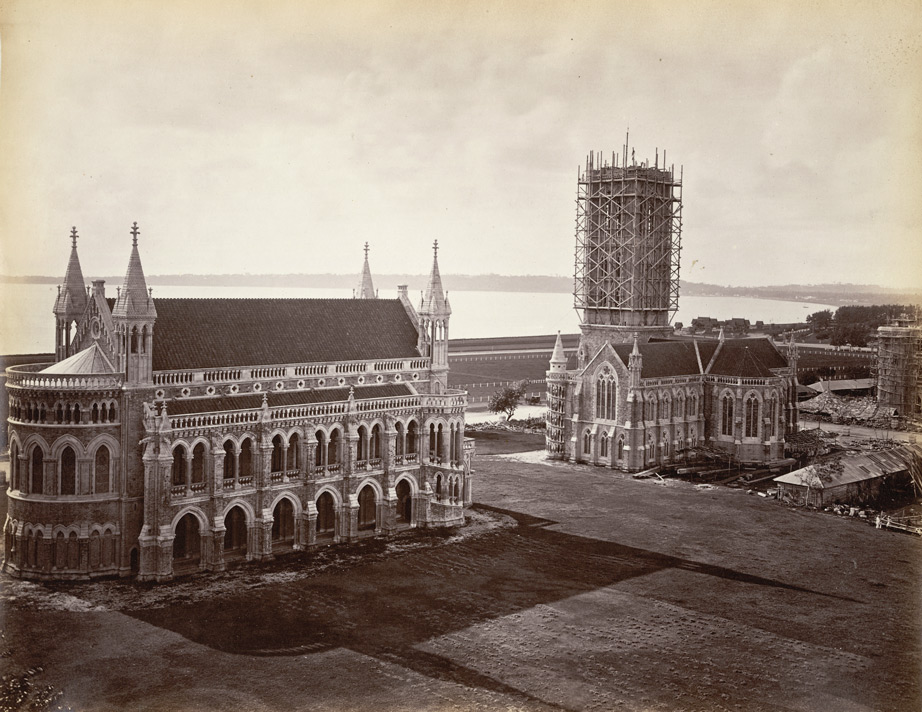
He was bankrupted. Wacha lists him first among the estates wound up under Act XXVIII of 1865 and gives the dividend: "Premchund's estate did not pay more than 1.4 per cent, that is to say, a creditor of one lakh received the magnificent return of 1,500 Rupees!" Across a hundred-odd bankrupt estates the average distribution ran 1 to 5 per cent; only Byramji Hormusji Cama's returned over ten annas in the rupee — "the honest Byramji Hormusji Cama". Aggregate liabilities across the big failures came to about 26 crore.4
And then he recovered. Wacha, writing within a decade of Premchand's death: "such was his marvellous optimism… that he was able to accumulate again a handsome fortune, even after many embarrassments and a reverse or two, which popular account reckons at a quarter million sterling." Note Wacha's own hedge — popular account.
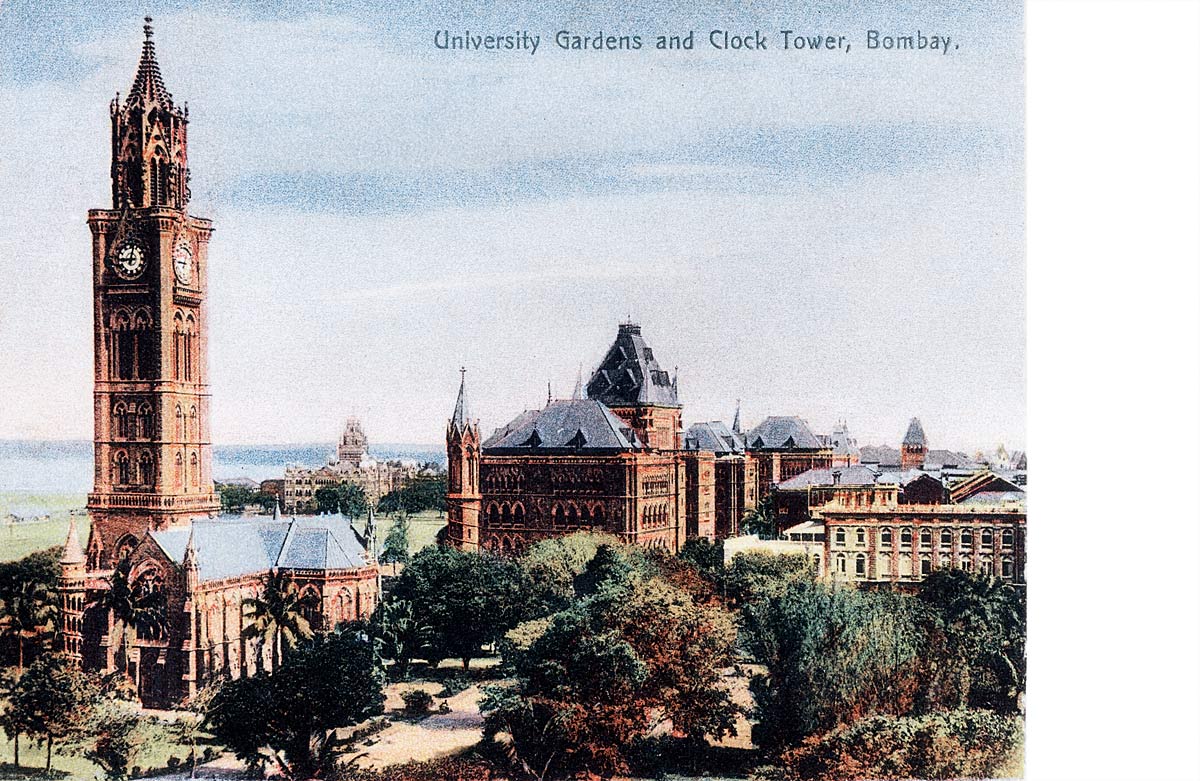
The gift and the sum are solid. The famous story is not. The account that the tower is named for his blind mother, who needed the bells to know when to eat before sunset as a Jain, rests on a 2015 newspaper feature and a 1995 library history. Wacha — who knew him, and who wrote about him at length twice — says only "University Library and Tower", and mentions neither the naming nor the blindness. Modern scholarship separates the documented career from the legend rather more carefully than the popular retellings do.24 ⚠ unverified Wikimedia Commons, CC BY 4.0.
Two other claims that travel with his name should be handled carefully. That he was a founding member of what became the Bombay Stock Exchange rests on the same 2015 feature; Wacha describes the brokers' meeting-place at length and names Jamnadas and Devidas, Chunilal Motilal and Burjorji Sorabji Lahaiwala as the men under the banyan tree — and does not name Premchand as a founder of any association. ⚠ unverified And that he "lost the majority of his fortune in the Back Bay reclamation scheme" understates it: the Commission's figures make his exposure far broader than Back Bay alone.
What is not in doubt is that the redemption arc was already being told in 1869, by the body that had just finished dismantling him. "His charities were munificent," wrote the Commission, in the same report that recorded the Bank becoming his.
Wacha's own memorial proposal
Writing in 1910, he noted that the brokers' banyan on the maidan opposite the old Oriental Bank was gone, the ramparts pulled down, the ditches filled, the site unidentifiable:
"An obelisk or a pillar to commemorate the financial folly of Bombay would not have been a bad idea."4
Nobody built one. This article is the nearest thing.
Chapter EighteenThe three designs, in order
Everything below is a note we hold a record of, and the design descriptions are the published catalogue wording rather than paraphrase.15 The progression is statues → plus Town Hall, Company arms and coloured underprint → plus four-corner legend and serial prefix. Unlike Bengal, which went Uniface → Commerce → Britannia and added both vignettes and colour, Bombay went the other way on one axis: it began two-sided and became uniface.
Type 1 — the statues alone held · 4 notes
J&R 1B.1.1.x · Pick S100–S105 · 10, 15, 25, 50, 100, 1000, 10000 Rupees
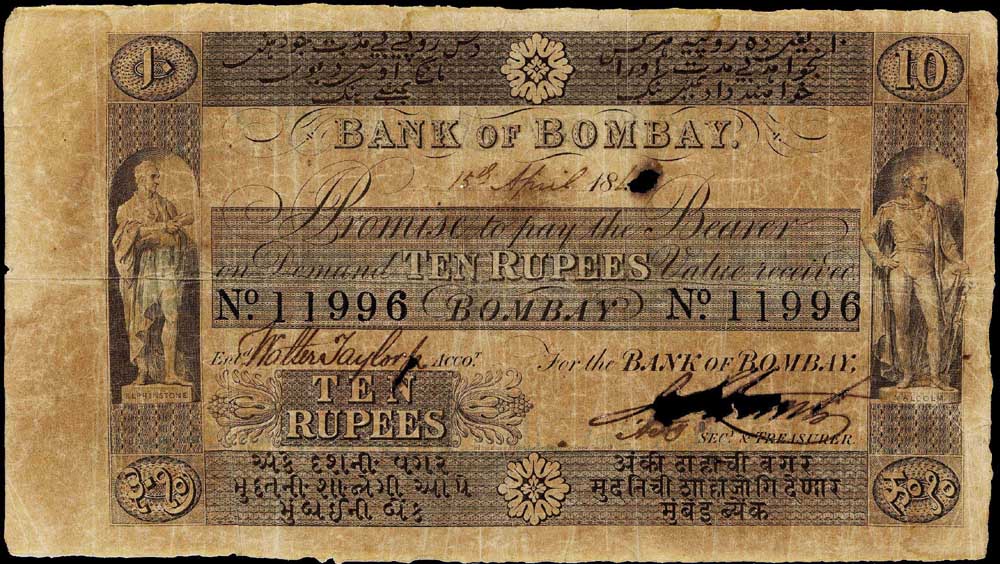
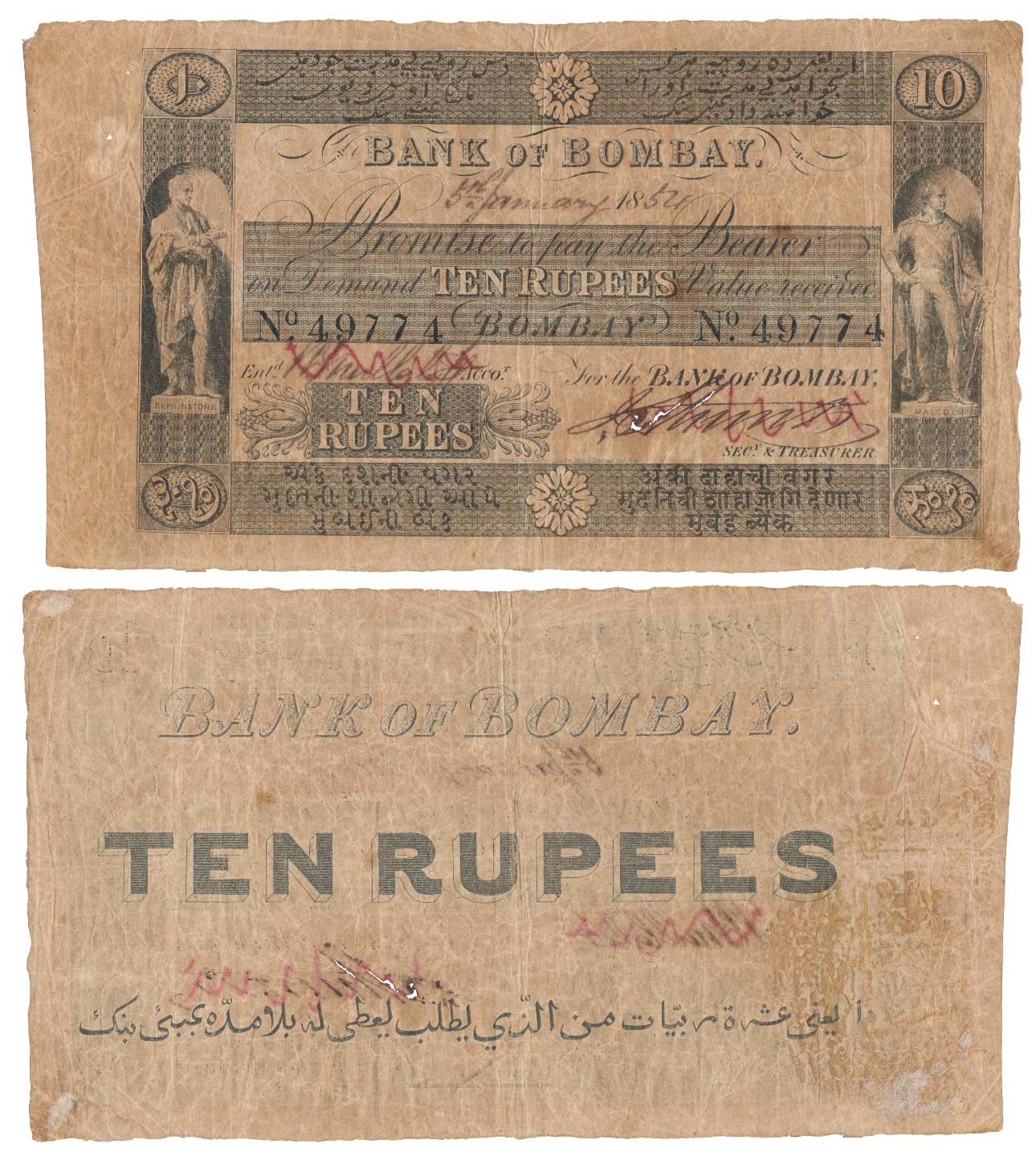
- Denominations
- 10, 15, 25, 50, 100, 1000, 10000 Rupees
- Obverse
- Statues of Mountstuart Elphinstone (left) and Sir John Malcolm (right); BANK OF BOMBAY in centre as a plain lettered line — no central vignette; promise text in four quadrants (Sindhi, Persian, Marathi, Gujarati); denomination in numerals at the four corners in Persian, English, Marathi and Gujarati
- Reverse
- Printed — BANK OF BOMBAY, the denomination in words in English, and promise text in Arabic. The only Bombay type with a printed back
- Paper / print
- Watermarked wove paper; monochrome black/grey intaglio on cream. No colour of any kind
- Printer
- Perkins, Bacon and Petch, London
- Attested dates
- 15 April 1846 (Rs 50) → 10 October 1856, with one 1857 attribution
- Tell it apart by
- Two statues, no Town Hall, no underprint — and turn it over: there is something on the back
Type 2 — Town Hall, Company arms, coloured underprint held · 6 notes
J&R 1B.1.2.x · Pick S110a–S112 · 10, 25, 100, 1000 Rupees · plates cut October 1854
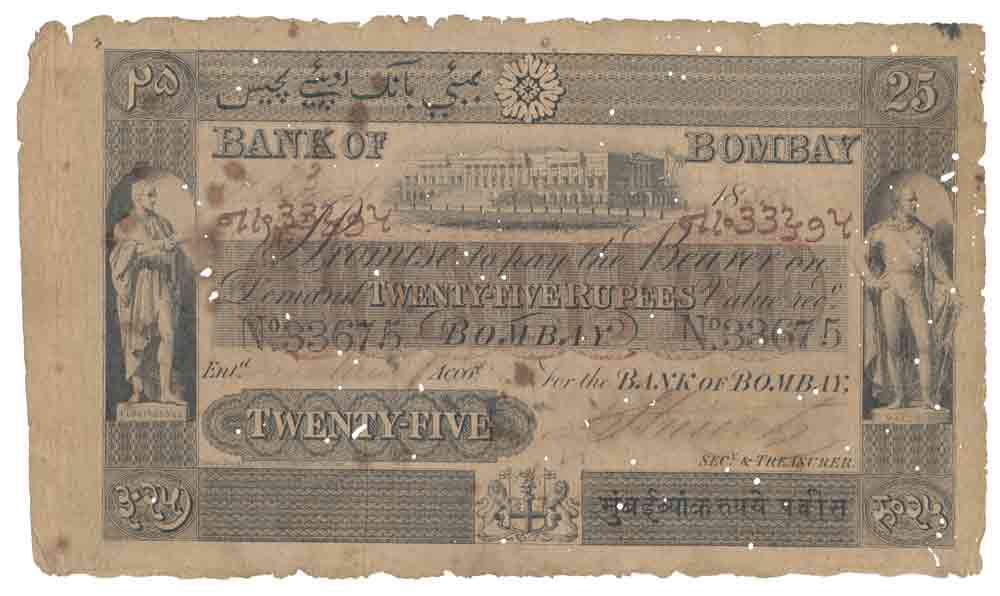
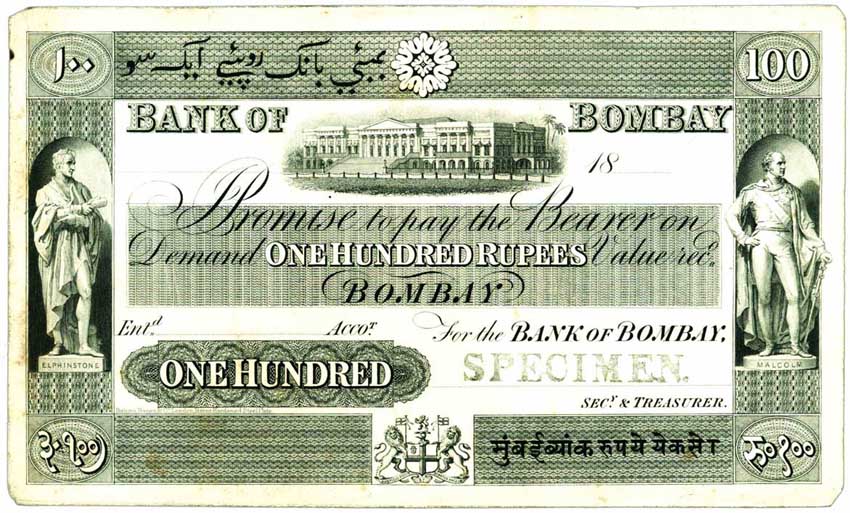
- Denominations
- 10, 25, 100, 1000 Rupees — matching the four plates cut 5–30 October 1854
- Obverse
- As Type 1, plus the Town Hall of Bombay above the promise text and the East India Company Coat of Arms at bottom centre; the date sits within the Town Hall vignette
- Paper / print
- Coloured concentric-circle underprint — Rs 10 reddish brown · Rs 25 brownish maroon · Rs 100 greenish blue · Rs 1000 specimen only
- Reverse
- Uniface — blank handmade paper
- Printer
- Perkins, Bacon and Co., London — the firm dropped "Petch" in 1852, so the imprint itself dates the type
- Attested dates
- 2 January 1858 read from a note; the plates are October 1854
- Tell it apart by
- Only two of the four corner panels carry script — Urdu top-left, Marathi bottom-right; the other two are blank guilloche
Type 3 — four-corner legend and a serial prefix held · 1 note
J&R 1B.1.3.x · Pick S110 / S117r · 10, 25, 100 Rupees · plates altered February–April 1856
- Denominations
- 10, 25, 100 Rupees — matching the three plates altered 29 Feb – 4 Apr 1856
- Obverse
- As Type 2, except BOMBAY BANK and the denomination in words appear in all four corners (Urdu, Arabic, Marathi, Gujarati); serial-number prefix A introduced
- Paper / print
- Coloured concentric-circle underprint, as Type 2; red manuscript numerals in Indian script added at upper left and right
- Reverse
- Uniface
- Printer
- Perkins, Bacon and Co., London
- Attested dates
- 8 September 1859 (A5534) and 1 November 1860 (A14518)
- Tell it apart by
- All four corner panels filled, and the serial carries an A prefix
The single Type 3 we hold is the Rs 10 of 8 September 1859 illustrated in Chapter Six. There is no graded Type 3 issued note anywhere in the PMG census; the only graded Type 3 piece in existence is a Rs 100 remainder.
What survives that we do not hold
Fourteen type-and-denomination combinations are catalogued. We hold notes for five. Surviving pieces are attested somewhere for ten. The gap is worth listing, because four of these are things the literature has never illustrated:
- Rs 15, Type 1 — an issued note (Choice Fine 15) and a back proof both survive in the PMG census.18 We hold neither, and no image of either is published
- Rs 50, Type 1 — one issued note, dated 15 April 1846, described in detail in a 1990s
IBNS report as "a whole note, with nothing missing", with the reverse legend
BANK OF BOMBAY
FIFTY RUPEES
and a line of Persian. Unlisted in Pick at the time of writing16 - Rs 100, Type 1 — the British Library holds an annotated specimen, obverse and reverse, carrying the production notes "pattern 26th April 1852" and "Guzerattee Type" — annotations that exist precisely to tell the London engravers which script was which17
- Rs 1000 — the British Library also holds an obverse proof for an unadopted Rs 1,000 of 1857, on which the East India Company's armorial bearings have been swapped for those of the British Government. It was never issued. Note the date problem: Crown administration replaced the Company in November 1858, so a note dated 1857 carrying Crown arms is anachronistic. Treat "1857" as the Library's catalogue label, not a confirmed issue date.17
- Rs 100, Type 3 — one graded remainder, at Extremely Fine 40: the finest Bank of Bombay piece in existence, and precisely not a circulation survivor
And four combinations have no surviving example attested in any source we can reach: Rs 25 Type 1, Rs 1000 Type 1, Rs 10000 Type 1, and Rs 25 Type 3.
What this catalogue is not
It is a sample, not a census. Eleven distinct notes across four catalogued type-and-denomination combinations, and all but one are Rs 10 or Rs 25. Two of our database rows are one note sold twice. We hold no image of a Rs 15, 50, 500, 1000 or 10000 of any type, so nothing above is evidence about the higher denominations. A Bank of Bombay Hyderabad Post Bill that had been grouped with these has been unlinked: it is a branch remittance instrument, not a banknote of Types 1–3.
And one denomination is missing from the catalogues entirely. The Perkins Bacon ledgers record "Bank of Bombay rs500 note", plate work of February 1854 — and no Rs 500 appears anywhere in the published Bombay run, with no surviving example attested. A plate was cut. Either the note was never issued, or its catalogue entry has been lost. ⚠ open question
Chapter NineteenWhy almost none survive
Fourteen. That is how many Bank of Bombay notes exist in the PMG graded census, across six catalogue entries, in a snapshot taken on 16 February 2026.18 Set against the other presidency banks:
| Issuer | J&R block | Catalogue entries graded | Total graded pieces |
|---|---|---|---|
| Bank of Bengal | 1A.3 | 41 | 112 |
| Bank of Madras | 1C.3 | 10 | 50 |
| Bank of Bombay | 1B.1 | 6 | 14 |
| Oriental Bank | 1B.3 | 4 | 4 |
| Bank of Western India | 1B.2 | 2 | 2 |
| Commercial Bank of India | 1B.4 | 2 | 2 |
Bombay is graded at one-eighth of Bengal's level and under a third of Madras's — and that is despite the one published output figure putting Bombay's Rs 10 alone ahead of the whole of Madras's issue across nine denominations. Issue volume and survival have come completely apart.
The output figure, and the first independent check on it
An IBNS article asserts, without a source, that "Bank of Bombay issued more than 125,000 notes of just one type of 10 Rupees notes" between 1843 and 1861, against about 110,000 for the whole Bank of Madras.16 It has never been testable.
Our serial run tests it. The Rs 10 numbering reaches 89,648 by January 1858; it then restarts at prefix A and reaches A14518 by November 1860 — a running total of roughly 104,000 Rs 10 notes by the end of 1860, with more than a year of issue still to come before the Act took effect. The unsourced 125,000 is entirely consistent with the surviving paper. It can now be cited with an evidential backstop rather than a shrug.
The auction record says the same thing from the other side, and more brutally:
| Archive | Searched | Result |
|---|---|---|
| Heritage Auctions — entire past-auction archive | "Bank of Bombay" | Two lots ever, both in the same January 2005 sale — and one of them is a Government of India note with a Bombay overprint |
| Stack's Bowers — 1,357,650 lots, 2003–2026 | "Bank of Bombay" | None. Thirty-one loose-term hits, every one of them a Dena Bank ingot, an RBI Bombay-circle note or a Bombay Mint coin |
| Classical Numismatic Gallery — Paper Money of India, 84 pp. | full text | Government of India Bombay Circle notes only |
| Marudhar Arts — British India banknote category tree | browse | A standing "Bengal Presidency" sub-category. No Bombay Presidency sub-category at all |
Between them, the two largest coin-and-currency auction archives in the world hold one Bank of Bombay note in over 1.3 million lots.
And the survivors are in terrible condition
| PMG grade | Pieces | Which |
|---|---|---|
| Very Good 8 | 1 | Type 2 Rs 10 |
| Very Good 10 | 6 | Type 2 Rs 10 ×3, Type 2 Rs 25 ×3 |
| Fine 12 | 4 | Type 1 Rs 10 ×3, Rs 15 back proof ×1 |
| Choice Fine 15 | 2 | Type 1 Rs 10 ×1, Rs 15 issued ×1 |
| Extremely Fine 40 | 1 | Type 3 Rs 100 — a remainder, unissued and never circulated |
Thirteen of the fourteen fall between Very Good 8 and Choice Fine 15. The finest known issued note in the census is a Choice Fine 15. Type 2 tops out at Very Good 10 in both denominations — so Spink's "[Top Pop]" on one of our notes is literally true, and tells you how low the ceiling is. The single Extremely Fine piece is precisely not a circulation survivor. The remainder reading rests on the standard catalogue suffix convention rather than an explicit PMG statement. ≈ interpretation
Why?
The honest answer is that nobody has established it, but three mechanisms are available and they compound:
- Redemption after 1861. When the Government took over the issue, Bank of Bombay notes were paper claims that had to be presented and destroyed. Notes that came home were cancelled. A direct trace of the transition survives in the same 2005 Heritage sale: a Government of India 10 Rupees of 7 June 1862 carrying an oval overprint for the Bank of Bombay — the successor instrument, with the predecessor's name stamped on it.
- The collapse. Bombay's paper had circulated almost entirely inside one city, in the hands of a mercantile community that lost 26 crore of rupees between 1865 and 1868. Nothing about that encourages people to keep souvenirs.
- Nobody was collecting. There is no Bombay Presidency category at the main Indian salerooms, and no published study to create demand. The scarcity is partly real and partly a self-fulfilling absence of attention.
One published claim about survival that our own data cannot support
An IBNS article states that "Bank of Bombay and Bank of Madras notes were spared from being cut in halves and signatures torn. A very few of them have survived in better grades than Bank of Bengal notes."16 The first half may well be right — none of our Bombay images shows the cut-away signature notch that is standard on redeemed Bengal notes. The second half is not right. Bengal's census has 112 graded pieces to Bombay's 14, and Bombay's ceiling is Choice Fine 15 while Bengal's runs far higher. Whatever happened to Bank of Bombay paper, it did not survive better. ⚑ disputed
What the money says
| Piece | Sale | Result |
|---|---|---|
| Type 1 · Rs 10 · s.11996 | Todywalla #5, Apr 2003 | unsold, est ₹65,000–70,000 |
| Type 1 · Rs 10 · s.65146 | Todywalla #49, Dec 2010 | ₹410,000 |
| Type 1 · Rs 10 · s.73879 | Todywalla #87, Apr 2014 | ₹400,000 |
| Type 1 · Rs 10 · s.49774 | Todywalla #125, Sep 2019 | unsold, est ₹16–19 lakh |
| Type 2 · Rs 10 · s.89648 raw | Oswal #72, Apr 2018 | ₹875,000 |
| Type 2 · Rs 10 · s.89648 PMG 10 NET — same note | Spink 23009, Sep 2023 | £8,000 ≈ ₹822,400 |
| Type 2 · Rs 10 · s.85958 PMG 10 Net · radar serial | Heritage #4035, Jan 2022 | $16,800 ≈ ₹1,320,480 |
| Type 2 · Rs 25 · s.33675 | Todywalla #52, Apr 2011 | ₹400,000 |
| Type 2 · Rs 25 · specimen | Todywalla #17, Dec 2006 | unsold, est ₹600,000 |
| Type 3 · Rs 10 · s.A5534 | CNG AUC42, Aug 2022 | ₹700,000 |
Three things that record actually shows, none of them obvious:
- Encapsulation did not help. The identical note, serial 89648, made ₹875,000 raw at Oswal in 2018 and ₹822,400 in a PMG holder at Spink in 2023 — nominally lower five years later. In a market this thin, the room matters more than the label.
- The radar serial did. 85958 is a palindrome, Heritage led its lot title with "Radar Serial Number", and it made about 60 per cent more than the contemporaneous 89648 result in the same grade on the same type.
- Estimates have run far ahead of bids. Todywalla's Type 1 Rs 10 estimate moved from ₹65–70,000 in 2003 to ₹1.6–1.9 million in 2019 — roughly twenty-five times in sixteen years — and the 2019 lot did not sell. Both 2006 specimens went unsold as well. The type is genuinely rare; the bid is not always there.
Chapter TwentyWhat it should have taught them
Every one of these is drawn from the record above. None of them is hindsight: in each case somebody at the time said it out loud, in a despatch or on the floor of the House, and was ignored.
1. Deregulation without supervision is not deregulation. It is abolition.
Act X of 1863 removed the lending caps, the term limits, the overdraft ban and the cash-ratio rule in a single instrument, and substituted a power for the directors to make by-laws. The by-laws were never made, and nobody checked. The Commission put the Act at the head of its six causes and called the removal of restrictions "in fact the chief cause of the Bank's failure" — while conceding, fairly, that "the old Act was unnecessarily restrictive." Both things were true. The error was not liberalising; it was liberalising and then walking away.
2. Putting the regulator on the board makes supervision worse, not better.
Three of nine directors were Government appointees. In practice this produced the worst of every world. They were a permanent minority, so they could not stop anything. They were shareholders' representatives, not the public's — Grant Duff was explicit that "they were put there to look after the heavy stake of the Government, quâ shareholder, not the interest of its fellow shareholders." They were not bankers: "selected as they were… from men who had no experience in banking." One of them, as President, took £37,575 in share allotments from the man looting the bank. And their presence gave everyone else — the Secretary of State, the Viceroy, the depositors — the false comfort that somebody was watching.
Tracey's remark to a nervous new director says exactly how the mercantile side experienced them: not as supervisors, but as people who "were only too apt to take alarm" and should therefore be kept out of the conversation.
3. Never let the supervised body conduct the inquiry into itself.
When Sir Charles Wood wrote in March 1865 "praying that the affairs might be looked into", the inquiry was handed to the Government Directors themselves. Gregory's description of the result is the sharpest single sentence in the whole parliamentary record:
"that inquiry was not only inefficient, but was misleading, because they reported that though it was true that large advances had been made upon shares of all sorts, yet these shares had been deposited only as 'collateral security'… but, in truth, the shares were the only real instead of being a merely collateral security."
A technically accurate sentence, engineered to produce a false impression, written by the people being examined. The Commission's own finding on the returns the Bank sent Government used one word for this: they were of "a delusive character."
4. A supervisory power you never use is worse than none, because it is relied upon.
Mr Henley, in 1872, on the Government's power of audit: "Was that not lâches?" It was never exercised. Not once, in five years, through two runs and a trebling of capital.
5. An implicit guarantee destroys market discipline — and then costs more than an explicit one.
This is the most transferable lesson in the story, and the numbers are unusually clean.
- June 1865: Frere telegraphs for 150 lakh. The run stops the moment support is known. Not a rupee is actually advanced.
- Massey, the Finance Member: after the announcement "the depositors brought back the moneys they had withdrawn, and the shares rose to 60 premium" — "though at that time it had actually lost half its capital."
- February 1867: a second run, Rs 1.69 crore in days. Government promises support again. The run stops again.
- January 1868: the bank fails anyway, with a loss of Rs 1.89 crore.
Henley drew the conclusion at the time, and it is devastating: had Government not propped the bank up twice, "the Bank might have been wound up; and the loss to the shareholders would not have been one-half what it had been since." Two free rescues bought the bank thirty-one months in which to double its losses.
Massey's own verdict on what the Bombay Government had done to itself: it had "made themselves partners and Directors of the Bank."
6. When you take away an institution's business model, watch where it goes looking for another.
The note issue was, in State Bank of India's own words, "a capital on which the proprietors did not have to pay any interest." At its peak it was worth roughly Rs 1.24 crore — about two and a half times the bank's paid-up capital. Act XIX of 1861 removed it. The compensation package was then reduced after it had been offered: the Currency Department and its balances were withdrawn from the deal, leaving only the Treasuries and Pay Offices.
Within two years the bank had rewritten its charter to permit unlimited advances against speculative shares. Wacha, who was inside it, draws the line directly. The Commission accepted the first capital increase as no more than replacing "the deficiency occasioned by the Bank's loss of their note circulation." The search for a replacement revenue stream is the causal spine of this whole story, and it began in a policy office in Calcutta.
7. If nobody is prosecuted, the finding is just literature.
The Commission found one Secretary "dishonest", another to have placed himself "in a position in which his own interests were at variance with his duty to the Bank", a Government President taking £37,575 in allotments, and a commercial director leaving the country ahead of the Commissioners. Nobody was charged. Grant Duff, 1870: "we do not see our way to taking effective legal proceedings even against the persons most implicated."
Bouverie's response is the standard one and it has not improved with age: "it was a shame to the Indian Government that they seemed never to have taken a single step to prosecute those officials." And the counter-argument had force too — Denison warned that compensating the shareholders would be "offering a premium for any future amount of misconduct." Both sides were arguing about moral hazard. Both were right, about different people, and the outcome delivered the worst of each: the shareholders were not compensated and the officers were not prosecuted.
8. The relief measure written in a panic will be gamed within a year.
Act XXVIII of 1865 applied only to insolvencies above Rs 5 lakh — so debtors bought worthless scrip for a song and booked it at mania prices to inflate their liabilities over the threshold and escape the Insolvency Court. Two estates were settled under it in three years. "Act XXVIII of 1865 became a by-word of reproach."
9. And the last one, which is about history rather than banking.
The Government of India did learn something. It began withdrawing from presidency-bank shareholding in 1870 and completed it in the Presidency Banks Act of 1876; the Bank of Bombay's Government shares were sold in 1875. Northcote had conceded in 1868 that the connection was "inexpedient", and the whole episode is the reason the state stopped being a shareholder in the banks it regulated.
But the institution that inherited the Bank of Bombay does not tell the story at all. State Bank of India's published history skips from 1861 to 1876. A bank that lost Rs 1.89 crore of its shareholders' money, was dissected by a Royal Commission over 787 pages of sworn evidence and debated four times in the House of Commons has been edited out of its own successor's account of itself. The most expensive lesson in nineteenth-century Indian banking is not taught by the bank that paid for it.
AppendixWhat still needs checking
Every claim in this article that we cannot fully stand behind is listed here, with what the sources actually say, why it is doubtful, and what would settle it. If you can close any of these, please write in — the article will be corrected and you will be credited.
| # | The claim | Status and what would settle it |
|---|---|---|
| 1 | "Section 32 of Bombay Act X of 1863" authorised advances on shares | ⚠ unverified The substance is double-sourced (Gazetteer clause (b); Hansard 1872). The section number is sourced nowhere outside the Commission quotation, and no digitised text of the Act exists. Confusingly, Bagchi records a §32 in the 1840 Act, on foreign exchange. Settles it: the Act itself, from the India Office Records or the Bombay Government Gazette for 1863 |
| 2 | Sir Jamsetjee Jejeebhoy was a director from 1843 | ✓ verified here Widely repeated online without a source, and our own web research had marked it unverified. The Bombay Calendar and Almanac for 1843 names him in the board list twice — establishment entry and civil list — and again in 1850 and 1851. Treat as established |
| 3 | He was the first Indian director | ⚑ disputed Bagchi places the Parsi merchant Framjee Cowasjee on the first board of April 1840 — three years earlier. The 1842 directory board is entirely European, which cuts the other way. Douglas prints the provisional committee of 26 December 1836, which includes Dadabhai Pestonjee — "the first native whose name appears conspicuously in Bombay Banking enterprise" — and the January 1837 requisition, signed among others by Framjee Cowasjee; so both men were in from the founding, but a committee seat is not a directorship.26 Settles it: the 1840 and 1841 directories, or the bank's own first minute book |
| 4 | The Rajabai Tower is named for Premchand's blind mother, who needed the bells to eat before sunset | ⚠ unverified Rests on a 2015 newspaper feature and a 1995 library history. Wacha, who knew him and wrote about him twice at length, mentions neither the naming nor the blindness — only "University Library and Tower" and Rs 2 lakh. The gift and the sum are solid; the anecdote is not evidenced in any primary source we can reach |
| 5 | Cooke's "forgeries… in the years 1848 and 1851", reducing "four-fifths of the entire circulation" | ⚑ disputed A full-text search of Allen's Indian Mail for 1851 finds no forged Bank of Bombay notes — only the theft of genuine ones and forged cheques on the Oriental Bank. And the falls were ~51% (1848) and ~27% (1851), not four-fifths. We treat 1848 as the bank's only documented note-forgery episode. Settles it: the Bombay newspapers of 1851 |
| 6 | The Government of Bombay guaranteed the note issue in 1851 | ⚑ disputed Bagchi's ch. 18 says so; his own ch. 13 and his footnote 28 both contradict it, making the guarantee the indemnity under which the Bank of Bombay honoured the stolen notes. The Oriental Bank's chairman said the same at its AGM of 15 Sept 1851. We follow the footnote |
| 7 | The Perkins Bacon ledger wording, especially "native char[acters]" | ⚑ our reading Transcribed by us from the RPSL page images with vision, not OCR and not the RPSL index. The native char line was re-read at ~4× on the original scan and is unambiguous, but the RPSL indexed that page only as "Bank of Bombay", so the wording is uncorroborated by the archive's own metadata. The EIC arms line is corroborated. Settles it: an independent reading of PB136026 p. 98 |
| 8 | The 1854 underprint and the 1856 four-corner legend are anti-raising measures | ≈ inference Ours, not any source's. Supported by: colours demonstrably varying by denomination; a contemporary source naming raising as the usual Indian method and colour-by-denomination as the fix; Bombay adopting it first. Weakened by: a six-year gap since the only documented forgery. No source states a motive for the 1854 redesign at all |
| 9 | Peak note circulation | ⚑ disputed Cooke gives Rs 1,28,12,000 as the all-time high; Bagchi's Bankers' Magazine table gives Rs 1,23,52,590 at 31 Dec 1860, and its figures are OCR-grade throughout. Both round to "about 1¼ crore". Settles it: the Bank's own half-yearly statements |
| 10 | When the note issue ended | ⚑ disputed Both Gazetteers say 1860; RBI says the Act was 1861; Cooke and the Act's commencement say February/1 March 1862. Bagchi gives 1861 twice and 1862 twice. 1860 is the policy decision. We use: Act XIX of 1861, effective 1 March 1862 |
| 11 | The Bank lent Premchand £250,000 in April 1866 | ⚑ misleading shorthand It was a seven-bank syndicate of Rs 25 lakh, of which the Bank of Bombay's own share was 10½ lakh (£105,000) — it merely fronted the whole. The others then repudiated. Gregory and Barttelot used the £250,000 form in the Commons and it has propagated everywhere since |
| 12 | Shareholders received "one-fiftieth" on a fully paid share | ⚑ disputed The phrase is in the abstract of Lovell's thesis and is contradicted by the body of the same thesis, which agrees with Wacha on Rs 100 per Rs 500 nominal. On a Rs 1,000 fully-paid share that is one-tenth; against the Rs 2,900–3,000 peak, about one twenty-ninth. We do not use "one-fiftieth" |
| 13 | A second, suppressed Commission report damning the Bombay Government | ⚠ unverified Alleged by Col. Barttelot in 1872; Northcote's answer (separate reports on matters of opinion) is consistent with the command-paper numbering C.4162, 4162-I, -II, -III. Untestable while the Blue Books are offline. Settles it: Parliamentary Papers 1868–69 vol. XV, via ProQuest or the British Library |
| 14 | What stands on the Bank's Elphinstone/Horniman Circle site today | ⚠ unverified Heritage blogs claim the 1866 building was demolished for the H. C. Dinshaw building in 1924. We would not print any of them. Settles it: somebody standing on the Circle with the 1909 Gazetteer plan |
| 15 | Premchand was a founding member of the Bombay Stock Exchange | ⚠ unverified Rests on the same 2015 feature as #4. Wacha describes the brokers' banyan at length and names Jamnadas and Devidas, Chunilal Motilal and Burjorji Sorabji Lahaiwala — not Premchand — as the men under it |
| 16 | SBI's statement that presidency-bank capital was "four-fifth… privately subscribed and the rest owned by the provincial government" | ⚑ wrong for Bombay The actual figure is Rs 3 lakh of Rs 52.25 lakh ≈ 5.7%. The same page calls the banks creatures of "royal charters"; the Bank of Bombay was constituted by an Act of the Government of India sanctioned by the Court of Directors |
| 17 | A Rs 500 Bank of Bombay note | ⚠ open question The Perkins Bacon ledgers record plate work on a "Bank of Bombay rs500 note" in February 1854. No Rs 500 appears in the published Bombay catalogue and no example is attested. Pick's S102–S105 band has room for it. A plate was cut; what happened next is unknown |
| 18 | Our Type 3 Rs 10 (A5534) is the finest known issued Type 3 | ⚠ unverified Follows only from CNG's "Very fine" grade plus the absence of any graded Type 3 issued note in the PMG census. Worth confirming before repeating |
| 19 | The Extremely Fine 40 Type 3 Rs 100 is a remainder | ≈ interpretation From the standard catalogue suffix convention (r = remainder), not an explicit PMG statement — though a grade of 40 on an 1859 note is otherwise hard to explain |
| 20 | Bombay notes were "spared from being cut in halves" and "have survived in better grades than Bank of Bengal notes" | ⚑ half right The cancellation claim is plausible — none of our Bombay images shows the cut-away signature notch standard on redeemed Bengal notes — but is a single unsourced sentence. The grade claim is contradicted by the census: Bengal 112 graded pieces to Bombay's 14, and Bombay tops out at Choice Fine 15 |
| Contested points this article deliberately does not assert | ||
| 21 | The total loss | We use the liquidator's Rs 1,88,99,331 / £1,889,933 of 12 Nov 1868. In the same 1872 debate Barttelot gave £1,998,833; Lord George Hamilton rounded to £1,800,000 in 1875. Wacha's Rs 2,04,66,991 is a different measure — gross loss on advances, not net capital destroyed — and his own text gives it two ways |
| 22 | The date of liquidation | Scutt says the bank went into liquidation from 10 December 1866. The Gazetteer and Hansard both give 13 January 1868. We use 1868, twice corroborated; Scutt's date is probably when the loss account was made up |
| 23 | When Blair left | Gregory: resigned 29 April 1865. Wacha: "made to retire… in March 1865" in one chapter and "at the close of 1865" in another. Unresolved; we say "1865" |
| 24 | Branches at the 1921 merger | SBI's own history says the three banks merged "with their 70 branches". A secondary source citing Bagchi and RBI says "in all the 115 years of its existence, the 3 Presidency banks just had 60 branches". Unresolved, so neither figure is used above |
| 25 | Who bought the old No. 1 Rampart Row building | The 1909 Gazetteer says it was auctioned to "the Presidency Bank, one of the mushroom associations", which resold to Government at a two-lakh profit. The same volume's currency chapter says Government bought it from the liquidators on 1 April 1868 for Rs 3½ lakh. Irreconcilable as written. Note that the first premises were a different address: Douglas records the bank taking No. 23 Rampart Row on 1 April 1840, from Jehangier Nusserwanjee Wadia, and the same building occupied by Ralli Brothers from about 186526 |
| 26 | An earlier "Bank of Bombay" of 1720 | The Maharashtra Gazetteer and Wikipedia describe an East India Company bank at Bombay Castle from 1720, wound up in 1770. RBI's own museum table merges it with the 1840 bank in a single row. Note that Cooke, a well-informed Bombay banker writing in 1863, treats Bombay as having had no public bank before 1840 — which is itself a data point on how thin the 1720 evidence is. A second, independent one: Douglas, a Bombay antiquary writing in 1899 with the city's newspaper files, opens his account "the earliest notice we possess of the origin of this institution" with the meeting of 26 December 1836, and his chapter on how Bombay banked before 1840 is about shroffs, not a Company bank26 |
Sources
Sources 6 and 10 were read and informed the study without being quoted directly above. Where a source is in copyright it is cited, not quoted at length. Figures marked OCR-grade in the underlying research have been treated as approximate and are flagged above where they matter. The full 26-source research dossier this article is built on runs to some 1.7 MB of separately researched, deliberately unreconciled notes; where two sources disagree, both readings were kept and the disagreement treated as evidence.
- primary C. N. Cooke, The Rise, Progress and Present Condition of Banking in India, Calcutta, 1863 — chapter "The Bank of Bombay", pp. 161–170, and the Oriental Bank chapter, pp. 141–146. archive.org
- primary The Gazetteer of Bombay City and Island, vol. III (1909–10), "Bank of Bombay", pp. 211–220 — which quotes the Bombay Bank Commission's Report directly in its footnotes. archive.org
- primary Bombay Bank Commission: Minutes of Evidence, 1869 — 787 pages of sworn examination, held in our library. The Report proper is Parliamentary Papers 1868–69 [C.4162, 4162-I, -II, -III] XV, and is not freely available
- eyewitness D. E. Wacha, A Financial Chapter in the History of Bombay City, 2nd edn, Bombay 1910 — chs. VI–XVI and XXIV. Wacha was being trained inside the Bank during the mania and quotes the Commission's Report at length. archive.org
- book D. E. Wacha, Premchund Roychund: his early life and career, Bombay 1913
- book D. E. Wacha, Shells from the Sands of Bombay, 1920 — his fuller memoir of 1860–75
- thesis Carol Grace Lovell, "The Failure of the Bank of Bombay, 1840–1868", MA thesis, University of Maryland, 1971 — the only monograph-length treatment in free full text, built directly on the Commission's Report. DRUM
- book · in copyright Amiya Kumar Bagchi, The Evolution of the State Bank of India: The Roots, 1806–1876, vol. 1, OUP Bombay 1987 — ch. 13 is the fullest account of the note issue anywhere, from the Bombay Archives
- book · in copyright Bagchi, vol. 2 (1997) — the reconstituted bank, 1876–1920. Part II of vol. 1, which carries the failure narrative, is not digitised
- official J. B. Brunyate, An Account of the Presidency Banks, Calcutta: Superintendent of Government Printing, 1900 — the official statistical account, cited by Scutt and Bagchi; not online
- primary The Bombay Calendar and Almanac / Bombay Almanac, Directory and Register, twelve annual volumes 1822–1856 — the establishment entries, board lists and residents' directories. The source for the officer and director tables above
- archive Perkins Bacon Engraving Books, Royal Philatelic Society London — 17 volumes, 1828–1935, page images free to view. Book PB136026 (1853–61) carries the whole Bombay redesign record. p. 61, 26 October 1854
- hansard HC Deb 8 May 1868; 21 July 1870; 3 May 1872, vol 211 cc204–247, "India—Old Bank of Bombay—Government Liability—Resolution" (~19,000 words, the richest free narrative of the failure); 9 April 1875, vol 223 cc624–39. Historic Hansard, 1872
- contemporary Allen's Indian Mail, vols. 6 (1848), IX (1851), and 1856 — the November 1848 run as reported at the time, the 1851 Oriental Bank robbery, and the Bank of Bengal redesign notice quoted in Chapter Five
- catalogue Rezwan Razack & Kishore Jhunjhunwalla, The Revised Standard Reference Guide to Indian Paper Money — group 1B.1, transcribed in our
constants/jr_tag_mapping-presidencies.md; all design descriptions above are its wording - journal · in copyright IBNS Journal — 29-3 (the unlisted Rs 50 of 15 April 1846), 11-3 (the Elphinstone and Malcolm identification), 56-1 (signatures, internally contradictory), 56-2 (the 125,000-note output figure, unsourced), 56-4 (printers), 57-1 (the two British Library Perkins Bacon items)
- archive British Library Philatelic Collections, Philatelic 26/1/9 — India, 1846–1858, two items, both Bank of Bombay: an annotated Rs 100 specimen marked "pattern 26th April 1852" and "Guzerattee Type", and an obverse proof for an unadopted Rs 1,000 of 1857 with the East India Company arms swapped for British Government arms
- census PMG Population Report, as held in our
pmg_populationtable — snapshot of 16 February 2026: 6 Bank of Bombay catalogue entries, 14 graded pieces - our data Our own
paper_moneydatabase and the saleroom catalogues behind it — Todywalla, Heritage, Spink, CNG, Oswal Antiques, Classical Numismatic Gallery, Marudhar Arts, Stack's Bowers. Every note illustrated above is a record we hold; every image is blob-mirrored from the cataloguing house - book G. P. Symes Scutt, The History of the Bank of Bengal, Calcutta 1904, pp. 73–75 — the 1867 amalgamation attempt from Calcutta's side. archive.org
- institutional State Bank of India, Evolution of SBI, and sbi.bank.in/web/about-us — the successor's own account, which does not mention the 1868 failure
- institutional Reserve Bank of India, Monetary Museum: Early Issues and Currency in Retrospect — on the Paper Currency Act of 1861 and the Bombay vignettes
- pamphlet The Late Bank of Bombay: Remarks on Act X of 1863, and the shareholders' pamphlets of 1867 and 1868 — contemporary advocacy, useful for the drafting history of the clause and read as advocacy, not documentation
- scholarship R. S. Rungta, The Rise of Business Corporations in India; Lakshmi Subramanian, Three Merchants of Bombay (2016), pp. 122–130 on Premchand
- catalogue Garry Saint, numismondo, "INDIA Paper Money INDEX, Bank of Bombay 1846-66 Issues" — the Pick and Jhunjhunwalla numbering skeleton, plus images of four notes not otherwise published. numismondo.net
- contemporary James Douglas, Glimpses of Old Bombay and Western India, with Other Papers, London: Sampson Low, Marston, 1899 — Part II, "Banks and Merchants", printed pp. 110–133, compiled by the late Sheriff of Bombay out of the city's newspaper files, and the source for the Bank of Bengal's hostility (p. 112), the reprinted Bank Committee advertisement of 27 January 1840 and the opening at No. 23 Rampart Row (p. 113), Cargill's succession by John Stuart (p. 114), and the mutual refusal of notes (p. 116). Douglas is a compiler of papers, not a historian — the documents he reprints are stronger than the sentences around them, and where his own asides conflict with them we follow the documents. archive.org